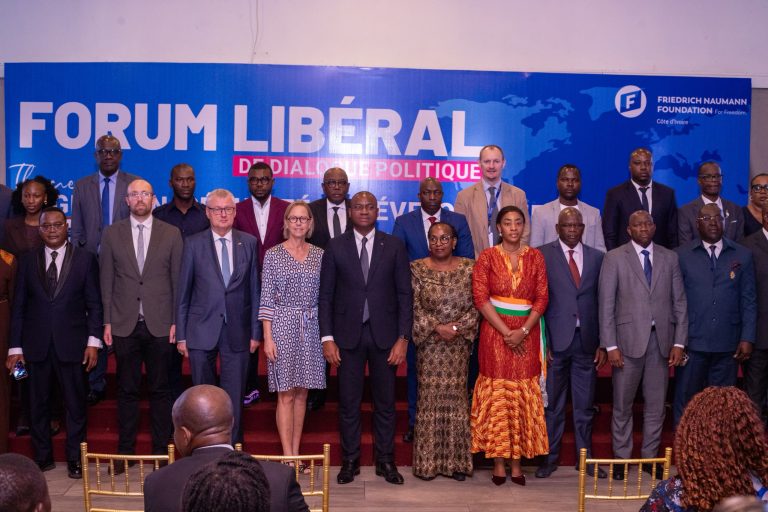
Abidjan — In a bold call for transformation, Côte d’Ivoire’s Vice President of the Liberal International and Minister of Animal and Fishery Resources, Sidi Touré, joined forces with Alexandra Heldt, Regional Director for West Africa at the Friedrich Naumann Foundation (FNF), to advocate for a fresh approach to Africa-Europe collaboration on migration.
Their joint appeal came on the first day of the Liberal Political Dialogue Forum, held from July 15 to 16, 2026, in Abidjan. The event, centered on the theme ‘Migration, Security, and Development: Rethinking the Africa-Europe Partnership,’ gathered policymakers, analysts, and civil society leaders to challenge outdated narratives.
Migration as a matter of freedom, not crisis
Sidi Touré opened the discussion by reframing migration not as a problem but as an inherent expression of human freedom. Citing United Nations data, he highlighted that migrants account for just 3.7% of the global population, with over 96% of people living in their country of birth. There is no wave overwhelming the world, he asserted, urging an end to fear-driven rhetoric.
He further noted that 70% of African migration occurs within the continent itself, pointing to the bustling daily flows at Adjamé’s bus station in Abidjan. Akwaba, the traditional Ivorian greeting meaning welcome, embodies the nation’s long-standing culture of hospitality, he reminded the audience. Migration is not a crisis—it is life.
Regional unity and the cost of division
Touré expressed deep concern over the withdrawal of Mali, Burkina Faso, and Niger from ECOWAS, warning of the ripple effects on regional mobility. Political disagreements must not sever the bonds between peoples or economies, he stressed. The free movement of people is a shared heritage that must be preserved. He called for actionable recommendations to be compiled into a policy paper to guide future negotiations.
Xenophobia on both sides of the Mediterranean
Alexandra Heldt expanded the critique, condemning the rise of anti-migrant violence in Africa and Europe alike. Recalling the recurring attacks against foreign nationals in South Africa since 2008, she argued that scapegoating migrants for economic woes only deepens societal fractures. No nation can thrive by casting migrants as the cause of its challenges.
She also spotlighted the European paradox: while labor shortages persist, hostility toward immigration grows. Migrations are not barriers but bridges. They fuel exchange, innovation, and entrepreneurship, fostering connections that transcend borders, she emphasized.
A partnership rooted in trust and shared responsibility
Heldt urged for an Africa-Europe partnership built on balanced mobility, shared accountability, and liberal values. Decision-makers were encouraged to replace fear with trust and exclusion with cooperation. Let us speak not of walls, but of pathways.
Touré closed the session with a powerful reminder: hospitality is not a sign of weakness—it is strength and smart policy. By embracing migration as a development catalyst, Africa and Europe can forge a future where movement benefits all.
The forum continued with panels dissecting the legal, geopolitical, and human dimensions of migration, aiming to distill actionable insights for policymakers.