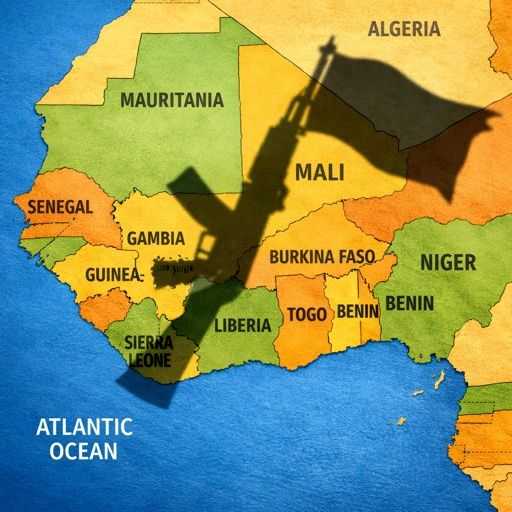
JNIM’s expansion beyond the Sahel: strategic dilemmas for Burkina Faso and West Africa
The Jama’at Nusrat al-Islam wal-Muslimin (JNIM), Al-Qaeda’s affiliate in the Sahel, has emerged as a dominant armed actor since its formation in 2017. Operating across Mali, Niger, and Burkina Faso, the group’s katibas (military units) now rival state authorities in controlling and administering key territories. However, recent years have seen JNIM’s influence extend southward—toward the Gulf of Guinea and northern Benin, Togo, and Côte d’Ivoire—regions previously considered less vulnerable to jihadist spillover.
Geographic expansion: a calculated move with unexpected twists
While JNIM’s southward push appears strategic, its implementation reveals inconsistencies. Notably, Ghana remains untouched, while Côte d’Ivoire experienced attacks between 2020 and 2022 but has seen no claimed operations since. Meanwhile, Benin has faced a sharp deterioration in security since 2025. These patterns raise critical questions: Is this expansion a deliberate long-term strategy, or a reactive response to shifting regional dynamics?
Internal dilemmas: growth vs. cohesion
A recent Crisis Group report examines the complex geography of JNIM’s expansion, highlighting how the group’s leadership grapples with competing priorities. For JNIM, territorial growth is not a straightforward decision. Failing to expand risks ceding influence to rival groups, while rapid expansion strains resources, risks internal fragmentation, and may dilute operational effectiveness. This dilemma underscores the group’s struggle to balance ambition with sustainability in an evolving regional conflict landscape.
Regional context: shifting alliances and security vacuums
The expansion occurs amid significant geopolitical shifts in West Africa. The Alliance of Sahel States (AES)—comprising Burkina Faso, Mali, and Niger—has distanced itself from the ECOWAS, creating new power vacuums and altering security architectures. These changes complicate counterterrorism efforts and heighten concerns among neighboring countries about the spread of armed jihadist groups.
Understanding JNIM’s internal decision-making processes is essential for developing coherent and effective security policies. Without this insight, regional governments and international partners risk miscalculating threats and deploying ineffective responses.
Key takeaways for Burkina Faso and West Africa
- JNIM’s expansion is not uniform: Its reach varies significantly across countries, suggesting strategic adaptation rather than a rigid blueprint.
- Internal cohesion is at risk: Rapid expansion may overextend the group, leading to operational strain or internal dissent.
- Regional alliances matter: The AES’s divergence from ECOWAS has created new dynamics that both facilitate and constrain JNIM’s movements.
- Policy must be informed by local realities: Blanket security strategies are unlikely to succeed without accounting for JNIM’s adaptive tactics and internal debates.
Expert insights: analyzing JNIM’s strategic calculus
To unpack these dynamics, the report and associated discussions bring together leading researchers and analysts:
- Jean-Hervé Jézéquel (International Crisis Group) – Director of the Sahel Project, specializing in political and security dynamics in the Sahel and its margins. He holds a PhD from the École des Hautes Études en Sciences Sociales (EHESS).
- Marte Beldé (Sciences Po Bordeaux) – Postdoctoral researcher contributing to the Gouverner le djihad en Afrique project. Her work focuses on the political economy and spatial expansion of jihadist movements in West Africa, including a 2025 ethnographic study on Salafi-jihadi expansion in Sikasso, Mali.
- Beatriz de León Cobo (GEMASS, Sorbonne University) – Doctoral candidate studying radicalization, Associate Fellow at the Royal United Services Institute (RUSI), and director of the Europe-Sahel Dialogue Forum at the University Francisco de Vitoria in Madrid.
- Dan Sanaren (CERI–Sciences Po / CNRS) – Moderator of the discussion.
For policymakers, security analysts, and regional stakeholders in Burkina Faso and across West Africa, this analysis offers a nuanced understanding of JNIM’s evolving threat and the challenges ahead in countering its influence.