
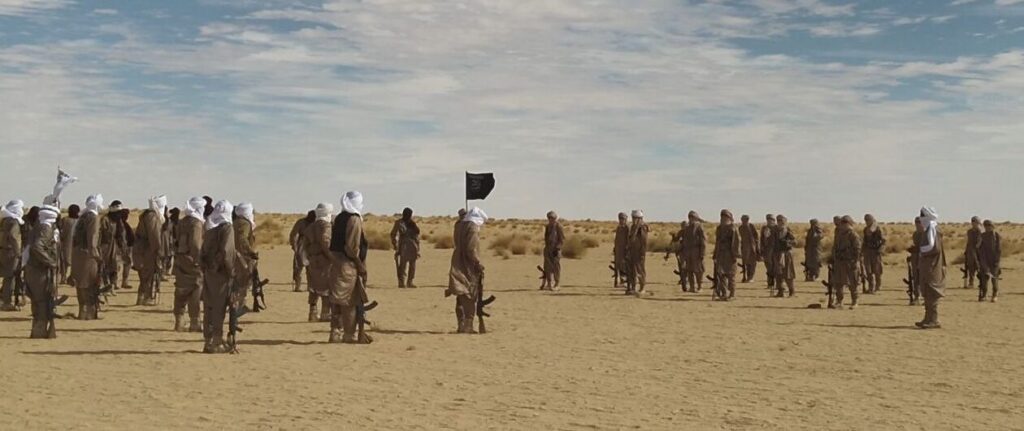
Northern and central Mali no longer face sporadic armed attacks. For years, these regions have endured a relentless cycle of violence and civilian exhaustion. Recent offensives by the Group for the Support of Islam and Muslims (JNIM) and the Azawad Liberation Front (FLA) against military positions, supply convoys, and critical infrastructure signal a pivotal shift in strategy.
Beyond territorial conquest: a war of attrition
These armed factions are no longer focused solely on capturing towns or staging high-profile attacks. Instead, their goal is to gradually render vast swathes of Mali ungovernable, pushing the military junta to the brink of collapse in Bamako.
The transformation is significant because it reframes the conflict’s core. The battle is no longer just about controlling cities or military camps—it’s about who can still guarantee safe passage for people, goods, fuel, administrative officials, or essential public services.
A deliberate assault on mobility
Over recent months, attacks on roadways and military supply lines have surged. In many areas, even routine administrative travel now requires armed escort, severely undermining the Malian army’s operational capacity and the state’s ability to function beyond major urban centers.
The JNIM has recognized a critical truth: in a nation already weakened by institutional, economic, and security crises, exhaustion can yield greater political dividends than open confrontation. This strategy is not only less resource-intensive than traditional territorial warfare; it disperses enemy forces, inflates security budgets, and perpetuates a climate of perpetual insecurity. Most damaging of all, it fosters collective fatigue—military, economic, and social.
In rural zones, the crisis extends beyond insurgent presence. It’s the absence of stable governance that increasingly defines the problem.
The limits of a militarized approach
The Malian military government has staked its legitimacy on restoring security following successive coups. The withdrawal of French forces and the growing influence of Russian military cooperation were framed as acts of regained sovereignty. Yet sovereignty cannot be measured by military prowess alone—it also demands territorial continuity, economic resilience, and administrative consistency.
The paradox is stark: intensified military operations do not guarantee lasting stability. In some regions, they coexist with the fragmentation of rural spaces, where schools, clinics, local courts, infrastructure, and economic circulation remain in tatters.
Current security doctrine relies heavily on offensive operations, airstrikes, and troop deployments. But it struggles to rebuild durable administrative presence—whether in education, healthcare, justice, or economic activity. The resulting vacuum fuels its own momentum. As public services vanish, communities increasingly depend on parallel systems for protection, dispute resolution, and survival.
The Sahel’s shifting power dynamics
The Malian crisis is no longer confined within its borders. Across the Sahel, armed groups, local alliances, and clandestine economic networks are rapidly recomposing. While Mali, Burkina Faso, and Niger—once united under a regional security pact—share porous borders that allow insurgent mobility, their responses remain fragmented. The JNIM and FLA offensives exposed the fragility of this alliance and the isolation of Mali’s junta, now reliant almost entirely on the Africa Corps mercenaries for external support.
This asymmetry favors groups that can adapt quickly. The JNIM thrives on its territorial flexibility, deep local roots in certain zones, and integration into informal economic networks. It doesn’t need to hold territory permanently—it only needs to make governance prohibitively expensive for the state.
The conflict in the Sahel is increasingly a war of endurance. Armed factions are less interested in fully administering a country than in preventing the state from functioning normally.
What Mali’s crisis reveals
This crisis exposes the flaws in a strictly counterterrorism lens. Reducing the conflict to a military confrontation obscures its deeper social, economic, and territorial dimensions.
In many rural areas, long-standing grievances—state neglect, land disputes, communal rivalries, structural poverty—create enduring vulnerabilities. Armed jihadist groups do not always create these fractures, but they exploit them with precision.
The central challenge is political: how can the state rebuild legitimacy in territories where its presence is intermittent, often limited to military patrols?
The future of Mali may hinge on one question: not in a single decisive battle, but in the capacity—or failure—to restore a stable public presence beyond security operations.
Because a war of attrition doesn’t just destroy military positions. It erodes roads, economies, administrations, social bonds, and ultimately, the very idea of a governed territory.
Mourad Ighil




More Stories
Niger: Tiani faces fallout from special forces anger after Russian intervention
Crisis in Niger, IMF agreement in Sénégal, and Moroccan elections: Five essential stories
RDC-Israël : un rapprochement aux enjeux multiples