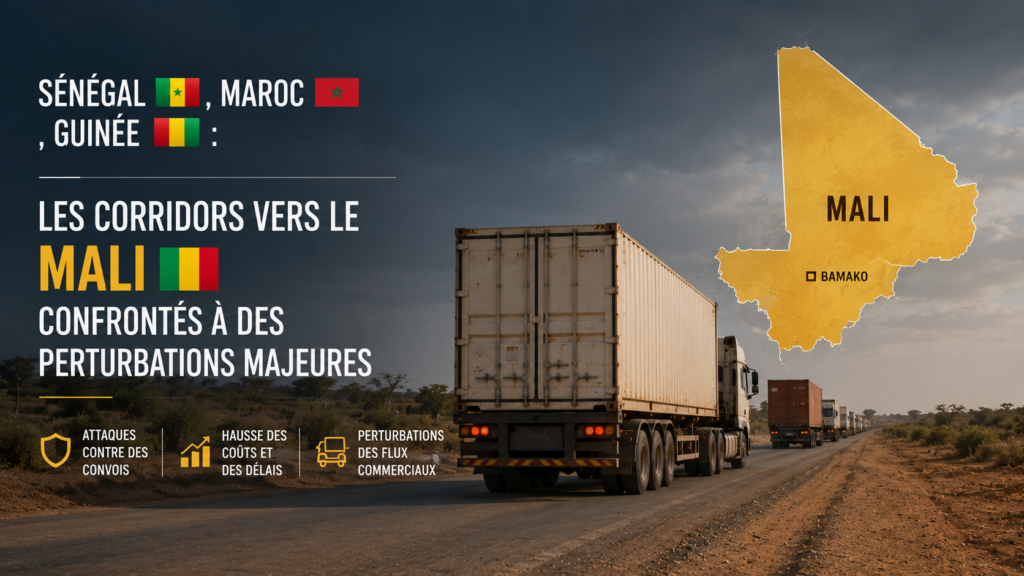
Transport routes linking Sénégal, Maroc, and Guinée to Mali are facing mounting disruptions, forcing regional transporters to reconsider their operations. From Senegalese hauliers calling for route suspensions to Moroccan operators tightening safety protocols, the challenges are reshaping cross-border trade dynamics and inflating operational costs.
Growing concerns among transporters
Freight operators across West Africa are reassessing their strategies as security threats and logistical hurdles intensify along Mali’s primary supply arteries. The situation has escalated to the point where professional associations are advising drivers to scale back or halt certain trips, citing economic unsustainability amid rising risks.
In Sénégal, the road freight union reports that at least eleven trucks bound for Bamako have been set ablaze in recent weeks. These incidents have prompted calls to suspend traffic on the Dakar-Bamako corridor, a critical lifeline for Malian imports. In 2024 alone, the port of Dakar handled approximately 2.6 million tons of goods destined for Mali, underscoring the corridor’s indispensable role in the country’s supply chain.
Moroccan operators adopt cautious measures
Moroccan transport companies are also recalibrating their approach to Malian routes. The May 6 attack on a commercial convoy along the Mauritanian border has heightened alarm, with syndicates noting over a dozen trucks—including Moroccan, Senegalese, and Mauritanian vehicles—targeted by armed groups. Six Moroccan trucks were destroyed in the assault, prompting operators to recalculate risk assessments and operational feasibility.
The fallout extends beyond immediate losses. Higher insurance premiums, vehicle immobilizations, extended security expenditures, and forced detours are eroding profit margins on routes already burdened by distance and expense. For businesses, these cumulative costs translate into delayed deliveries, inflated storage fees, and disrupted supply chains.
Guinea-Mali route faces similar strain
The corridor connecting Guinée to Mali, a vital alternative to traditional routes, is no longer immune to disruption. Attacks reported in late April have severely curtailed freight and passenger movement, limiting Mali’s ability to diversify its logistics infrastructure. This route, which leverages the port of Conakry, is now a less reliable fallback when other corridors face instability.
The ripple effects are far-reaching. Drivers delay departures, convoys travel in closer formations, and families endure prolonged uncertainty over relatives en route. For merchants, every delay compounds costs, slows trade, and strains regional economic cooperation. When multiple corridors falter simultaneously, the impact on Malian supply chains, logistics timelines, and cross-border commerce becomes unmistakable.
Broader Sahel implications
Three years after Mali, Burkina Faso, and Niger redefined their security partnerships—shifting away from Western allies and toward new alliances—regional instability continues to strain trade networks. The resulting insecurity is no longer confined to conflict zones but is now reshaping the region’s economic connectivity, forcing transporters from Sénégal, Maroc, and beyond to confront an increasingly precarious operating environment.