
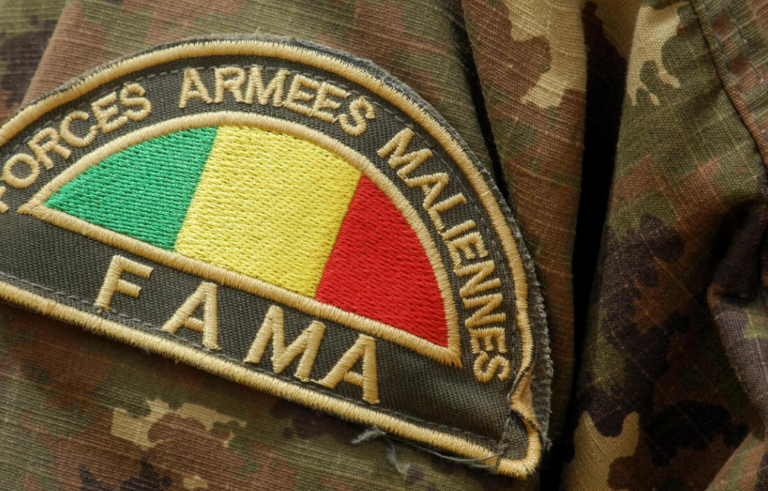
The assault on the military camp at Dioura, in Mali’s Mopti region, has torn open a deep wound. On 10 September, close to 80 Malian soldiers are believed to have been killed when fighters overran the position — one of the deadliest strikes suffered by the country’s armed forces in recent times.
Within hours, the Group for the Support of Islam and Muslims (JNIM), an Al-Qaïda affiliate, claimed the operation. According to the group, its fighters took control of the camp and later pulled out. Several troops are still unaccounted for, while others are thought to have been captured.
For those living in and around Dioura, the figures matter less than what they announce. Every new attack pushes the violence closer to the villages where families sleep, trade and try to hold on to some semblance of ordinary life.
A toll that lays bare the weaknesses of the Fama
Among the bloodiest episodes endured by the Malian forces in recent memory, the Dioura raid stands apart. The accounts available point to roughly 80 service members losing their lives in the assault.
A few hours later, JNIM stepped forward to claim responsibility, stating that its fighters had seized the camp before withdrawing from the site.
The sequence is troubling on several counts. It suggests that even a position viewed as strategically vital can still be hit with devastating force, despite years of military operations launched against armed groups.
Yet for residents of Dioura and nearby communities, the consequences stretch far beyond a military tally. Each attack feeds the same quiet dread: that insecurity will creep ever closer to the places where people actually live.
Civilians pay a price that rarely reaches the headlines
Across this corner of central Mali, communities have spent years living to the rhythm of clashes, displacement and the restrictions that insecurity imposes. A military camp is, in principle, meant to offer a shield.
So when such a camp collapses under the assault of an armed group, the message delivered to nearby villagers is profoundly unsettling.
Missing soldiers and waiting families
Soldiers gone silent, possible captures and uncertainty over the fate of certain troops sharpen the anxiety still further. Families wait for word. Communities brace themselves for reprisals or fresh fighting.
Everyday life grows heavier as well. Movement is curtailed, commerce is disturbed and access to essential services frays. Over time, military insecurity hardens into a social crisis.
A fresh blow to the junta’s narrative
The Dioura attack lands at a politically delicate moment for Mali’s authorities. The junta in power has built much of its legitimacy on two central arguments: reconquering national territory and restoring sovereignty.
Officials have repeatedly pointed to a stronger Malian army and greater autonomy in the campaign against jihadist groups.
Dioura abruptly recalls the limits of that messaging.
How can a significant military position be held for hours by a jihadist group when the authorities have pledged for years to regain control of the land?
The question is all the more uncomfortable because the Malian authorities have gradually scaled back cooperation with certain foreign partners while embracing a more self-reliant security strategy.
That course can be defended in the name of sovereignty. It must also be judged by what it delivers. For the people of Mopti, what it delivers remains deeply worrying: insecurity persists, and attacks on Malian forces are still capable of inflicting mass casualties.
A sense of abandonment that keeps spreading
In Dioura, as in other rural stretches of central Mali, inhabitants are squeezed between several dangers at once. They must reckon with armed groups, military operations and the economic fallout of instability.
Feeling abandoned can become as dangerous as fear itself. When a population stops believing the state is able to shield it, confidence in institutions erodes.
Rebuilding that confidence demands more than political declarations. It requires lasting protection for communities, safe roads, the freedom for farmers to work their land and guaranteed access to public services.
A tragedy whose reach goes well beyond the battlefield
What happened at Dioura should not be boiled down to a single clash between the Fama and JNIM. Behind the military toll stand grieving families, missing soldiers, relatives left waiting and civilians confronting a new surge of anguish.
For Mali’s junta, the attack is above all a serious warning. After years of security promises, people now expect tangible results.
At Dioura, the real issue is not who briefly holds a camp, but whether the Malian state can truly protect those who live around these military positions. As long as that question goes unanswered, every new attack risks feeding more insecurity — and more disillusionment.
More Stories
Niger: why general Barmou’s removal says more about sovereignty than about betrayal
In Niger, a transition that speaks of security from Niamey while the villages await the state
Niger: the disappearance of Moussa Kaka and the silence around Tiani