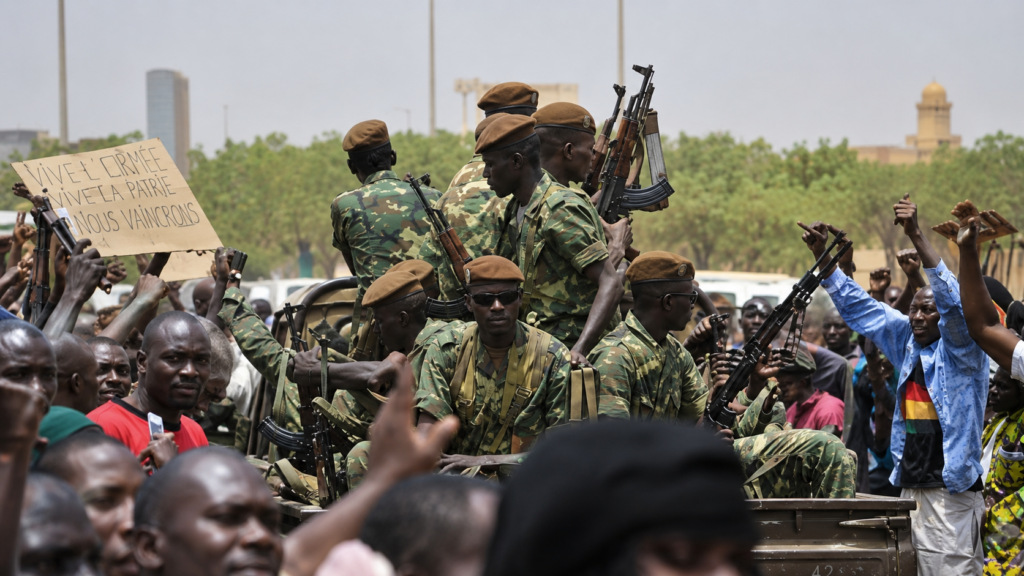
The events of spring 2026 represent more than a simple tactical setback; they signal the profound collapse of the political project championed by the Malian junta since 2021. Despite the regime’s defiant rhetoric, it is clear that without the constant support of Russian Africa Corps mercenaries, the current leadership would have been driven out of Bamako long ago.
By centering its legitimacy on the concept of “security sovereignty,” the military government crafted a narrative based on a single, ambitious promise: that by stripping away foreign oversight, the Malian state would finally reclaim its territory. Three years later, the reality on the ground has categorically disproven this claim.
The coordinated strikes launched by JNIM in late April, in tandem with Touareg separatists from the Front for the Liberation of Azawad, hit critical hubs including Kidal, Gao, and Mopti, even reaching the outskirts of Bamako. This offensive stands as a massive strategic humiliation. The death of Defense Minister Sadio Camara, a cornerstone of the military administration, was not just a symbolic loss; it laid bare the fragility of a security system that the junta had hailed as a modernized powerhouse. Instead of neutralizing the threat, the military appears increasingly paralyzed by an insurgent force capable of striking at the very heart of the state.
Even more concerning is the structural evolution of JNIM. The group has transitioned from a peripheral rural threat into a sophisticated actor capable of executing complex, politically targeted, and synchronized operations. This surge in capability occurred despite—and perhaps because of—the junta’s decision to sever ties with Western partners in favor of a heavy reliance on Russian security elements whose actual impact remains highly questionable. While the security failures are glaring, the economic decline facing the nation is arguably even more catastrophic.
Official communiqués praising the resilience of the state and the prowess of the FAMAs now ring hollow, sounding more like desperate propaganda than a sober assessment of the conflict. It is a facade that few Malians still believe in. While government institutions technically remain standing, the issue is no longer their survival, but their total loss of credibility. By failing to secure the country and allowing violence to creep toward major urban centers, the military regime is effectively dismantling the foundation of its own authority.
The crisis is further deepened by the fact that local dynamics are slipping away from Bamako’s influence. The tactical alignment between JNIM and certain Touareg armed groups highlights the failure of a purely kinetic approach. By reducing a multifaceted crisis to a mere security problem, the junta ignored the essential political, social, and territorial grievances at play. This neglect has only served to unify a diverse front of opposition against the central government.
The junta’s security gamble appears not only weakened but fundamentally flawed. Increasing military hardware and swapping international partners has failed to shift the conflict’s momentum. On the contrary, jihadist groups have shown a greater capacity for adaptation than the state, successfully exploiting governance gaps, communal friction, and the total absence of public services.
On a broader scale, this stalemate also exposes the limitations of the Alliance of Sahel States. Marketed as a sovereign solution to regional instability, the alliance has struggled to produce any meaningful results against agile, transnational armed groups. Rather than providing a solution, it risks becoming a formalized structure for collective helplessness.
Ultimately, the current turmoil reveals a fatal contradiction: the junta built its reputation on restoring order, yet security is precisely where it has failed most visibly. JNIM is no longer just a sign of Mali’s weakness; it has become the most brutal evidence of the state’s decline. By clinging to an exclusively military interpretation of the war, the leadership in Bamako seems unable to address the deeply political nature of the crisis it claimed it would solve.