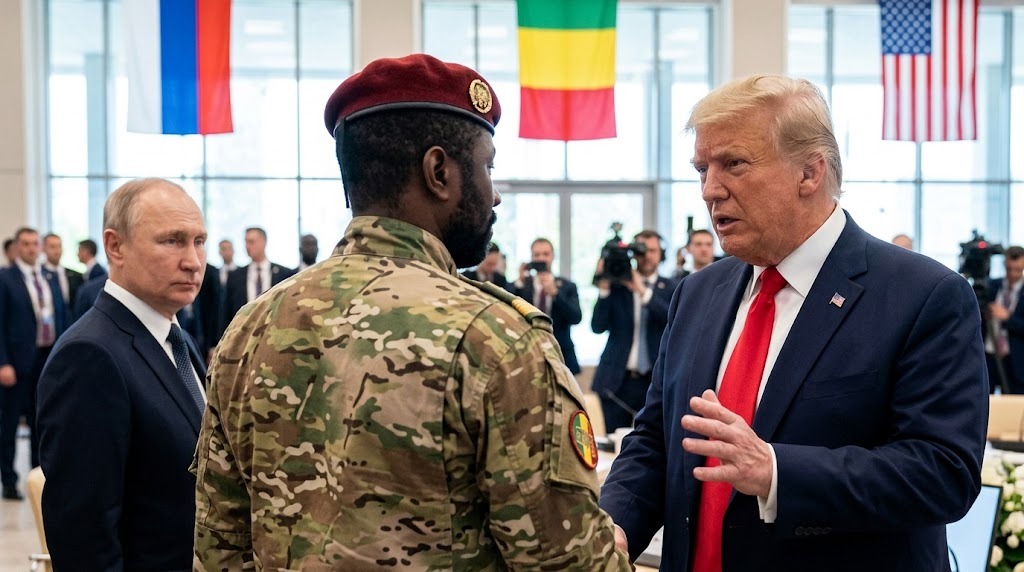
Bamako’s silent shift: from Moscow’s shadow to Washington’s embrace
The narrative has been clear for years: after ousting France and its European allies, Mali turned decisively toward Russia. Under the leadership of General Assimi Goïta, Bamako elevated Moscow to its top security partner, welcoming Wagner fighters and later Africa Corps troops while steadily distancing itself from Western governments.
But in 2026, that story is beginning to crack. Mali has not formally severed ties with Russia. Yet unmistakable signals point to a quiet rapprochement with the United States. Intelligence-sharing initiatives, discussions on resumed U.S. surveillance flights, and the lifting of sanctions against top Malian officials—each move reflects a clear shift in alignment. Bamako appears to be diversifying its alliances, and Washington has quietly reclaimed its place as a key partner.
Intelligence cooperation: Washington’s return as a key security ally
Perhaps the most striking evidence of this change lies in military intelligence collaboration.
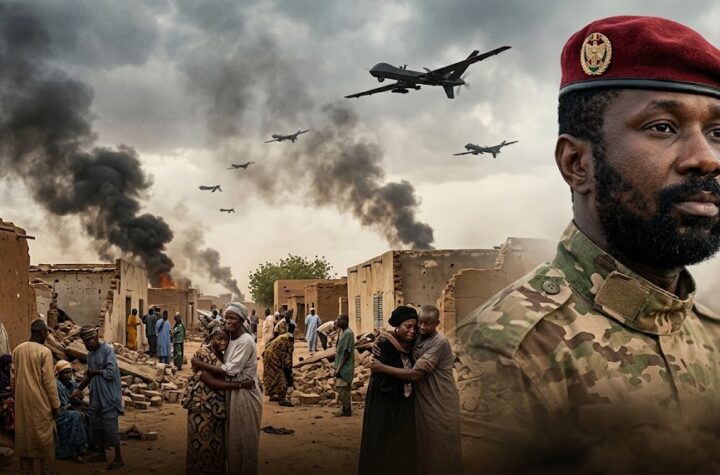
Early in 2026, reports emerged of a potential agreement between Washington and Bamako to allow U.S. surveillance aircraft and drones to operate over Malian airspace—targeting jihadist groups like the Jama’at Nusrat al-Islam wal-Muslimin (JNIM), affiliated with Al-Qaeda. By February of that year, the U.S. had lifted sanctions previously imposed on Mali’s defense minister and several senior officials, signaling a thaw in relations.
This shift carries deep symbolism. During a period of intense friction with Western states, Bamako had positioned Russia as the essential replacement for former colonial powers. Now, Malian authorities are once again engaging Washington on critical defense needs—intelligence, surveillance, and reconnaissance capabilities.
U.S. intelligence support has already played a role in Malian counterterrorism operations, at least in limited instances. American officials are now seeking to formalize this cooperation, moving it from ad hoc assistance to a more structured security partnership.
From confrontation to collaboration: the pragmatic turn
The irony is hard to ignore. The same government that publicly distanced itself from the West to embrace Moscow may now be rediscovering the strategic value of Washington.
Where once Bamako rejected Western cooperation as neo-imperial interference, today it appears willing to accept intelligence and aerial surveillance support—capabilities it once deemed unnecessary or politically toxic.
The Russian security record: a partnership under scrutiny
Why the change now? Part of the answer lies in the unvarnished results of Russia’s military involvement in Mali.
It’s important to clarify: Wagner’s deployment did not single-handedly cause Mali’s security crisis. The country faced a growing jihadist insurgency long before French forces exited. Local and regional factors—political instability, social grievances, economic hardship, and vast ungoverned spaces—have fueled the rise of armed groups for years, largely independent of foreign military presence.
Yet official assessments tell a sobering story. U.S. State Department data from 2022—when French forces completed their withdrawal—showed a sharp increase in both the frequency and lethality of terrorist attacks. That year was labeled the deadliest in Mali’s history in terms of terrorist violence and counterterror operations. Malian troops, backed by Wagner, occupied former French bases, but the violence only escalated.
2023 followed the same grim pattern. According to a subsequent U.S. terrorism report, jihadist activity intensified further, marking 2023 as another record year for violence—combining insurgent attacks with brutal counterinsurgency operations involving Malian forces and their Russian allies.
These figures present a stark contradiction to the narrative that framed Russia as Mali’s path to security.
Moscow’s fading promise: setbacks and strategic cracks
Russia has not disappeared from Mali. Wagner has been gradually replaced by the Africa Corps, a force directly tied to Russia’s defense ministry. Moscow retains significant military and political influence—especially in mining, energy, and infrastructure projects.
Yet recent events have exposed vulnerabilities in Russia’s security guarantees.
In April 2026, a major offensive by JNIM fighters, joined by Tuareg militants, dealt heavy losses to Malian forces and their Russian allies. Mali’s defense minister, Sadio Camara—who trained in Russia—was killed in an attack. The Africa Corps was also forced to withdraw from Kidal, a strategically vital northern city it had helped retake in 2023.
Analysts, including ACLED’s Héni Nsaibia, have argued these developments expose the limits of Russia’s ability to stabilize Mali. Successive JNIM campaigns, fuel blockades, and battlefield reversals suggest Moscow’s intervention has not quelled the insurgency.
While assessments vary, the pattern is undeniable: the Russian model has not delivered the security gains Bamako expected.
Civilian toll and jihadist gains: a nation under strain
By 2025, the human cost had become impossible to ignore.
ACLED data cited in international reports attributed 918 civilian deaths to Malian forces and their Russian paramilitary allies (Wagner and Africa Corps) that year. In contrast, jihadist groups—including JNIM and the Islamic State in the Greater Sahel—were responsible for 232 civilian fatalities. These figures, though incomplete, highlight a disturbing imbalance: government-backed operations, though aimed at eliminating insurgents, have resulted in far greater civilian casualties than the attacks they sought to prevent.
Meanwhile, jihadist groups have continued to expand their influence, disrupting supply routes and tightening pressure on Bamako. In March 2026, authorities released around 200 detainees suspected of jihadist links in a bid to secure a temporary ceasefire on fuel convoy attacks—an unprecedented move that underscored the regime’s desperation.
For a junta that rose to power promising to restore sovereignty and security, the reality is starkly different.Washington’s strategic advantage: what Moscow couldn’t deliver
Despite the setbacks, Bamako is not abandoning Russia outright. Moscow remains a key economic and political partner, especially in gold, lithium, and energy projects. Russian firms continue to support major infrastructure initiatives.
But the Malian leadership now appears to be adopting a more pragmatic approach: no longer relying on a single ally to solve its security challenges.After making Moscow its sole security guarantor following France’s departure, Bamako now seems to recognize that Russian support is insufficient—especially in intelligence and high-tech surveillance. Washington, with its advanced satellite networks, aerial reconnaissance, and deep understanding of regional jihadist networks, offers capabilities Russia cannot match on the same terms.
This rapprochement is less an ideological reversal than a strategic necessity: Mali needs multiple partners to counter a threat its alliance with Russia has failed to eradicate.
From confrontation to balance: a new era of Malian diplomacy
The past few years have seen Bamako shift from outright hostility toward Western powers to a more nuanced engagement with Washington. A few years ago, such cooperation would have been unthinkable.
Russia remains in Mali—militarily, politically, and economically. But its security record is now openly questioned, its forces have suffered humiliating reversals, and the jihadist threat persists.
In this context, the renewal of U.S.-Malian ties is more than a diplomatic footnote. It may signal the beginning of a new foreign policy orientation: leveraging great power rivalry not by choosing one side, but by extracting maximum benefit from both.Mali has not yet turned its back on Russia. Yet the era of exclusive reliance on Moscow appears to be over. Bamako is learning to play the geopolitical game—and Washington is back at the table.
More Stories
Niger’s military restructuring sparks high-stakes financial and political power struggle
Mali’s drone war: a turning point in civilian deaths and accountability
Nigeria’s election security: a decisive shift to ensure credible polls