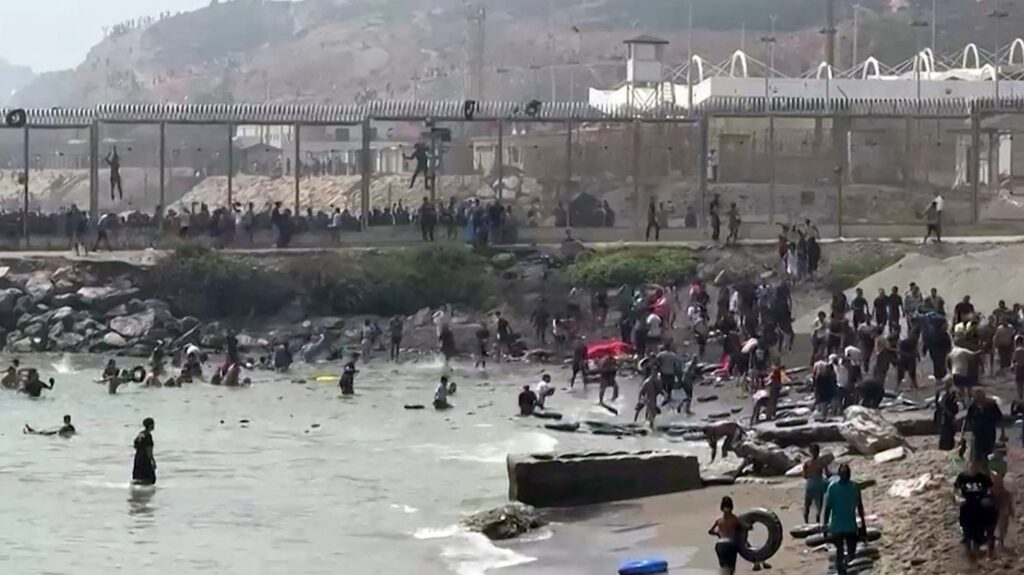
Massive migration surge at Ceuta: Spain accuses Morocco of political pressure
In just 24 hours, nearly 60,000 migrants illegally entered the Spanish enclave of Ceuta, bordering Morocco. Spanish authorities suspect Rabat of orchestrating the influx as a response to Madrid’s recent diplomatic overtures toward Algeria.
Thousands of Moroccan nationals reached Ceuta by swimming just days after Spanish Prime Minister Pedro Sánchez’s official visit to Algeria. In 2021, nearly 9,000 people entered the Spanish territory following Madrid’s decision to host the leader of the Polisario Front, a move strongly criticized by Rabat.
Border chaos unfolds
Chaos erupted at the Ceuta-Castilejos border as thousands of young Moroccans, including families and individuals with reduced mobility, dispersed across the terrain or swam ashore. Despite Moroccan police blocking road access, the surge overwhelmed security forces, marking one of the most severe migration crises in five years.
Spanish officials insist bilateral relations remain strong, with the Foreign Ministry describing the current agreement with Morocco as “excellent” and highlighting “intense” coordination efforts. Following initial silence, Moroccan authorities confirmed an agreement with Spain to repatriate those who entered Ceuta illegally.
Legal ruling fuels human trafficking networks
Spanish Interior Minister Fernando Grande-Marlaska linked the crisis to human trafficking networks exploiting a recent Supreme Court ruling. The decision guarantees legal assistance and individual case reviews for all who enter Spanish territory. Ruth Ferrero, a political science professor and researcher at the Complutense Institute for International Studies, clarifies that the ruling does not imply an “open-door” policy or prevent repatriations. She emphasizes that traffickers likely exploited the legal framework to facilitate irregular entry.
Historical parallels
This situation mirrors the May 2021 crisis, when nearly 9,000 people entered Ceuta in retaliation for Spain’s decision to hospitalize Brahim Ghali, leader of the Polisario Front. Morocco condemned the move as “deplorable,” and reports later surfaced of rumors spread among Sub-Saharan migrants that Moroccan security forces would relax border controls.
Haizam Amirah Fernández, executive director of the Center for Contemporary Arab Studies, notes a “pattern” in such mass entries: “Moroccan authorities use human movements as a tool to send messages, often tied to unmet expectations from Moroccan leadership.”
Ferrero cautions against interpreting all migration pressure as a deliberate political strategy, stating that the available evidence suggests otherwise. She highlights the role of disinformation networks linked to criminal gangs in fueling the crisis.
Diplomatic tensions and regional rivalries
The influx coincides with Sánchez’s visit to Algeria, described by observers as a “new phase” in Spain-Algeria relations. Amirah Fernández suggests a potential link: “While not definitive, the timing is striking. The rivalry between Morocco and Algeria is at one of its worst points in decades, and Sánchez’s visit likely did not sit well in Rabat.”
He adds that Morocco views Spain’s regional engagements through a “zero-sum” lens: “Improved ties with Algeria are seen as harming Morocco’s interests, just as stronger Spain-Morocco relations would be perceived as detrimental to Algeria.”
Ferrero argues that Morocco’s leverage stems from Europe’s outsourcing of migration control: “It’s not that Morocco sought this position deliberately, but it has skillfully navigated a system where European governments, including Spain, delegate migration management to third countries.”
The unresolved Western Sahara conflict
This migration pressure follows years of bilateral tensions, including Morocco’s 2020 suspension of high-level meetings after the U.S. recognized Moroccan sovereignty over Western Sahara in exchange for normalization with Israel. Later, Spain’s decision to hospitalize Ghali triggered deadly border clashes.
Amirah Fernández describes the Spain-Morocco relationship as “complex,” noting Morocco’s assertive decision-making style. The Western Sahara conflict, rooted in the territory’s 1975 invasion by Morocco after Spain’s withdrawal, remains a persistent source of strain. The Polisario Front, founded in 1973, controls the remaining 20% of the territory.
Ferrero points out that Spain’s 2022 letter to Mohamed VI, supporting Morocco’s autonomy plan for Western Sahara, marked a significant shift from its historical neutrality. “This was the first time Spain explicitly endorsed a solution—Morocco’s autonomy proposal—though it did not legally recognize Moroccan sovereignty.”
The role of social media
A recent study by the North African Human Rights Observatory reveals that 81% of young people surveyed in northern Morocco view social media content portraying irregular migration as a viable path to improved living conditions. The survey, conducted among 500 youth in Tangier, Tetouan, and Al Hoceima, found that 78.4% reported easy access to posts promoting irregular migration, while 74.2% follow pages providing logistical guidance for such journeys.


More Stories
Togo: how a journalist’s sanction resonates far beyond newsrooms
Niger: reshuffle fallout hits households, traders and an economy running on fumes
Niger’s military regime cuts off information flow—citizens and economy reel from media blackout