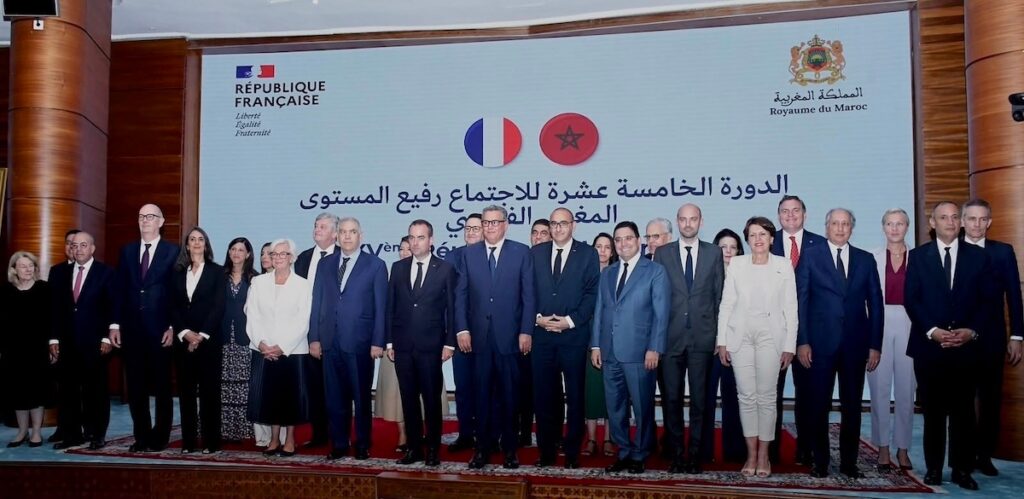
Morocco and France deepen strategic ties with historic agreements
- Political and strategic convergence
- The human dimension: cornerstone of Morocco-France partnership
- A new era in bilateral relations
- Signed agreements
Moroccan Prime Minister Aziz Akhannouch emphasized that the fifteenth high-level Morocco-France meeting arrives at a decisive juncture in the journey both nations embarked upon since October 2024. This gathering provides an opportunity to assess progress and accelerate the implementation of commitments made within the framework of their strengthened exceptional partnership.
The meeting serves as a platform to advance critical and foundational steps in implementing the guidelines set by King Mohammed VI, who underscores Morocco’s commitment to ambitious cooperation that is balanced and creates future opportunities for both partners.
During this occasion, Mr. Akhannouch praised French President Emmanuel Macron for injecting fresh dynamism into bilateral relations, thereby consolidating an exceptional partnership between the Alaouite Kingdom and the French Republic.
Political and strategic convergence
In a global context marked by multiple crises and uncertainties, Morocco and France not only share a common goal of stability and cooperation but have also deepened their dialogue on major regional and international issues. This dialogue is rooted in trust, shared responsibility, and mutual respect.
“This convergence is particularly resonating in the Mediterranean, African, and Atlantic spaces,” Mr. Akhannouch stated. “The position of France in favor of Morocco’s territorial integrity and the Moroccan nature of the Sahara has contributed to fostering a climate of strengthened trust between the two nations.”
He added that the economic momentum initiated since President Macron’s last state visit has accelerated the implementation of foundational projects in industries, decarbonization, infrastructure, renewable energy, logistics, innovation, and productive investment.
Aziz Akhannouch highlighted the robustness and quality of cooperation between Morocco and France, driven by the emergence of new value chains where banking services are becoming one of the pillars of the bilateral economic relationship.
The Moroccan Prime Minister also underscored the shared commitment to promoting major technological transformations. Special emphasis was placed on artificial intelligence, digitalization, applied research, and other strategic sectors poised to enhance the competitiveness of both economies.
The human dimension: cornerstone of Morocco-France partnership
This exceptional and strengthened partnership extends beyond strategic and economic domains to anchor itself in a shared conviction: the richness of human ties between the two societies. The human dimension, which encompasses academics, researchers, entrepreneurs, artists, creators, and the diaspora, plays a vital role in bringing the two peoples closer and strengthening their cultural exchanges, Mr. Akhannouch noted.
Regarding human capital, he affirmed that both countries continue their efforts to promote higher education, scientific research, vocational training, innovation, and talent mobility. Simultaneously, both nations prioritize cultural cooperation, intercultural dialogue, the promotion of shared heritage, and the strengthening of human exchanges. These form the living and sustainable foundation of the relationship between the two parties.
The two countries have reaffirmed their ambition to project their bilateral relations into the future by inaugurating a new phase of their strategic partnership. This dynamic draws inspiration from the vision of King Mohammed VI and President Macron’s commitment to consolidating cooperation suited to the challenges of the 21st century.
Both governments expressed their determination to translate political commitments into concrete results. Their goal is to build a more effective and innovative partnership capable of addressing the common challenges they face together in economic, technological, geopolitical, and human domains.
A new era in bilateral relations
French Prime Minister Sébastien Lecornu stated that this high-level Morocco-France meeting marks a turning point in bilateral relations. It signifies the implementation of commitments made during the historic state visit of the French President to Rabat in October 2024.
The primary commitment, according to him, was to give a new dimension to the partnership between Morocco and France. This involves creating privileged links—inter-ministerial, political, diplomatic, economic, and cultural—to establish specific governance between the two countries.
“France and Morocco aspire to consolidate a strategic partnership that, beyond strengthening their privileged relationship with the European Union, will serve as a bridge to renewed cooperation based on converging interests and oriented toward the development and stability of the African continent,” Mr. Lecornu explained. He reaffirmed France’s support for the autonomy plan aimed at providing a definitive solution to the Sahara conflict.
The two countries stressed that security will remain one of the pillars of their strategic partnership, alongside major demographic and environmental challenges facing the continent.
Both nations will enhance their coordination in combating terrorism and transnational threats, convinced that regional stability requires increasingly close diplomatic and security action.
Indeed, both governments agreed on the necessity of elevating their bilateral relations to a higher level. This aims to project Moroccan-French cooperation beyond the bilateral framework and make it an instrument serving the development, stability, and integration of the African continent.
Sébastien Lecornu concluded by emphasizing that this high-level meeting marks a new stage in deepening the Franco-Moroccan partnership. This dynamic, he added, will prepare for the upcoming state visit of King Mohammed VI to France. This visit is set to be a key moment in Morocco-France relations and could lead to the signing of an exceptional friendship treaty. The treaty aims to consolidate an unprecedented strategic partnership between the two countries.
Signed agreements
Moroccan Minister of Foreign Affairs, African Cooperation, and Moroccans Residing Abroad Nasser Bourita, and French Minister for Europe and Foreign Affairs Jean-Noël Barrot signed a letter of intent regarding cooperation in feminist foreign policy. This aims to strengthen feminist diplomacy at both the ministerial and international levels.
Additionally, Moroccan Minister of Economy and Finance Nadia Fettah and French Minister of Economy, Finance, Industrial Sovereignty, Energy, and Digitalization Roland Lescure signed a memorandum of understanding confirming the financing implementation of the high-speed rail program between Kenitra and Marrakech.
A joint declaration was also signed, complementing the memorandum of understanding that confirms the implementation of the partnership in the water sector. This was signed by Nadia Fettah, Roland Barrot, and the Director of the French Development Agency (AFD) in Morocco, Catherine Bonnaud. This agreement further specifies the commitments made by the parties in the memorandum of understanding dated October 28, 2024, regarding support for the national water policy.
Furthermore, Moroccan Minister of National Education, Preschool Education, and Sports Mohamed Berrada and French Minister Delegate for Francophony and International Associations Eléonore Caroit signed a declaration of intent regarding the teaching of Arabic language and history-geography in French schools in Morocco. This aims to promote bilingual competence.
Additionally, Moroccan Minister of Transport and Logistics Abdessamad Kayouh and his French counterpart Philippe Tabarot signed a three-year action plan (2026-2028) to implement technical cooperation in the field of civil aviation.
Mr. Kayouh also signed an agreement with the Director of the French National Maritime School (ENSM), François Lambert, to establish a partnership between this institution and the Moroccan Higher Institute of Maritime Studies (ISEM). The goal is to consolidate scientific and educational exchanges between the two institutions.
In the cultural domain, Moroccan Minister of Youth, Culture, and Communication Mohamed Mehdi Bensaid and his French counterpart Catherine Pegard signed a declaration of intent regarding cooperation in cinema and moving images across Africa. They also signed a declaration of intent on cooperation in artistic exchanges.
Mr. Bensaid also signed a strategic partnership agreement with the President of the Arab World Institute, Anne-Claire Legendre. This aims to establish a general framework of cooperation between the two parties to develop a partnership around cultural, intellectual, and civic actions.
The Director General of the Public Laboratory for Testing and Studies (LPEE), Hammou Bensaadout, and the Director General of the Center for Studies and Expertise on Risks, Environment, Mobility, and Development (CEREMA), signed a framework cooperation agreement covering various fields, including soil engineering and expertise in port, hydraulic, and maritime infrastructure.
Finally, the Director of the Agronomic and Veterinary Institute (IAV) Hassan II, Abdelaziz El Hraiki, and the Deputy Director General for Research and Strategy at the International Cooperation Center for Agronomic Research for Development (CIRAD), Jean-Paul Laclau, signed a framework cooperation agreement covering sectors such as agriculture, veterinary medicine, and fisheries and aquaculture sciences.
By Emmanuel Mbarga — Reporter