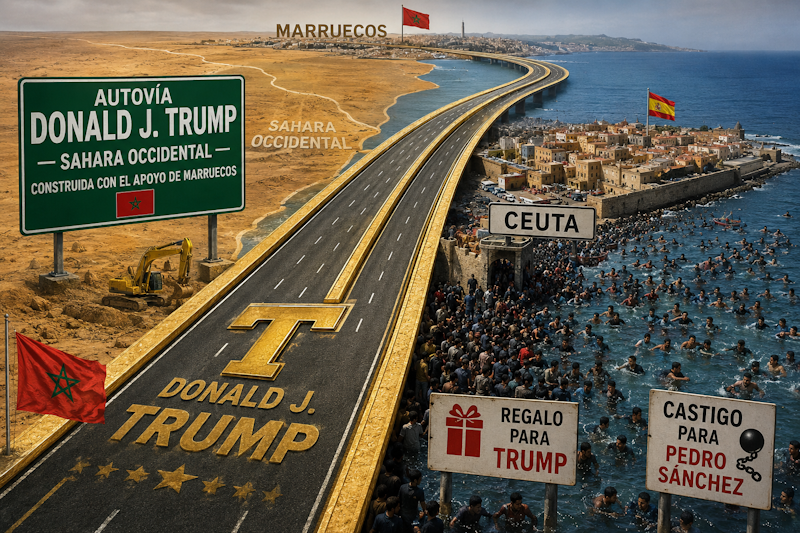
Rabat is skillfully deploying a multifaceted diplomatic strategy, intertwining a symbolic tribute to a former US president with intense migratory pressure on a Spanish enclave. The objective? To secure decisive support from Washington regarding the disputed Western Sahara territory. While the Tiznit-Dakhla highway now bears the name of Donald J. Trump, it is through an entirely different channel that Morocco aims to influence Spain’s stance.
The summer of 2026 has unfolded as a period of significant diplomatic activity involving Morocco, the United States, and Spain. With Donald Trump back in the White House, Rabat has intensified its efforts to cement American backing for its claims over Western Sahara, a territory Morocco has asserted as its own since Spain’s withdrawal in 1975.
A highway honoring Trump
The gesture holds profound symbolic weight. By decree of King Mohammed VI, the 1055-kilometer Tiznit-Dakhla highway has been officially designated the “Donald J. Trump” highway. In a letter released by the MAP agency, the monarch articulated his intention to express gratitude to the American president for his “historic recognition of Morocco’s sovereignty over its Sahara in 2020.”
This infrastructure project, hailed by the King as “the longest road network in all of Africa,” connects the southern regions of the country to Dakhla, traversing Laâyoune, situated at the heart of Western Sahara. It represents a vital artery that, as the monarch underscored, “unites Morocco’s north and south and links Europe to the African continent.”
Donald Trump promptly responded on his Truth Social platform, stating: “What a tremendous honor! I eagerly anticipate one day traveling the entire length of this magnificent highway, hopefully soon!”
Ceuta: another strategic leverage point
However, Morocco’s primary leverage in negotiations isn’t the highway. A far more crucial instrument is immigration. In late July, nearly 60,000 migrants crossed into the Spanish enclave of Ceuta within a few hours, triggering a significant humanitarian and diplomatic crisis.
Spanish authorities reported that at least 57 individuals perished during their attempts to cross, either by drowning or being trampled. Morocco, whose border guards notably remained uninvolved, officially acknowledged 11 fatalities.
The enclave of Ceuta, one of only two land borders between the European Union and Africa, serves as a critical flashpoint in Hispano-Moroccan relations. Morocco has consistently refused to acknowledge Spanish sovereignty over these territories, deeming them “occupied.”
A recurring pattern
This unfolding scenario is not unprecedented. A similar migration crisis in May 2021, involving 8,000 entrants, previously compelled Madrid to reconsider its position on Western Sahara. Spain subsequently abandoned its historical neutrality, expressing support for Morocco’s autonomy plan, a shift that followed its decision to provide medical care to Brahim Ghali, the leader of the Polisario Front.
“Morocco believed Spain supported its autonomy project for Western Sahara, but this isn’t enough, as Morocco seeks recognition of its full sovereignty,” explained Carlos Ruiz Miguel, director of the Western Sahara Studies Center at the University of Santiago de Compostela.
This time, the circumstances are distinct. The crisis emerged just ten days after a visit by Pedro Sánchez to Algiers, where Spain sought to re-establish ties with Morocco’s regional rival. This overture evidently did not go unnoticed by Rabat.
A multi-pronged approach
Analysts see a clear correlation. “Morocco aims to disrupt Spain’s constitutional space,” asserted Alejandro del Valle, a professor of international law, suggesting that Rabat perceives Madrid as a “geostrategic adversary.”
Morocco’s strategy rests on three key pillars:
-Flattering Trump with a powerful symbolic gesture (the highway), thereby reinforcing American recognition of its sovereignty over Western Sahara.
-Leveraging migratory pressure on Ceuta to remind Spain of its vulnerability and dependence on Moroccan cooperation.
-Securing Washington’s unwavering support for the dossier, particularly as UN negotiations on Western Sahara remain stalled.
The United States’ role
The Trump administration has made no secret of its backing for Morocco. Secretary of State Marco Rubio recently reiterated that “the United States recognizes Moroccan sovereignty over Western Sahara.” Donald Trump himself characterized Morocco’s autonomy proposal as the “sole basis for a just and lasting solution,” adding that “any other path prolongs the status quo and is unacceptable.”
The White House also voiced criticism of Spanish migratory policies, with a spokesperson warning that Spain risked “compromising its own survival.”
Europe under pressure
The Ceuta crisis sent ripples across the European Union. Italy temporarily suspended its Schengen agreements with Spain, a move soon followed by Finland and Denmark. Georges-Louis Bouchez, president of the Belgian MR party, called for a partial suspension of Spain from the Schengen area.
For Paul Melly, a researcher at Chatham House, this crisis underscores the evolving geopolitical landscape: “Morocco has already demonstrated its willingness to employ migratory pressure as a retaliatory tactic against Spain, which is particularly vulnerable due to its two North African enclaves.”
Conclusion: a clear message conveyed
While the Trump highway doesn’t physically pass through Ceuta, an equally explicit message has been delivered: Rabat holds the keys to Europe’s southern border. By skillfully combining symbolic tributes to Washington with migratory pressures on Madrid, Morocco is weaving a complex diplomatic tapestry, each thread designed to strengthen its position on Western Sahara. This is a lesson that Spanish and European negotiators have undoubtedly now fully grasped.

More Stories
Mali’s information war: can the public still trust the news when Maliweb.net amplifies the army’s narrative?
Will West Africa’s sleeping savings finally become its financial lifeline?
Can Benin and Spain turn cultural diplomacy into a lasting strategic advantage?