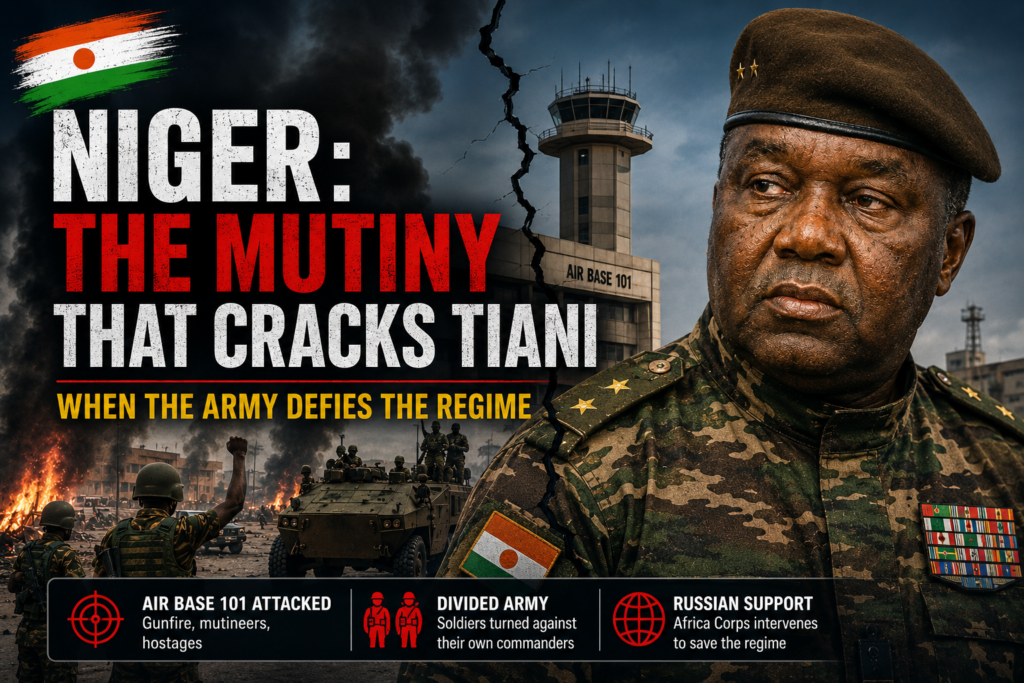
Crisis of confidence in Niamey after mutiny at strategic military base
On Saturday, August 29, 2026, Niger’s capital, Niamey, witnessed an unprecedented challenge to its leadership when a faction of soldiers launched coordinated attacks against high-profile military and governmental installations. The assault on Air Base 101, a cornerstone of the country’s defense infrastructure, marked not merely a display of discontent but a direct assault on the foundations of the current regime. Authorities confirmed that mutineers had detained fellow servicemen before engaging in sustained gunfire exchanges with loyalist forces near critical state institutions.
Unlike isolated expressions of dissatisfaction, this mutiny targeted the very symbols of state authority. Heavy exchanges of gunfire erupted around the presidential palace and the international airport, while national broadcast networks were abruptly silenced. These events, unfolding in broad daylight, shattered the narrative that the regime’s control remained unassailable.
Internal fractures threaten military cohesion
At the heart of this crisis lies a profound institutional rupture. When soldiers turn their weapons on their own comrades and seize control of a vital military installation, the issue transcends mere ideological disagreement. This is no longer a matter of political dissent but a breakdown in the chain of command that defines any functional army.
The mutineers were not isolated actors. Reports indicate participation from military personnel originating from multiple regions, including Ouallam, Téra, and Dosso, all of whom managed to infiltrate and seize control of Air Base 101. Their ability to coordinate and execute such an operation suggests deep-seated grievances within the armed forces, no longer confined to the ranks of junior officers or disgruntled soldiers.
Regime’s paradox: sovereignty claims versus internal instability
Since assuming power in July 2023, General Abdourahamane Tiani has positioned himself as the architect of Niger’s renewed sovereignty, particularly in matters of national security. His administration has emphasized the restructuring of the military apparatus and the restoration of state authority. Yet the mutiny of August 29 casts a stark shadow over these claims.
A regime that prides itself on having consolidated control over the security apparatus should not be vulnerable to internal military rebellion. The fact that soldiers loyal to the regime required external support to reclaim the base underscores a critical weakness. Elements affiliated with the Africa Corps reportedly intervened to assist in retaking the installation, a development that raises uncomfortable questions about the true extent of Niger’s military autonomy.
External alliances and the erosion of legitimacy
The regime’s insistence on sovereignty as a cornerstone of its legitimacy now faces a glaring contradiction. If the restoration of national security was to be achieved through domestic means, the reliance on foreign military assistance to suppress internal dissent undermines the very narrative that Tiani’s government has so vigorously promoted. This reliance risks deepening divisions within the armed forces, particularly among those who view foreign military presence as an encroachment on national prerogatives.
The psychological impact of this intervention cannot be overstated. Soldiers who have dedicated their careers to defending Niger may perceive foreign troops as occupying a more central role in the defense of their own country. Such perceptions risk fueling further resentment and potentially eroding the loyalty of the very institution tasked with safeguarding the state.
Political crisis masked by military victory
The swift retaking of Air Base 101 and the surrender of mutineers represent a tactical victory for the regime. However, military success does not equate to political resolution. The deeper question remains unanswered: Why did soldiers within the defense apparatus choose to rise against their own command?
The mutiny may have been quelled, but the underlying causes persist. Repression alone cannot restore the fractured trust between the regime and its armed forces. The challenge now facing Tiani’s administration is not merely to restore order but to address the grievances that led to this unprecedented act of defiance.
Security challenges compounded by internal threats
The crisis unfolds against a backdrop of persistent jihadist violence, a threat that the regime has consistently cited as justification for its consolidation of power. Despite repeated assurances of improved security, attacks by armed groups continue to plague Niger, including strikes on military and airport facilities in 2026 alone.
This juxtaposition is striking. While the government champions its security achievements, the mutiny has exposed a new and potentially more destabilizing threat: the erosion of cohesion within the very institution responsible for countering external threats. The regime now faces a dual challenge: confronting armed insurgencies while preventing further fractures within its own ranks.
From unity to fragmentation: the unraveling of a myth
In the aftermath of the 2023 coup, the National Council for the Safeguard of the Homeland (CNSP) positioned itself as the unifying force against political decay and foreign interference. Yet the mutiny of August 29 has laid bare the fragility of this unity. The armed forces, long presented as a monolithic bloc, now reveal deep divisions that strike at the heart of the regime’s stability.
A regime may endure external opposition, but it cannot survive sustained internal rebellion within its security apparatus. The mutiny may have failed militarily, but it has succeeded in exposing a vulnerability that threatens the long-term viability of Tiani’s leadership.A warning rather than an isolated incident
It would be premature to declare the regime on the brink of collapse. Loyalist forces have re-established control, and the mutiny has been contained. Yet to dismiss this episode as a mere disciplinary issue would be equally shortsighted.
For the first time since the 2023 coup, the Tiani administration has faced a military challenge of such scale that it spilled into the streets of Niamey. The mutiny failed in its immediate objectives, but it succeeded in demonstrating that the regime’s veneer of invincibility is not as solid as once believed. The most troubling revelation of August 29 may be that the most dangerous threat to Tiani’s power now comes from within.