
The fragile economic landscape of West Africa has been further strained by recent trade decisions from Niger’s transitional authorities, leaving regional operators and analysts deeply divided over their implications.
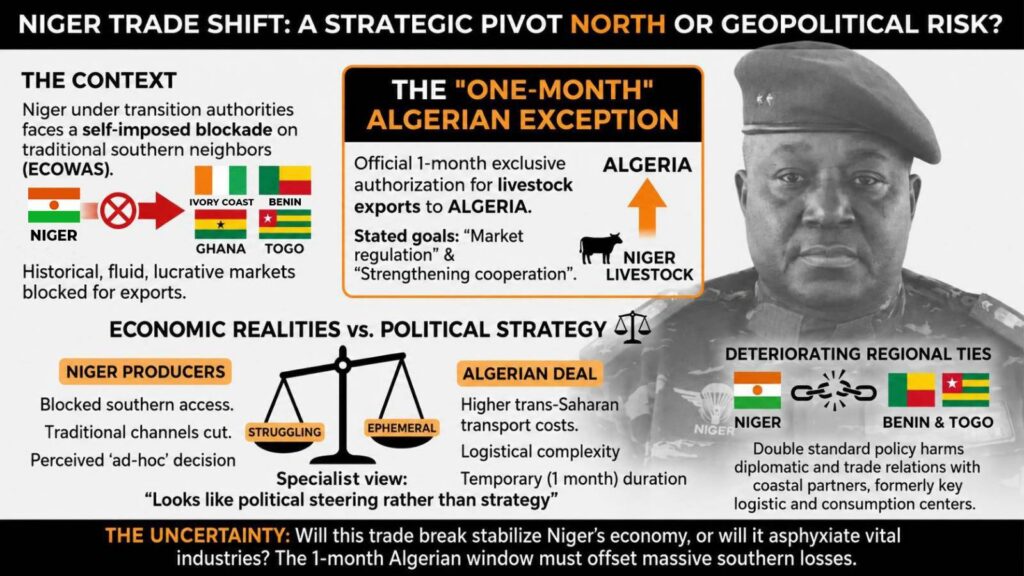
While commercial routes to the Gulf of Guinea—including Côte d’Ivoire, Bénin, Ghana, and Togo—remain either completely sealed or heavily restricted, Niamey has unexpectedly pivoted toward the North with a temporary concession.
A one-month lifeline for Algerian trade
The Nigerien government has formally approved a 30-day exceptional authorization for livestock exports bound for Algeria. Official channels frame the move as part of an “internal market regulation” initiative and a step toward “strengthening economic cooperation” between Niamey and Algiers.
Though the stated goal is diversification of trade partnerships, the practical impact on local producers reveals a far more complicated—and potentially damaging—reality.
Local producers caught in the crossfire
The selective easing of trade restrictions has left many economic actors questioning the long-term logic of such measures. The Gulf of Guinea has long served as the most accessible and profitable outlet for Niger’s pastoral sector, with porous borders and established logistics networks.
« Prioritizing a one-month window to Algeria while shutting out traditional markets in the South looks less like an economic strategy and more like a political gamble, » remarks a seasoned observer of Sahelian trade flows, speaking on condition of anonymity.
By favoring Algeria over neighboring CEDEAO states, the ruling junta appears to be embracing a shift in ideological alignment, even at the risk of destabilizing an already fragile livestock industry reeling from repeated crises.
Regional relations strained by selective trade policies
This inconsistent approach to trade has done little to ease tensions with regional partners, steadily eroding diplomatic and fraternal ties with coastal nations. Bénin and Togo, which historically functioned as critical logistical hubs and consumption markets for Niger, now find themselves sidelined in favor of a Saharan axis that is logistically fraught and cost-intensive.
As producers voice concerns over decisions perceived as hasty or poorly considered in terms of their microeconomic impact, many fear they are being held hostage by geopolitical maneuvering. With only a single month of access to Algerian markets, will this measure be enough to offset losses from lost trade with Côte d’Ivoire, Bénin, or Ghana? Early indicators suggest it may not be, especially as the overhead costs of trans-Saharan transport threaten to absorb a significant share of expected profits.
The coming weeks will determine whether this breakaway economic diplomacy can stabilize Niger’s fragile economy—or whether it will further suffocate vital sectors already struggling to survive.




More Stories
Gabon’s economic management hindered by unreliable public data
Analyse du prêt du FMI et des ambitions d’Ousmane Sonko
Niger: Tiani faces fallout from special forces anger after Russian intervention