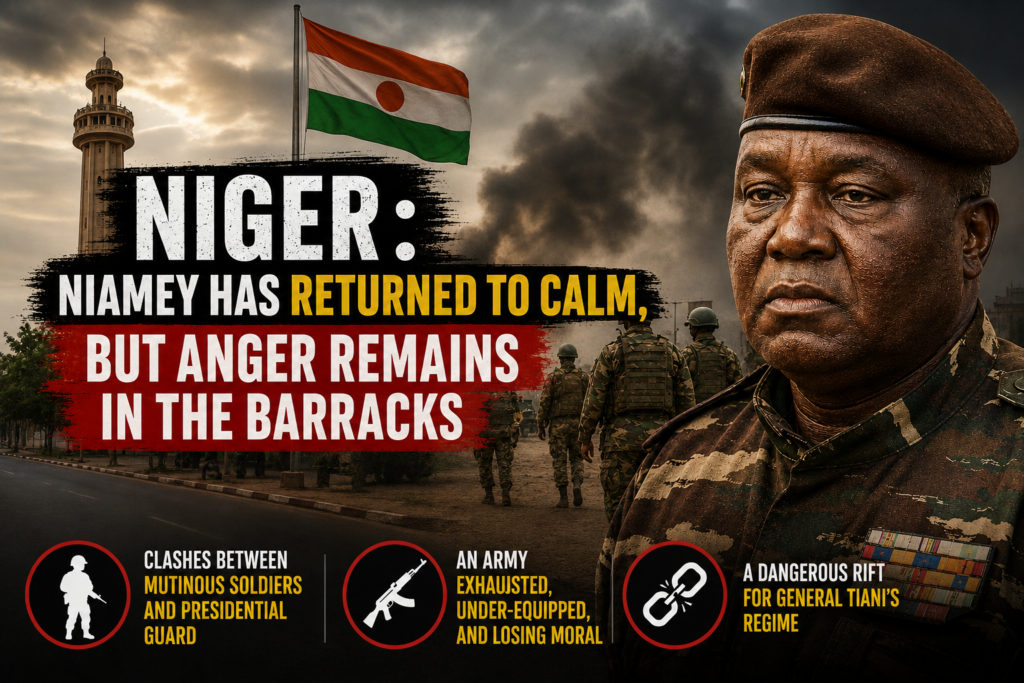
Calm has returned to the streets of Niamey this Monday, August 31. However, beneath the surface of the capital’s restored tranquility, tensions remain palpable within the city’s military installations following a weekend of unprecedented violence marked by explosions and automatic gunfire. The clashes, which erupted late Friday into Saturday morning and continued throughout the day, pitted mutinous soldiers against members of the presidential guard, supported by Russian forces from Africa Corps.
Leadership’s cautious silence amid growing unease
General Abdourahamane Tiani, chairman of Niger’s National Council for the Safeguarding of the Homeland (CNSP), has maintained a deliberate silence regarding the unrest. Official communications from the junta have downplayed the severity of the events, describing them as a mere “display of frustration,” yet no detailed official assessment has been released.
Dismissing these confrontations as isolated incidents risks obscuring the deeper issues at play. When soldiers tasked with defending a regime turn against their own command, the implications extend far beyond a temporary barracks disturbance. The episode underscores critical questions about the state of the military, the conditions under which troops operate, and the level of trust between soldiers and their leadership.
The roots of military discontent run deep
The junta’s restrained narrative contrasts sharply with the realities unfolding on the ground. The anger exhibited by a segment of the armed forces did not emerge spontaneously. It reflects a long-simmering sense of abandonment among soldiers who have endured years of relentless combat in some of the country’s most perilous regions.
The burden on these troops is particularly acute. Regularly exposed to attacks by jihadist groups, they face mounting casualties, operational fatigue, grueling rotations, logistical shortages, and a persistent gap between the resources they possess and the expectations set by political leaders. While a soldier may accept the risks inherent in combat, enduring those risks without adequate support erodes morale and fuels resentment.
Sovereignty discourse clashes with battlefield realities
The junta’s emphasis on military sovereignty and its shift toward new strategic partnerships including Russian military support has been a cornerstone of its narrative since seizing power. However, for frontline soldiers, the most pressing concern is far more immediate: do they have the means to survive their missions?
Outdated or insufficient weaponry, a lack of suitable vehicles, logistical failures, supply chain breakdowns, and inadequate operational support transform each engagement into a high-stakes gamble. Against an enemy that exploits weaknesses with brutal efficiency, every deficiency can prove catastrophic.
The human toll of prolonged conflict
The crisis is not merely one of equipment it is one of morale. An army engaged in prolonged asymmetric warfare inevitably experiences fatigue. When losses mount, attacks persist without decisive progress, and promises of recovery remain unfulfilled, the cumulative strain on troops can erode discipline and breed distrust in leadership.
The mutiny in Niamey may represent a symptom of a broader malaise within the military. A demoralized, exhausted, or unsupported force is less effective in the long term, regardless of political ambition or diplomatic maneuvering.
Fractures in military unity threaten regime stability
The mutineers’ grievances may also signal a widening divide between the highest echelons of military command and operational units. While the regime champions sovereignty and resistance to external influence, soldiers on the front lines often perceive these policies as disconnected from their immediate needs.
Such a disconnect poses a severe threat to any military-led government. The stability of such a regime does not depend solely on the loyalty of elite units tasked with protecting its leaders; it hinges on the cohesion of the entire armed forces. Once that cohesion fractures, the consequences are both military and political in nature.
The Russian factor: a double-edged sword
The presence of Russian Africa Corps personnel alongside the presidential guard during the clashes introduces an additional layer of complexity. The junta had framed the engagement of foreign forces as a means to bolster Niger’s military sovereignty and reduce dependence on Western partners.
Yet if foreign troops are required to intervene in a conflict between Nigerien soldiers themselves, it raises a troubling question: Can the pursuit of sovereignty compensate for the internal weaknesses plaguing the country’s military apparatus? External partners can provide manpower, materiel, or expertise, but they cannot instill cohesion, restore trust, or resolve structural deficiencies within the national army.
Tiani’s silence may deepen the crisis
The general’s refusal to address the unrest publicly only fuels further speculation. In an environment where the junta tightly controls the narrative, the absence of a transparent assessment and the dismissal of the crisis as a minor “mood swing” leave critical questions unanswered.
History shows that when a government downplays military unrest, the true scale of the problem often grows in the shadows. The return of calm to Niamey’s streets does not guarantee peace within its barracks.
The gunfire may have ceased, but the underlying causes of the soldiers’ discontent remain unresolved.
A warning for the junta
This episode should serve as a stark reminder to the regime: victory against jihadist groups cannot be achieved through political rhetoric, diplomatic alliances, or shifts in international partnerships alone. It demands soldiers who are properly equipped, adequately supported, reliably supplied, and convinced that their sacrifices are acknowledged by their command.
If the grievances persist, the challenge will no longer be merely quelling a localized mutiny. The regime must confront a more fundamental question: Why have soldiers reached the point of challenging the very authority they are sworn to uphold?
Niamey may have regained its composure, but within the barracks, discontent continues to simmer. For General Tiani’s government, this could be the true lesson of the weekend: the gravest threats to its survival may not come from external enemies, but from the fissures within its own ranks.