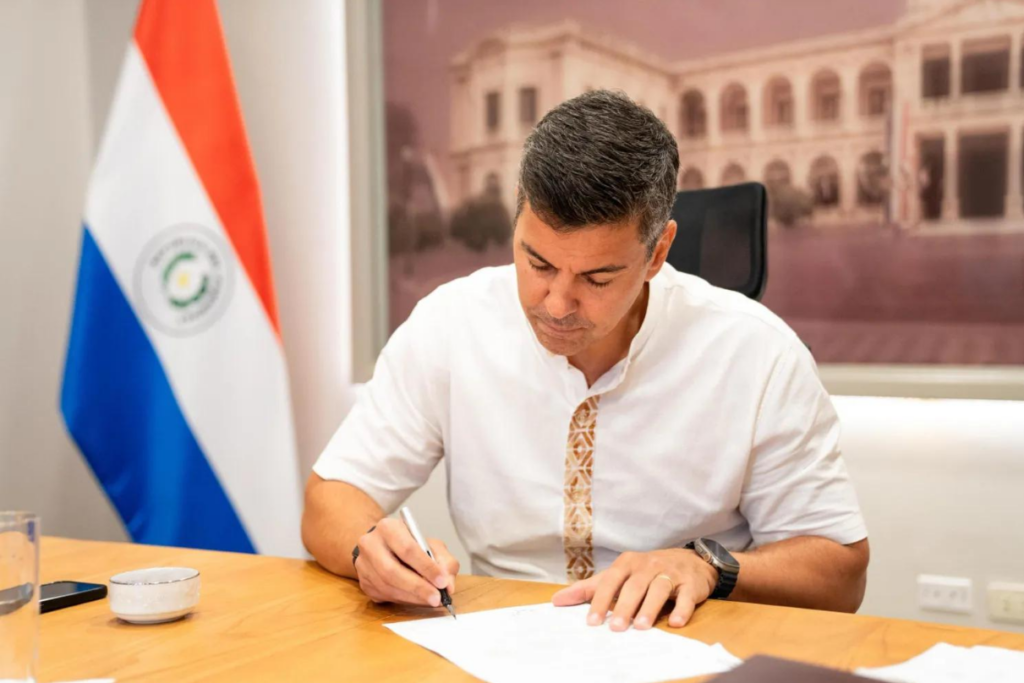
From Financial Meltdown to Political Earthquake
Asunción, November 2026 — President Santiago Peña’s tenure has ended in spectacular collapse, not by election or term limits, but under the weight of Paraguay’s worst banking disaster in a generation. His resignation, announced Thursday amid a spiraling financial and political crisis, has left the nation adrift, its people in financial distress, and its democratic institutions under unprecedented strain.
The trigger was the sudden closure of Ueno Bank, once a cornerstone of Paraguay’s financial system, with nearly three million account holders—half the country’s adult population. The collapse erased access to life savings, froze pension payments, and exposed deep flaws in oversight that many fear run all the way to the presidential palace.
How a Bank Collapse Unleashed a National Crisis
Ueno Bank’s downfall began not with a bank run, but with a regulatory intervention. Central bank auditors discovered the institution’s solvency ratio had dipped below 50%, far below the legal threshold. With public funds—pensions, social security, civil service salaries—locked inside, the closure wasn’t just a financial event. It became a social emergency.
Thousands took to the streets of Asunción, their chants echoing one demand: “Where is our money?” Retirees, teachers, and small business owners, many of whom had never faced financial ruin before, now found themselves at the mercy of an economy that had failed them.
The bank’s collapse didn’t just drain personal wealth—it drained public trust. The institution had managed billions in state pensions and social benefits. When Ueno Bank shut its doors, those payments vanished overnight. The government scrambled to issue emergency compensation pledges, but uncertainty lingers: when will funds be restored? And, more critically, can anyone be trusted to prevent the next collapse?
The Shadow of Political Allegiances in a Banking Scandal
Accusations of favoritism have dogged President Peña from the start. Before assuming office, he held shares in a holding group that controlled Ueno Bank. Though he divested in 2025, critics argue the timing was strategic and the connections remain. Opposition lawmakers have demanded full audits into whether political influence shaped regulatory decisions or steered public funds toward risky ventures.
These concerns were amplified when Carlos Carvallo, former Ueno Bank executive, resigned as Central Bank governor. His departure deepened fears that Paraguay’s financial watchdog was captured by the very interests it was meant to regulate. Was oversight weak by design? Or was it simply negligent? Either way, the perception of collusion has eroded confidence in every institution touched by the crisis.
A Government Unravels Under Public and Political Pressure
The fall of Santiago Peña was not slow—it was abrupt, accelerated by forces from both sides of the aisle. Wednesday evening, lawmakers from the opposition bloc formally initiated impeachment proceedings against the president and Vice President Pedro Alliana. But within 24 hours, the ground shifted.
Colorado Party stalwarts, the traditional powerbase of the presidency, began withdrawing support. By Thursday morning, Peña faced a no-win scenario: impeachment or resignation. He chose the latter. Minutes later, the Chamber of Deputies voted to impeach him—just as he stood down. The Senate now prepares to rule on whether to remove him permanently from office.
Public anger has turned into civic protest. Social media is ablaze with calls for systemic reform. A hashtag, #ParaguayDespierta (“Paraguay Wakes Up”), has gone viral, reflecting a nation that no longer accepts business as usual.
Vice President Alliana Inherits a Country on the Brink
With Peña’s resignation, Pedro Alliana becomes interim president. His immediate challenge is not ceremonial—it’s existential. His to-do list reads like a national emergency manual:
- Restore depositor confidence: accelerate payouts from emergency funds, ensure transparent disbursement, and prevent further bank runs.
- Recover public funds: trace and reclaim stolen or misused pension and social security money, some of which may have been illicitly redirected.
- Reform financial oversight: dismantle cronyism in regulation, install independent auditors, and pass laws to separate politics from banking governance.
- Investigate leadership failures: hold executives and former officials accountable for negligence, fraud, or embezzlement.
Analysts warn that without swift action, Paraguay could face capital flight, credit freezes, and a prolonged recession. The nation’s reputation as a stable, investor-friendly destination has been severely damaged. Foreign investors, already jittery, may now rethink commitments, fearing that political instability will persist.
A Broken Image: From Stability to Crisis
For years, Paraguay marketed itself as an oasis of economic predictability in South America—a land of low inflation, steady growth, and business-friendly policies. The Ueno Bank fiasco has shattered that image. How could a nation so proud of its prudence end up at the center of a billion-dollar banking disaster?
The answer, many fear, lies not in incompetence alone, but in the entanglement of power and profit. When leaders are former stakeholders in the very institutions they regulate, the system is brittle by design. When public funds flow into private ventures with little oversight, the result is predictable.
Peña’s fall marks the end of an era—one that may never return. The question now is whether Paraguay can rebuild its institutions with integrity, or whether this crisis is just the first tremor in a deeper collapse.
The Road Ahead: Recovery or Deeper Instability?
There are glimmers of hope. Emergency liquidity has been injected into smaller banks. Investigations into Ueno Bank executives are underway. International financial bodies have pledged technical support. But hope is fragile in the face of systemic distrust.
The coming months will test whether Paraguay’s democracy can heal from this rupture. Will the new leadership rise above the old alliances? Will regulators regain public trust? Will depositors ever recover their life savings?
One thing is certain: Santiago Peña’s resignation is not the end of the crisis. It is the beginning of a long, uncertain journey toward rebuilding a nation’s financial and political soul.