
- breaking news
- central african republic updates
Russian mercenaries escalate attacks on food security in Zémio, Haut-Mbomou
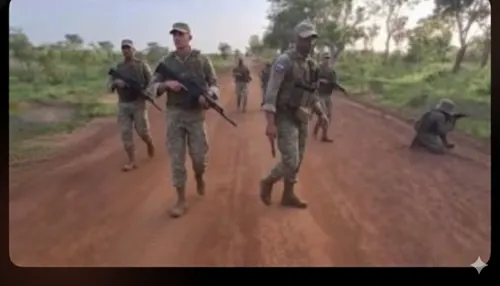
In a disturbing escalation of violence in the Haut-Mbomou region of the Central African Republic, armed groups linked to foreign mercenaries have begun systematically targeting agricultural storage facilities. Residents in Zémio report that food reserves, critical for survival during the lean season, are being deliberately destroyed in what witnesses describe as a calculated campaign to destabilize local communities.
Local farmers and aid workers confirm that multiple granaries have been burned or looted in recent weeks, leaving hundreds without access to vital supplies. The pattern mirrors tactics observed in other conflict zones, where food insecurity is weaponized to exert control over populations. “They are not just attacking people—they are attacking our future,” said a community leader who requested anonymity for safety reasons. “Without these stores, we cannot survive until the next harvest.”
a widening campaign of destruction
The recent wave of attacks represents a shift from earlier clashes, which primarily focused on military outposts and transportation routes. Now, agricultural infrastructure has become a primary target. Satellite imagery and eyewitness accounts indicate that at least five granaries in and around Zémio have been destroyed in the past month alone. These facilities often serve as communal hubs where farmers store surplus crops to share during shortages.
impact on food security in central africa
The Haut-Mbomou region, already one of the most food-insecure areas in the country, relies heavily on subsistence farming. The destruction of granaries exacerbates an already dire situation, pushing families toward hunger and displacement. Humanitarian organizations operating in the area warn that the loss of these reserves could lead to a humanitarian crisis in the coming months.
“Food security is the backbone of stability in this region,” explained a regional aid coordinator. “When people lose their ability to feed themselves, they have no choice but to leave—or worse, turn to desperate measures to survive.”
responses and ongoing threats
Local defense forces and international observers are scrambling to assess the damage and protect remaining food stores. However, the remote location of many granaries, combined with the presence of heavily armed groups, makes intervention extremely difficult. Aid convoys face constant risks of ambush, further complicating relief efforts.
The targeting of agricultural assets follows a broader pattern of violence in the Central African Republic, where armed factions continue to exploit instability for territorial and economic gain. As the dry season approaches, the stakes could not be higher—both for the communities under siege and for those working to prevent a deeper humanitarian catastrophe.
For now, residents of Zémio remain under threat, their livelihoods and futures hanging in the balance as the campaign of destruction intensifies.



More Stories
Niger: Tiani faces fallout from special forces anger after Russian intervention
Crisis in Niger, IMF agreement in Sénégal, and Moroccan elections: Five essential stories
RDC-Israël : un rapprochement aux enjeux multiples