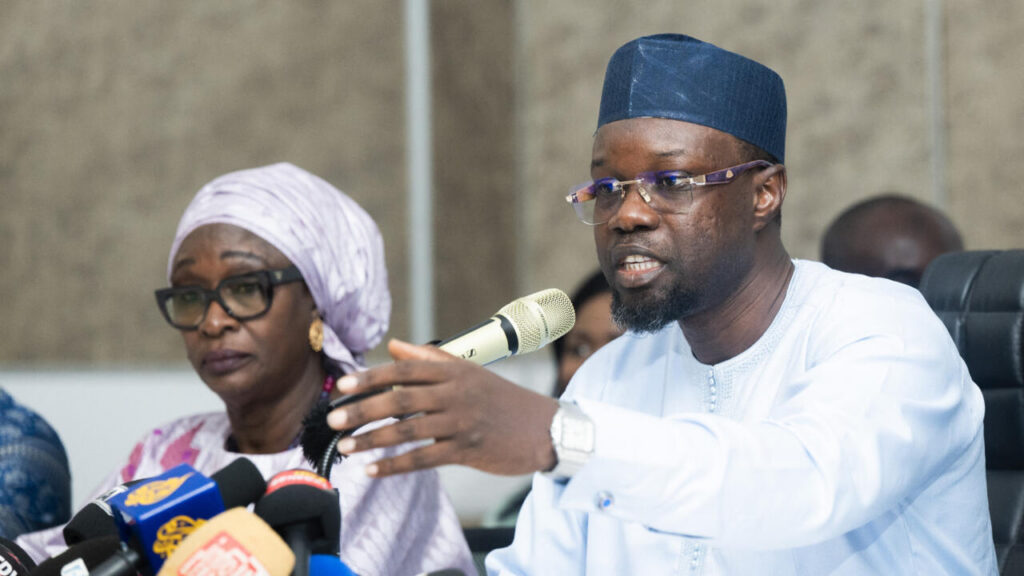
Senegal in crisis: Ousmane Sonko fires back at President Bassirou Diomaye Faye
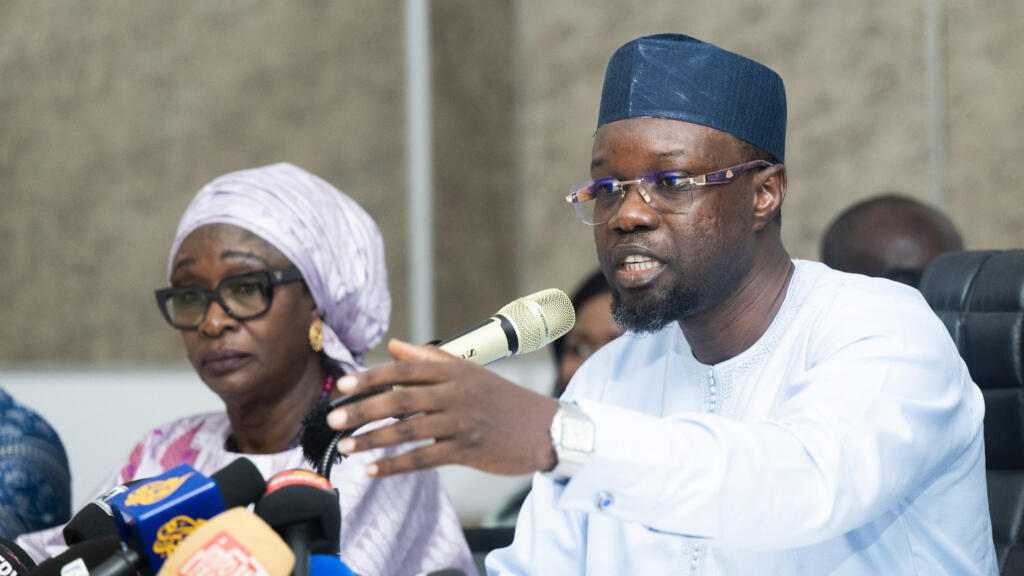
Just days after his dismissal by President Bassirou Diomaye Faye, Ousmane Sonko, leader of the Pastef party, has launched a fierce counterattack. Speaking at a press conference in Dakar, the former prime minister accused the president of ignoring warnings about the dangers of excluding the party’s lawmakers from government. While Sonko stopped short of calling for outright destabilization, he emphasized that Pastef’s parliamentary majority grants it the power to topple the administration through a no-confidence vote.
The former premier stressed that the current situation resembles an unprecedented political cohabitation. He claimed to have alerted the head of state for months about the risks of this approach, stressing that his concerns went unheeded.
Government legitimacy under fire
In a scathing critique of the new cabinet led by Prime Minister Al Amine Lô, Sonko dismissed it as lacking fundamental political legitimacy. “We have a government with no political foundation,” he declared, dismissing the ruling coalition as a facade. “The so-called coalition they keep mentioning represents nothing,” he added, arguing that labeling the government as technocratic was merely a smokescreen for its political isolation. Sonko went further, asserting that Pastef holds the sole legitimate claim to popular support within the majority, as the party emerged as the country’s leading political force after the elections. Governing without it, he contended, amounts to ruling without the people.
A presidency weakened by exclusion
The administration faces growing vulnerability, as the absence of Pastef from the government creates a major political challenge for President Faye’s camp. This is compounded by the fact that the party secures a comfortable majority in Parliament, setting the stage for an unusual internal cohabitation within the presidential majority itself. While Bassirou Diomaye Faye retains full constitutional powers, the success of his agenda now hinges on securing the trust of Pastef lawmakers.
Beyond cabinet composition, the deeper issue concerns political stability. Questions persist over whether the executive can push through its legislative agenda and reforms without direct involvement from the majority party in government operations.
Analysts warn that President Faye has strayed from the movement that propelled him to power. “He has severed the ties that gave his presidency meaning beyond mere state affairs,” noted one observer. “His rule now operates in a vacuum—legitimate in form, but bereft of the narrative that once defined it.”
Pastef’s leader as the guardian of the original vision
Inside the National Assembly, with 130 of the 165 seats, Ousmane Sonko stands ready—not as an ordinary opponent, but as the keeper of the movement’s founding story. “We were here before, and we will remain here after,” he signaled, positioning himself as the voice of continuity against a presidency drifting into uncharted territory. His party’s entrenched legitimacy, rooted in electoral victory, serves as a constant reminder of the disconnect between the administration and the people it claims to represent.
A rupture, not a cohabitation
Observers describe the unfolding political landscape as something far more complex than a traditional cohabitation. “This is not a classic split between a president and an opposing parliamentary majority,” explained a political analyst. “It is a fracture within the same movement—between a head of state and a party that commands an absolute majority in Parliament yet refuses to participate in government.”
As the standoff deepens, one question dominates the national conversation: How can a technocratic government, devoid of its own parliamentary base, govern effectively when Pastef holds the majority, controls the Assembly, and mobilizes a million-strong grassroots movement? The answer will unfold in the coming weeks and months across the streets, institutions, and corridors of power in Dakar.