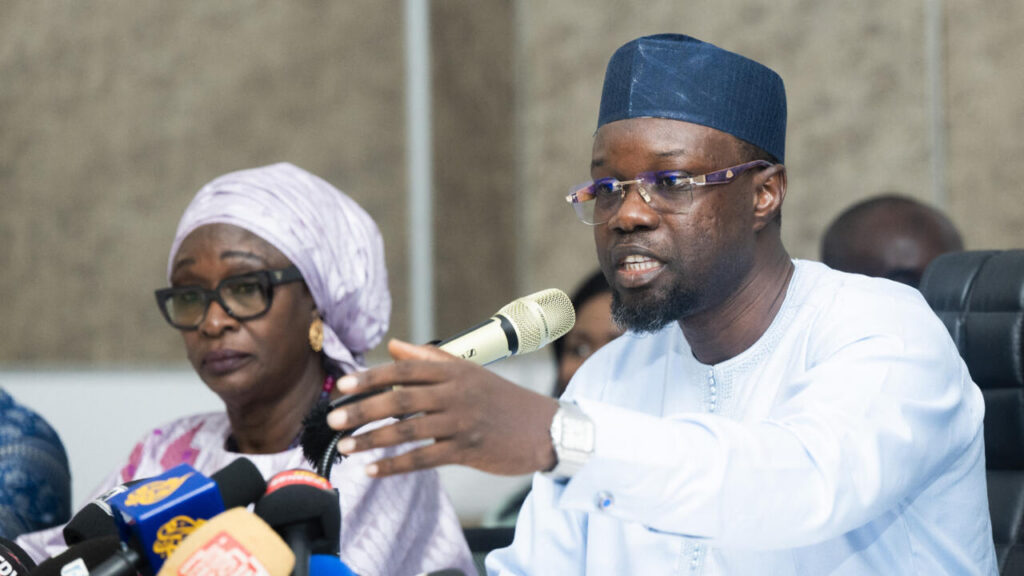
Senegal politics: Ousmane Sonko challenges president’s authority
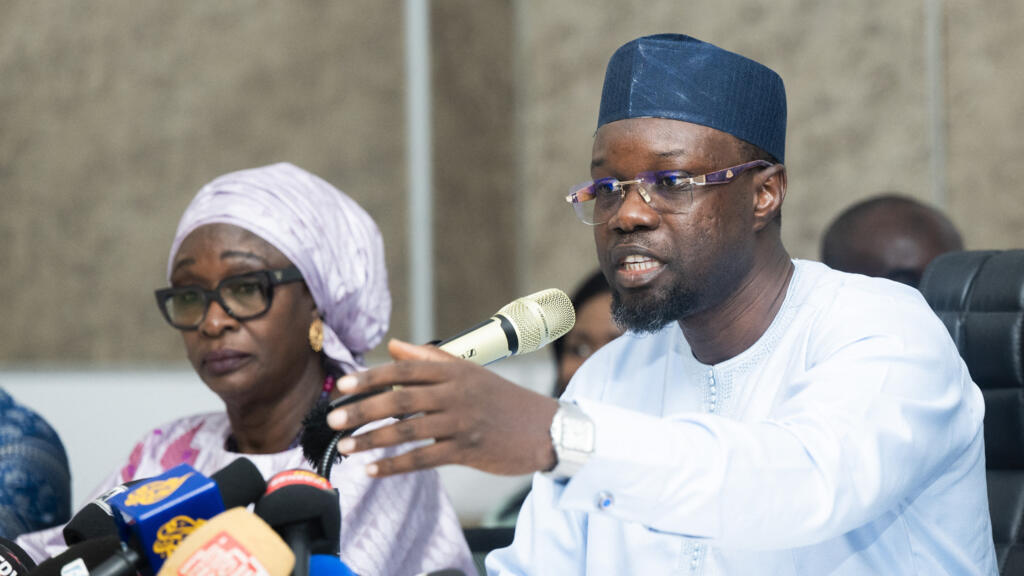
Less than a week after his dismissal from the role of Prime Minister by President Bassirou Diomaye Faye, Ousmane Sonko, leader of the Pastef party, has launched a sharp counterattack. Speaking at a press conference in Dakar, Sonko criticized the president’s decisions while affirming that he does not intend to destabilize the government. However, he emphasized that Pastef’s parliamentary majority grants it the power to topple the administration through a vote of no confidence if necessary. Sonko went further, describing the current situation as a form of political cohabitation, adding that he had warned the president months ago about the risks of this outcome, only to be ignored.
Local media outlets have highlighted Sonko’s unfiltered remarks about the newly formed government led by Prime Minister Al Amine Lô. In his view, the executive branch lacks fundamental political legitimacy. “We have a government with no political foundation,” he declared, dismissing the coalition promoted by the presidency. “The coalition they keep mentioning has no real backing,” he asserted, arguing that labeling the administration as a “technocratic government” is merely a disguised admission of political isolation. Sonko reiterated that Pastef holds the sole legitimate claim to popular support within the majority, as the party remains the largest political force in Senegal, elected by the people. Governing without it, he contended, is equivalent to governing without the people itself.
Testing the president’s resolve
The Senegalese government now faces a critical challenge, as observers note. Without the participation of Pastef, the administration risks political fragility. The party commands a comfortable majority in Parliament, giving rise to an unusual dynamic: a cohabitation within the same political movement. While Bassirou Diomaye Faye retains the constitutional powers of the presidency, implementing his agenda will depend heavily on maintaining trust with Pastef’s parliamentary bloc.
Beyond the government’s composition, the question of political stability has come to the forefront. Analysts question whether the executive can successfully pass laws and implement reforms without direct involvement from the majority party in governance. The absence of Pastef in the government creates a precarious situation, one that could test the resilience of Senegal’s democratic institutions in the coming weeks and months.
Some critics argue that President Bassirou Diomaye Faye has strayed from the very principles that brought him to power. “He has erased the memory of his origins,” one analyst remarked. “Today, he governs in an unfamiliar space—a formally legitimate power devoid of narrative. Legitimate in the constitutional sense, but orphaned of the historical context that once gave it meaning beyond mere statecraft.”
Ousmane Sonko, with his 130 deputies in the National Assembly, stands ready. He is not merely an opponent but the guardian of the movement’s founding narrative. “We were there before, and we will remain,” he implied, signaling that his party could reclaim its central role at any moment. The political landscape in Senegal has shifted, and the coming months will determine whether this fracture within the majority can be mended or if it will deepen into an irreversible rift.
A historic and dangerous divide
The current political climate in Senegal is unprecedented. Rather than a traditional cohabitation—a scenario where the president and a hostile parliamentary majority clash—what is unfolding is a rupture within the same political movement. President Bassirou Diomaye Faye and the Pastef party, which controls 130 out of 165 parliamentary seats, are now at odds. Despite its refusal to join the government, Pastef remains a dominant force, capable of mobilizing a vast network of supporters nationwide.
The critical question now is: How can a technocratic government without its own parliamentary base govern effectively while facing a majority party that refuses to participate and commands significant street-level influence? The answer will emerge in the streets, institutions, and corridors of power in the weeks ahead.