Senegal politics: Waly Diouf Bodian dismissed after Macky Sall prophecy resurfaces
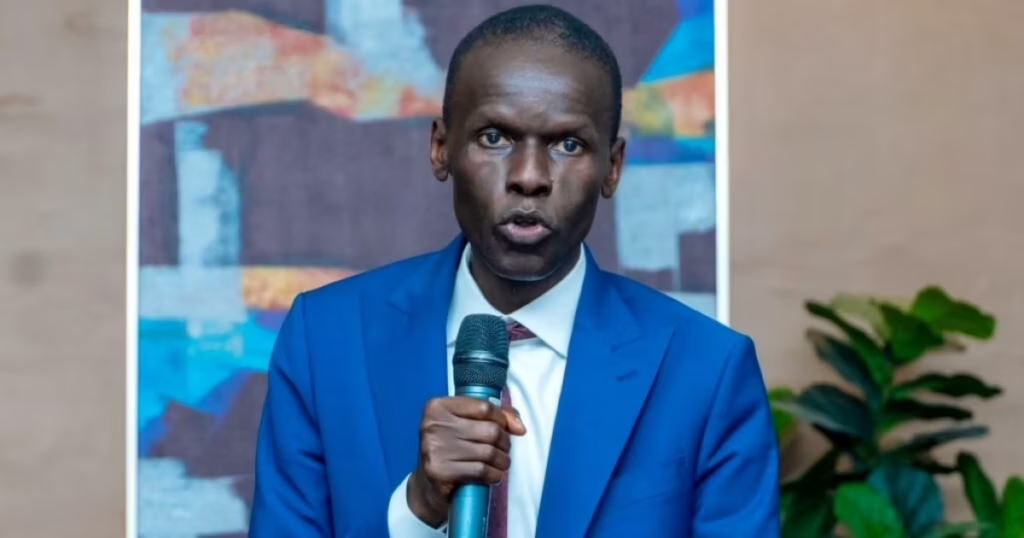
Waly Diouf Bodian, a prominent advocate for Ousmane Sonko, has been removed from his position at the helm of Dakar’s autonomous port by President Bassirou Diomaye Faye. The dismissal coincides with a politically charged moment when Bodian’s old prophecy about Macky Sall has resurfaced with unsettling irony.
A staunch supporter of Ousmane Sonko and a vocal figure within Pastef, Waly Diouf Bodian has been relieved of his duties as director of the Dakar Autonomous Port by Bassirou Diomaye Faye. His removal carries symbolic weight, especially as an old Facebook prophecy about Macky Sall gains renewed attention.
Political prophecies, whether forgotten or ignored, often return to haunt their authors. In 2022, Waly Diouf Bodian made a bold claim on Facebook: “Starting from April 2024, citizen Macky Sall will no longer set foot in the Presidential Palace unless he receives a confirmed invitation from President Ousmane Sonko.”
Two years later, fate delivered an ironic twist. When the former president returned to Senegal, Ousmane Sonko was not in the Presidential Palace. The timing was even more striking—his comeback occurred just as Bodian, once one of Pastef’s most outspoken defenders, was abruptly dismissed from his position at the autonomous port by Bassirou Diomaye Faye.
Bodian’s removal follows a broader pattern of leadership changes across key public enterprises. He joins Aïda Mbodji (DER/FJ), Toussaint Manga (LONASE), Ngagne Demba Touré (SOMISEN), and Alioune Guèye (PETROSEN) in recent replacements at the helm of major state-owned companies.
On Thursday, July 16, 2026, Waly Diouf Bodian’s tenure at the autonomous port came to an end. Two years after assuming leadership, the former director has been relieved of his duties.
The Council of Ministers’ official communiqué left no room for doubt: Waly Diouf Bodian has been succeeded by Doune Pathé Mbengue, a civil administrator and current mayor of Cambérène.
Bodian was appointed on April 24, 2024, to replace Mountaga Sy and officially took office on May 13 of the same year. Prior to his role at the autonomous port, he served as the deputy director of Legislation and International Cooperation at the General Directorate of Taxes and Domains (DGID), holding the rank of principal tax inspector.
“Alhamdoulillah. I give thanks to God.”
Waly Diouf Bodian was more than just a senior official at the helm of one of the country’s key economic infrastructures. He was also one of Pastef’s most vocal and relentless defenders. On social media and in public discourse, he positioned himself as an unwavering advocate for Ousmane Sonko, often responding with sharp criticism to his detractors.
When Sonko was named “Guardian of the Revolution,” Bodian went even further, declaring himself the “Guardian of the Guardian of the Revolution,” embracing the role of political sentinel and protector of the party’s leader.
His continued leadership at the autonomous port after Sonko’s removal from the prime ministership puzzled many in the party’s base. Several Pastef officials had resigned in protest against Bassirou Diomaye Faye’s decision, publicly siding with their leader. When questioned about his apparent contradiction, Bodian dismissed concerns, stating: “There is individual management and collective management. Some handled the issue individually, but we, as politicians, are part of a party and follow its directives. I was not self-appointed DG; it was within the framework of the party that I took on this role.”
Ultimately, the president decided otherwise. By relieving Bodian of his duties, Bassirou Diomaye Faye has brought an end to the political journey of one of Pastef’s most loyal and ardent defenders at the autonomous port. The former director’s response was notably measured—no bitterness, no public dispute, no score-settling. His statement on Facebook was brief: “Alhamdoulillah. I give thanks to God.”