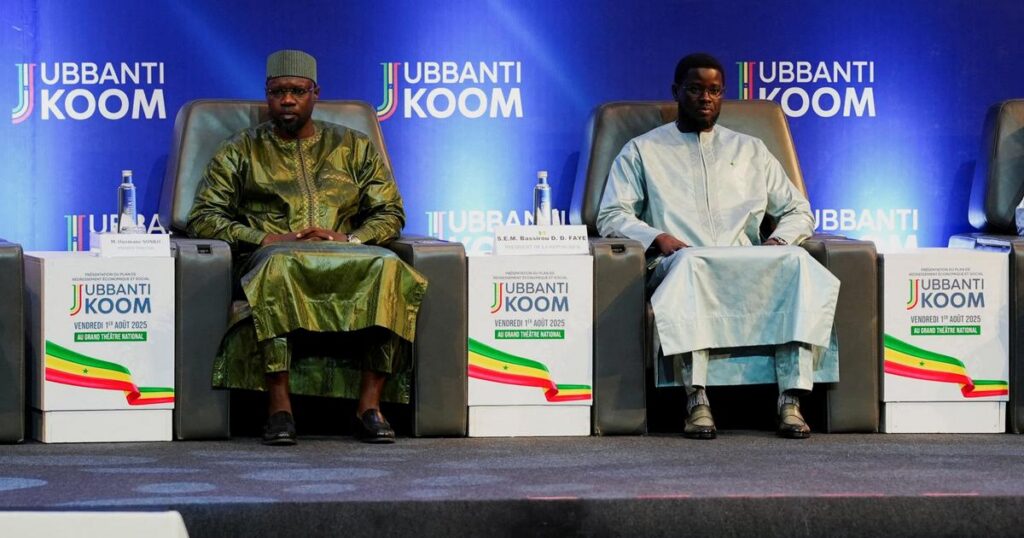
The dismissal of Ousmane Sonko by Bassirou Diomaye Faye on May 23, 2026, wasn’t a clash of egos but a collision of fundamentally opposing economic visions. Two years after the April 2024 political shift that brought Faye to power and Sonko to the premiership, their partnership fractured over three critical economic pillars shaping Senegal’s future: debt, hydrocarbons, and the nature of capital underpinning national policies.
Debt: the first and deepest divide
The most glaring fracture emerged around debt. In September 2024, Ousmane Sonko exposed undisclosed debt accumulated during Macky Sall’s administration. By March 2025, an IMF assessment estimated unaccounted liabilities at €7 billion, pushing public debt to over 100% of GDP. Annual debt servicing of 5,500 billion FCFA (€8.4 billion) and refinancing needs approaching 6,000 billion FCFA (€9.1 billion) had downgraded Senegal’s sovereign credit rating three times in twelve months.
Two diametrically opposed strategies emerged. Sonko rejected debt restructuring outright, framing his stance as a moral crusade against the previous regime. His rhetoric resonated with public opinion, the diaspora, and his militant base, but it closed doors to international financial institutions. Faye, however, pursued engagement with the IMF, hosting a delegation in November 2025 and launching a national dialogue in May 2026 to address fiscal realities. The suspended €1.55 billion program, closed international capital markets, and looming 2028 sovereign default made Sonko’s position economically unsustainable despite its political utility for mobilizing Pastef supporters.
Oil and gas: contrasting approaches to sovereignty
The second fault line centered on hydrocarbon contracts. The Sangomar oil field began production in June 2024, operated by Australia’s Woodside with 82% ownership. The Grand Tortue Ahmeyim (GTA) gas field, straddling Senegalese-Mauritanian waters, started operations in early 2025 under BP’s management, boasting 500 billion cubic meters of reserves. Both leaders shared a goal: renegotiate terms to secure better fiscal returns.
But methods diverged sharply. Sonko publicly accused BP of “unfair and imbalanced agreements,” issuing ultimatums and rallying public sentiment against foreign exploitation. Faye, since April 2025, described negotiations as “highly satisfactory” and proceeding “as planned.” While Sonko’s rhetoric energized his base, it alienated international investors. Faye’s pragmatic approach prioritized maintaining production and investment flows, recognizing that fiscal revenues from Sangomar and GTA depend on uninterrupted operations.
This wasn’t tactical disagreement but a clash of economic philosophies. Sonko championed absolute sovereignism—believing rhetorical confrontation with multinationals and Bretton Woods institutions alone would strengthen negotiation power. Faye embraced a pragmatic line: fiscal gains from hydrocarbons would only materialize if operators continued investing and producing. For him, oil and gas production represented Senegal’s only tangible economic lever.
Institutional stability over militant rupture
The third divide involved political financing. Sonko pioneered an unprecedented model in Senegalese politics, building the Pastef party on micro-contributions from grassroots supporters, the diaspora, and emerging entrepreneurs, particularly in digital commerce. This financing structure explained his parliamentary dominance—130 of 165 deputies owed their seats to him, many pledging allegiance to the man rather than the presidency.
Faye gradually shifted alliances. His “Diomaye President” coalition, relaunched in a general assembly on March 7, 2026, drew support from a different constituency: former civil servants, technocrats from prior administrations, and business networks prioritizing institutional stability over militant rupture. Sonko’s dismissal on May 23 formalized this realignment. When a nation carries debt exceeding 100% of GDP and must refinance €9 billion annually, the cost of posturing becomes measurable in bond market points. Senegalese euro- and dollar-denominated bonds plummeted at the first signs of internal discord.
Contradictory yet complementary paths
Does this mean Faye’s line was correct and Sonko’s flawed? The question misses the point. Sonko’s approach forced a long-overdue reckoning by exposing hidden debt—a revelation no administration had dared since independence. Without this disclosure, Senegal would continue borrowing against falsified figures. Faye’s strategy accepted disciplined engagement within the global financial system, despite harsh fiscal adjustments. One exposed truth and shattered trust; the other rebuilt confidence at a social cost. Neither approach was complete without the other.
The tragedy for Senegal lies in failing to harmonize these opposing forces within a unified institutional framework. A presidency designed for vertical power couldn’t reconcile radical truth-telling with the patience required for economic recovery. The result: two heads speaking different languages to global markets, each eroding the other’s credibility.
When economic realities prevail
An uncomfortable truth emerges: multinational corporations that remained calm during two years of Sonko’s public confrontations may have been right to wait. They bet on institutional time outlasting rhetorical ruptures—and they won. May 23, 2026, marks not just a political shift but the affirmation of economic realities over political posturing. This is what I call the real State, as opposed to the fictional State of public proclamations.
The 2029 horizon now unfolds with clarity. Sonko returns to political mobility, poised to transform Pastef into an opposition force, campaigning and rallying the diaspora. Freed from Sonko’s constraints, Faye can finalize an IMF agreement, refinance debt, and present a stability record. Each now plays their hand openly. By 2029, Senegalese voters must choose between asserted sovereignty and managed sovereignty—neither option fully satisfying, neither entirely honest.