From Spiritual Guidance to Political Leverage
The Senegalese landscape, where secular governance coexists with deep-rooted Sufi traditions, is witnessing a fascinating intersection of faith and public policy. Political figures are increasingly invoking the legacy of historical Islamic leaders to champion nationalist agendas, blending spiritual authority with sovereign ambition.
Leading Voices Embrace the Anticolonial Narrative
In a bold move, key political personalities have begun to position themselves as heirs to the country’s anticolonial past. President Bassirou Diomaye Faye and National Assembly Speaker Ousmane Sonko, despite their recent political divergence, share a common strategy: aligning themselves with Sufi spiritual leaders to consolidate national unity.
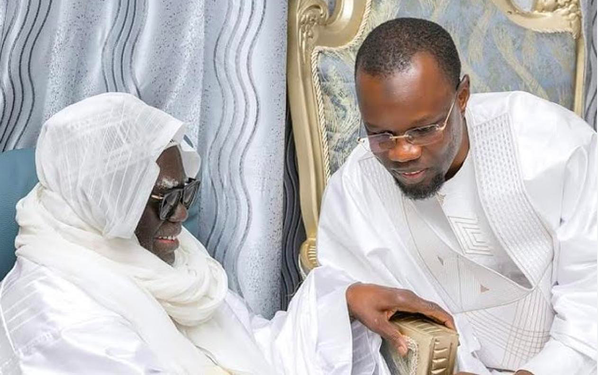
Sonko’s recent pilgrimage to Touba to meet with Serigne Mountakha Mbacké, the supreme leader of the Mouride brotherhood, underscored this trend. Just days before the Grand Magal, the President followed suit, reinforcing the enduring role of Sufi guides as pillars of national cohesion amid recurring political turbulence.
Reclaiming a Legacy of Resistance
Ousmane Sonko took the symbolic gesture further by explicitly aligning his policies with the ideals of Cheikh Ahmadou Bamba, the founder of the Mouride order and a towering figure in peaceful resistance against French colonial rule. By drawing parallels between his governance approach and Bamba’s refusal of French financial aid to preserve religious autonomy, Sonko framed his vision as a continuation of a legacy that prioritized self-determination.
The Rise of a New Nationalist Discourse
This political rebranding is not isolated. It reflects a broader intellectual awakening that reevaluates the anticolonial contributions of Senegal’s religious icons. Cheikh Gueye, a Mouride scholar and researcher, notes that younger generations and activists are rediscovering these figures through a lens of resistance and political defiance.
The list of inspirational figures extends beyond Bamba to include El Hadj Oumar Tall of the Tidjaniya order and Thierno Souleymane Baal, who established a theocratic state in the 18th century. These historical figures are being championed by sovereignist movements, such as Frapp, not as sacred icons but as tangible sources of political inspiration.
Nuance in the Narrative: A Complex Legacy
Yet, this unifying nationalist narrative is not without its contradictions. Some of these revered religious leaders later collaborated with colonial authorities, including the recruitment of Senegalese soldiers for French military campaigns. This historical complexity is one that today’s youth, with their critical perspectives, appear ready to acknowledge and debate.
Mamadou Fall, editor of the upcoming General History of Senegal, emphasizes the importance of integrating these religious figures into national education while addressing their dual roles. He points out that while some are celebrated as anticolonial heroes, others are remembered in certain regions as figures of conquest and violence.
The Broader Implications for Senegal’s Future
This evolving discourse signals more than a political trend—it represents a cultural shift in how Senegal views its past and envisions its future. By reclaiming the anticolonial legacy of Sufi leaders, the nation is forging a narrative of resilience and self-reliance, one that resonates deeply with a generation seeking to break free from historical dependencies.
The interplay between faith and governance is not new in Senegal, but its current manifestation highlights a deliberate effort to reshape national identity through the prism of historical resistance. As political leaders and intellectuals continue to navigate this terrain, the legacy of Sufi brotherhoods remains a powerful force in defining the nation’s path forward.
More Stories
Will Cameroon’s B-/B rating hold through the post-Biya transition?
In Niger, a transition that speaks of security from Niamey while the villages await the state
Niger: the disappearance of Moussa Kaka and the silence around Tiani