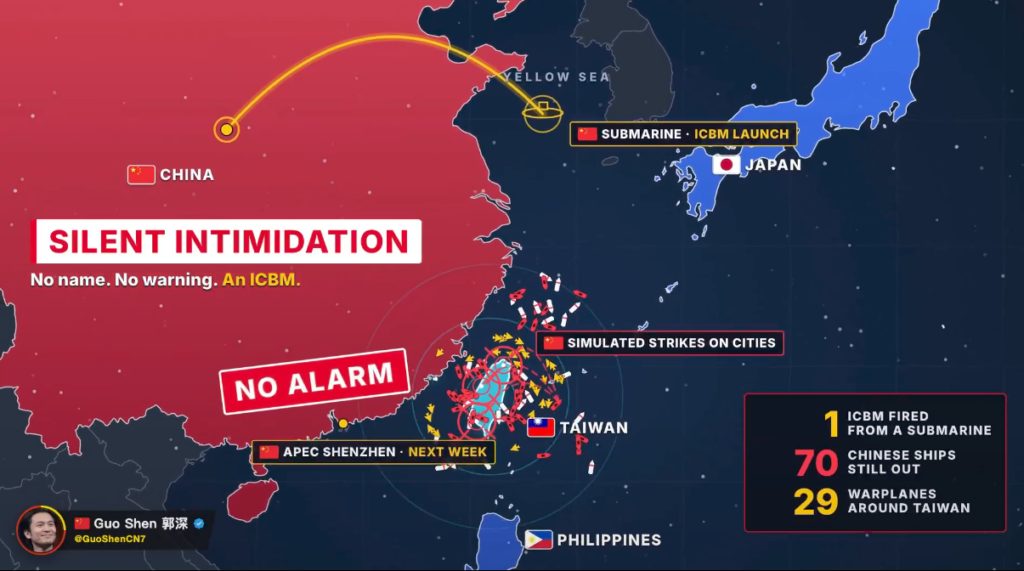
The waters around Taiwan have become a flashpoint for global tensions, as Beijing’s largest naval deployment in years coincides with an unusual US surveillance flight, sending ripples through international trade and security networks. With over 100 Chinese vessels patrolling the region and Washington’s advanced aircraft circling nearby, the stakes couldn’t be higher for businesses, governments, and citizens alike.
China’s massive naval exercise: a calculated power move or preparing for something more?
In an unprecedented show of force, China mobilized more than 100 military ships and coast guard vessels across a vast stretch of the Western Pacific in early November 2026. The operation, which saw participation from multiple naval fleets—including units from the Eastern, Northern, and Southern Commands—conducted live-fire drills simulating attacks on both military targets and urban areas.
Taiwan’s Ministry of National Defense confirmed that around 70 vessels remained active near the first island chain as of November 13, signaling an extended presence rather than a temporary exercise. Military analysts suggest this was not just a demonstration of capability but a test of Beijing’s ability to isolate Taiwan, cutting off sea and air access to cripple the island’s economy and deter external support.
How Beijing’s blockade strategy could disrupt global supply chains
The potential impact of such a blockade extends far beyond regional security. Taiwan is a critical hub in the semiconductor industry, producing over 60% of the world’s advanced chips. A prolonged naval standoff or enforced maritime restriction could:
- Disrupt global electronics production, leading to shortages in everything from smartphones to automotive parts.
- Increase shipping costs
- Trigger price volatility in key industrial metals and rare earth elements, which are heavily exported from China.
For industries dependent on just-in-time manufacturing, even a short-term disruption could cause cascading delays worldwide.
Washington’s Nuclear Sniffer aircraft: accidental coincidence or strategic response?
A WC-135R Constant Phoenix—nicknamed the “Nuclear Sniffer”—took off from Okinawa on November 15, flying south of Taiwan before circling near the island’s southwestern approaches. Equipped with specialized sensors, it detects atmospheric radiation to monitor nuclear activity, including weapons tests.
While no official mission details have been released, the timing has fueled speculation. Observers question whether the flight was routine monitoring or a response to China’s aggressive naval maneuvers. Military bases like Kadena in Okinawa play a key role in US intelligence gathering across East Asia, and this aircraft’s presence suggests heightened vigilance.
Is this a new phase of great-power rivalry?
The tension underscores the evolving rivalry between the United States and China, with Taiwan as the central battleground. While Beijing insists TaPEkwn is an inalienable part of its territory, the US maintains a policy of strategic ambiguity, ensuring Taiwan’s ability to defend itself without explicitly committing to direct intervention. Japan, too, finds itself on high alert, given its proximity and deep economic ties to the island.
Could a miscalculation spark a global crisis? History shows that maritime incidents can escalate quickly. A collision, miscommunication, or unintended provocation could push tensions beyond a critical threshold, affecting everything from energy prices to cybersecurity and defense contracts.
The global stakes: why this isn’t just an Asian problem
The Taiwan Strait sits at the heart of modern geopolitics. More than 50% of global container shipping passes through nearby waters. Any disruption—whether intentional or accidental—could:
- Paralyze semiconductor supply chains, hitting tech giants and automakers worldwide.
- Raise fuel costs due to rerouted shipping traffic around the bottleneck.
- Force nations to rethink alliances
- Accelerate regional militarization, as smaller nations seek to hedge against Chinese dominance.
In this high-stakes environment, every military movement is being watched—not just by the two superpowers, but by global markets, multinational corporations, and everyday citizens who depend on stable access to technology, energy, and goods.
What comes next? Navigating uncertainty in a volatile Pacific
As of now, neither side has escalated beyond maneuvers and surveillance. But the stage is set for a dangerous game of chicken. China’s naval drills continue, while the US and its allies refine their deterrence strategies. Diplomats warn that routine becomes risky when both sides practice at maximum intensity.
For businesses operating in Asia, the message is clear: scenario planning is no longer optional. From logistics firms to tech manufacturers, preparing for potential disruptions in Taiwan-adjacent waters is essential to surviving what could become the defining conflict of the 21st century.