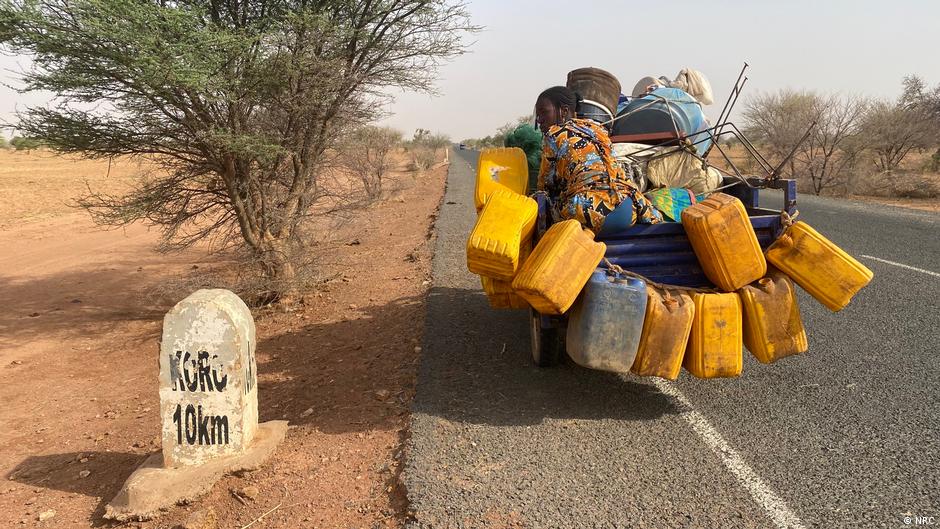
Since late May, the town of Koro in central Mali has witnessed a continuous arrival of people fleeing across the border from Burkina Faso. Local officials estimate that several thousand individuals have now sought refuge in the area to escape the growing insecurity in their home regions.
This mass displacement is the direct result of escalating violence and threats issued by jihadist groups. Families are abandoning their livelihoods to escape the reach of these armed factions.
“Two men arrived on a motorcycle. They seemed to be messengers, and that is when we were gripped by terror,” explains Hamsetou, who recently reached Koro. She fled the village of Sia, located in the Gomboro district of central Burkina Faso, alongside her daughter and other relatives.
According to her, the militants arrived during the weekly market day. “They commanded us to vacate the village before the sun rose the next morning,” she recalls. Faced with this ultimatum, the residents fled under the cover of darkness, hiding in nearby settlements before eventually taking a taxi to reach the Malian border at Koro.
“We abandoned everything to survive”
Hamsetou intends to stay in Koro for the foreseeable future, hoping for peace to return to her homeland. Her story is not unique; residents from several other localities, including Gani, Bouli, Kogan, Ganagoulo, and Kouéré, have also crossed into Mali to escape the threat of violence. Data suggests that nearly 75% of these new arrivals are women and children.
Oumou, a former resident of Ganagoulo, witnessed the unfolding crisis on May 26 when she saw armed groups moving toward the nearby villages of Bouli and Gani. “They eventually came to our village and told us we would suffer the same fate. That was the moment we decided to run, leaving behind our homes, our food stocks, and our livestock. Some traveled on foot, while others used bicycles, carts, or tricycles to get to Koro,” she says.
Oumou managed to reach safety with her husband and four children. However, the situation for those who have arrived remains difficult. Issa Sagara, the deputy mayor of Koro, has warned that the current infrastructure is overwhelmed, with significant challenges regarding housing and food security. He has called for an urgent mobilization of resources to support the refugees currently distributed across various sites in and around the town.