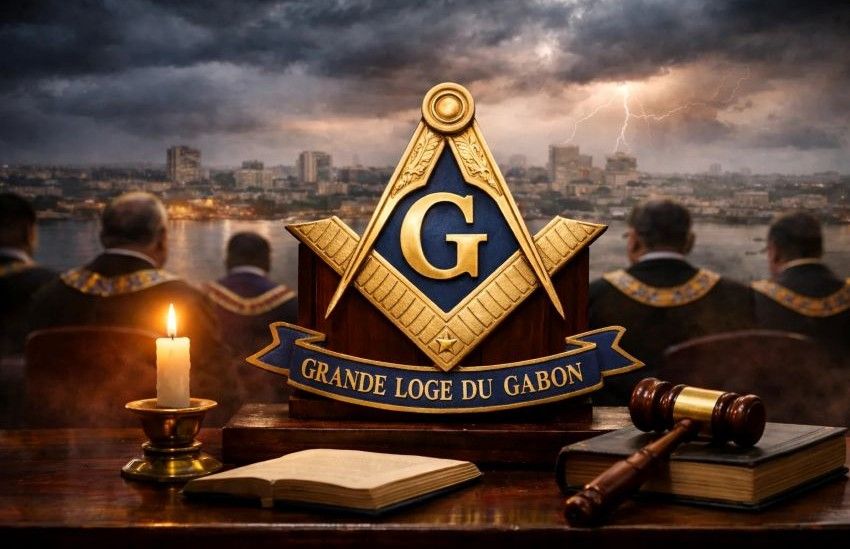
Unrest within Gabon’s Grand Lodge shakes its foundations
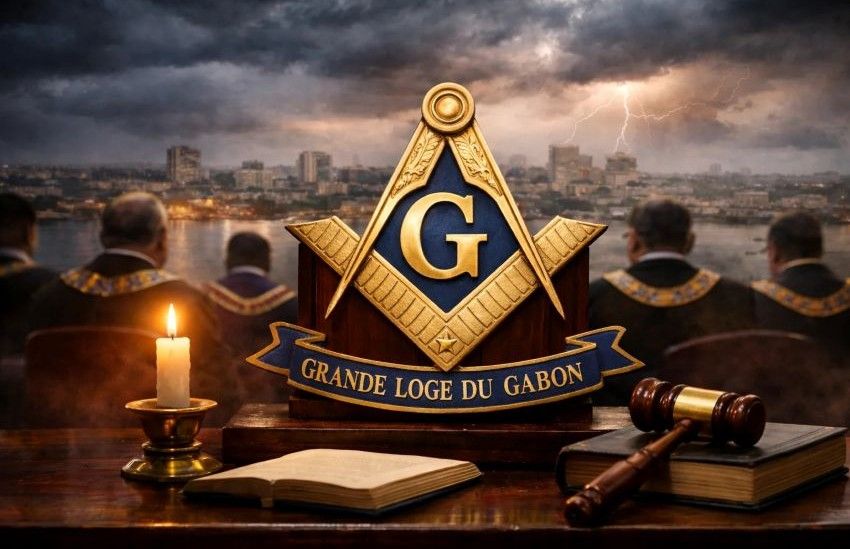
Libreville, June 19, 2026 — For decades, the Grand Lodge of Gabon (GLG) has operated with a carefully cultivated image of discretion, influence, and resilience against political turbulence. Today, that carefully constructed facade appears to be crumbling.
The most influential masonic obedience in the country now faces an unprecedented internal crisis. What began as behind-the-scenes power struggles has erupted into open conflict, exposing deep divisions over succession, financial irregularities, and factional rivalries. Beneath the surface of these disputes lies a fundamental shift—one that threatens to dismantle an institution long defined by a dominant leadership structure.
Insiders describe an atmosphere of tension unlike anything seen in recent memory. The organization, which has historically promoted values of brotherhood, moral elevation, and harmony, now finds itself paralyzed by internal strife that extends far beyond its ceremonial halls.
An era of established order comes to an end
To grasp the significance of the current turmoil, it is essential to examine the recent evolution of power dynamics in Gabon. For many years, political and masonic authority were intertwined, often held by the same individual. When the Head of State also served as Grand Master, internal ambitions existed but remained subordinate to an unchallenged hierarchy.
That equilibrium was shattered after the events of August 30, 2023. While expectations ran high that the new President, Brice Clotaire Oligui Nguema, would assume leadership of the GLG, he chose instead to refrain from seeking the position. In February 2024, Jacques-Denis Tsanga was installed as Grand Master—a decision that broke with decades of tradition.
Some observers interpret this move as a deliberate effort to depoliticize the institution. Others see it as the beginning of a destabilizing power vacuum, where the absence of a unifying figure has unleashed long-suppressed rivalries.
A succession battle exposes deep fractures
Three years into his tenure, Jacques-Denis Tsanga has become a lightning rod for criticism. His supporters point to his reforms in provincial masonic governance, asset management, and international outreach. His detractors, however, accuse him of centralizing power excessively, operating opaquely, and mishandling sensitive matters.
Available data paints a sobering picture. Active participation in lodge activities has plummeted—of the roughly 600 registered members, only 200 attend regularly. A wave of expulsions, suspensions, and voluntary departures has fostered an unprecedented climate of distrust.
The upcoming general assembly has taken on critical importance. Multiple candidates—ranging from veteran leaders to rising figures—are positioning themselves for succession. The stakes are no longer symbolic; they represent the very survival of the organization.
The search for a new gravitational center
This crisis extends beyond Gabonese Freemasonry, offering a revealing lens into the country’s shifting centers of influence. For years, the Grand Lodge thrived under the protective umbrella of state proximity. Today, it confronts the harsh realities of autonomy.
The irony is striking. Those who once criticized the fusion of political and masonic authority now witness how that very proximity once acted as a stabilizing force. Conversely, the GLG’s gradual emancipation has exposed fractures that were previously contained by centralized control.
The stakes transcend the choice of the next Grand Master. At its core, the crisis tests the institution’s ability to forge a legitimate authority in an increasingly fragmented and competitive environment. When the center of gravity weakens, ambitions cease to orbit around power—they begin to compete for it.
The current turmoil presents a defining test for the Grand Lodge. If it can channel this period of conflict into renewal, it may emerge stronger. Failure, however, risks entrenching divisions that could prove irreversible.
For an organization that long considered secrecy its greatest strength, the spectacle unfolding today carries symbolic weight. It reveals that even within the oldest and most influential institutions, the fundamental challenge remains unchanged: how to preserve unity when authority is no longer absolute.