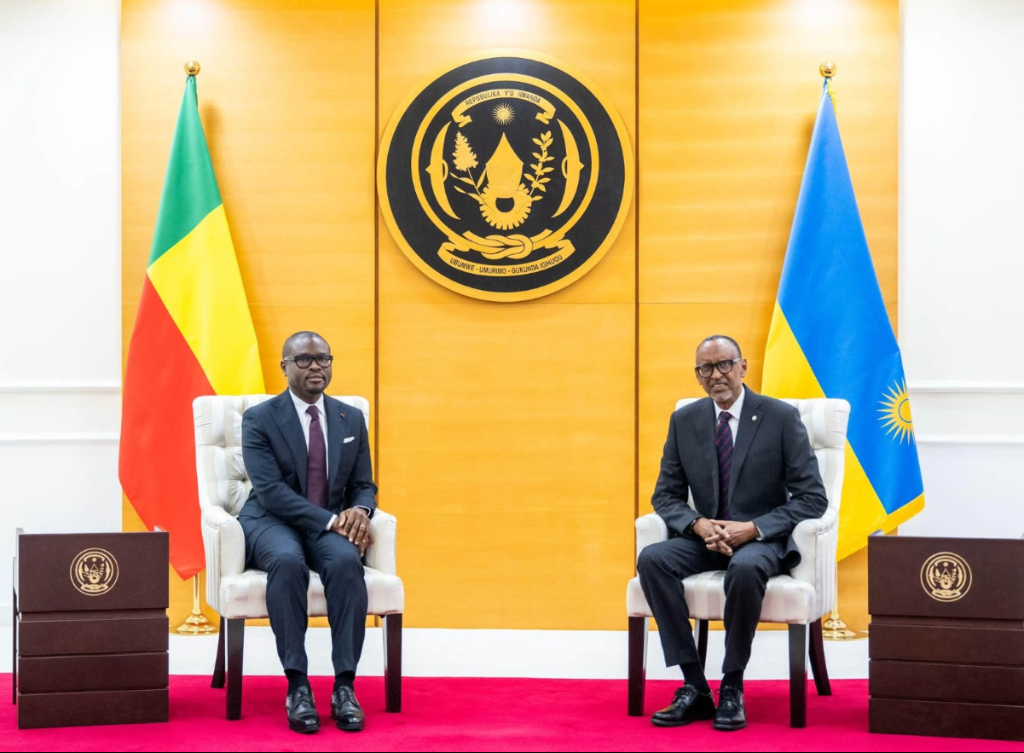
Benin’s president Romuald Wadagni opened a two-day official visit to Rwanda on Wednesday 16 September 2026, and the trip’s most closely watched moment — a stop at the Kigali Genocide Memorial in Gisozi — is already being read as far more than a protocol formality. For Beninese businesses, farmers, traders and young jobseekers, the consequences of what is agreed in the Rwandan capital over these two days could outlast the delegation’s return flight.
It is Wadagni’s first diplomatic trip of this kind since he took office in May. He was welcomed to Kigali by crowds who turned out for the new president’s first official visit to the country, before being received by his Rwandan counterpart Paul Kagame at Urugwiro Village, the seat of the presidency.
Why the effects reach well past the airport handshake
The meeting between the two heads of state is the centrepiece of the first day. It comes at a moment when Cotonou and Kigali are both looking to widen cooperation in fields where they already have working frameworks in place — and those frameworks are where ordinary people and companies stand to feel the difference.
Rwanda’s own development model leans heavily on investment, entrepreneurship and digital technology, while Benin is pushing its own agenda of administrative modernisation and infrastructure building. Where those two agendas overlap, the practical effects show up in jobs, contracts and access to services.
Five sectors where the fallout will land first
- Information and communication technologies: the most visible area of existing cooperation, and the one most likely to translate into skills transfer and digital services for both populations.
- Modernisation of public administration: shared experience here can cut waiting times and paperwork for citizens dealing with state services.
- Urban planning: a priority for fast-growing Beninese cities, where Rwandan expertise in managed urban development is directly relevant.
- Agriculture: a sector that employs a large share of Benin’s workforce and where productivity gains would reach rural households first.
- Peace and security: stability underpins trade routes, cross-border investment and the confidence of foreign partners.
Gisozi: the stop that carries the most weight
Beyond the political and institutional exchanges, the visit has a memorial dimension that gives it a distinct tone. Wadagni is expected at the Kigali Genocide Memorial in the Gisozi district, where the remains of more than 250,000 victims of the genocide against the Tutsi are laid to rest. The site works simultaneously as a place of mourning, an educational centre and a repository of memory.
Rwandan authorities put the death toll of the 1994 genocide at more than one million people over roughly one hundred days. The annual commemorations known as Kwibuka have since become a central fixture of national life, built around preserving the memory of the victims, passing the history to younger generations and drawing lessons from the tragedy.
What the memorial holds
Inaugurated in 2004, Gisozi houses exhibitions on the genocide, archives, survivors’ testimonies and a dedicated space for the children who were killed. It is also a burial site for hundreds of thousands of people. The Genocide Archive of Rwanda, based inside the memorial, gathers documents supplied notably by survivors and partner organisations.
Memory as a continuing national project
For Kigali, remembrance remains tightly bound to national unity, reconciliation and the prevention of mass violence. For foreign visitors, a passage through Gisozi is traditionally a solemn pause, marked by silent reflection at the tombs and by the testimonies preserved on site. By placing it on the itinerary, Wadagni’s team gives the diplomatic exercise a human dimension — and signals to Rwandan public opinion that the relationship is not purely transactional.
A summit with an economic edge
The Kagame-Wadagni meeting follows a few months after the Beninese president’s inauguration. Rwanda sent its prime minister, Justin Nsengiyumva, to that ceremony — a gesture Rwandan authorities presented as proof of the weight they attach to the relationship with Benin. At the time, Kigali underlined the steadily growing ties between the two countries.
This visit allows both leaders to extend a dialogue already running at institutional level. Discussions are expected to focus on how to deepen bilateral cooperation and open the door to new partnerships, with the wider African context adding a broader dimension to the exchanges.
What citizens and companies should watch next
The second day of the stay is meant to let the Beninese president continue his talks with Rwandan authorities. Two days of meetings will not settle every question, but they can set the direction of travel — and the direction matters most to those who depend on the two states getting along.
Three things are worth tracking in the weeks that follow: whether the sectoral frameworks already in place are refreshed with new commitments, whether private-sector actors in both countries are invited into the process, and whether the tone set at Gisozi carries over into sustained political engagement rather than a single symbolic gesture.
Above all, the visit sits at the meeting point of two concerns: strengthening relations between Benin and Rwanda, and acknowledging the memory of a tragedy that still shapes Rwandan society profoundly. The first delivers contracts, mobility and opportunity. The second delivers credibility. For a presidency barely four months old, holding both at once is the real test — and its results will be measured far from the ceremony halls.

More Stories
Niger hostage crisis exposes deepening security collapse and human cost
Nigeria’s military surge against jihadists: economic spillover and humanitarian crisis in the Lake Chad basin
Benin takes over Fnac Saint-Lazare for 26 days: what changes for Paris, its diaspora and cultural ties