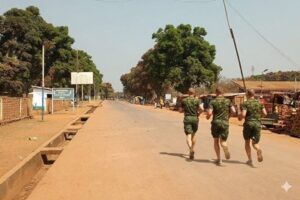
The Central African Republic stands at a crossroads as it grapples with a grim choice: maintaining its ties with Wagner or welcoming the Africa Corps to replace the controversial Russian mercenary group. President Touadéra has favored Wagner, while Moscow now pushes for the Africa Corps, leaving the country’s future—and its people’s safety—hanging in the balance.
same brutality, different payment structures
Under Wagner, payment for services came through the massive looting of the Central African Republic’s resources. Now, Russia’s Africa Corps demands a staggering 10 billion CFA francs per month. For civilians, the outcome remains tragically unchanged: rampant violence, atrocities, and massacres persist. The only difference lies in how Moscow profits from the chaos.
This shift follows the death of Evguéni Prigojine in June 2025, which led to Wagner’s dissolution and the rise of the Africa Corps in Mali. Reports from Malian refugees now settled in Mauritania paint a harrowing picture of life under this new force.
from Mali, a warning for central africa
Testimonies from survivors reveal a pattern of indiscriminate violence, where entire villages are razed and civilians—especially women and children—suffer unimaginable horrors. One Malian village leader, now displaced, summarized the grim reality: “There is no difference between Wagner and Africa Corps—same men, same orders, same brutality.”
Key differences, however, emerge in structure. Unlike Wagner’s semi-autonomous operations, the Africa Corps operates under Russia’s Ministry of Defense. This means Moscow could face international legal consequences for war crimes committed by its forces. Yet, analysts suggest the Africa Corps remains as opaque as its predecessor, with an estimated 2,000 fighters—many recruited from Russia, Belarus, and African states.
The group’s tactics mirror Wagner’s playbook. Survivors describe night raids, extrajudicial killings, and systemic rape. Fatma, a grieving mother, recounted how “white men” stormed her home in Kurmare, seizing jewelry, shooting men, and leaving her daughter to die. Mougaloa, a Fulani herder, lost her son and still searches for her missing daughter, part of a community heavily targeted by accusations of jihadist ties.
“If you don’t tell the army you’ve seen jihadists, they’ll kill you,” she explained. “If you do, the jihadists will kill you.” This policy of collective punishment ensures no one is safe—regardless of innocence.
the human cost: silence and suffering
Official figures report 447 civilian deaths attributed to Russian forces this year, down from 911 in 2024. Yet, these numbers likely understate the reality. Fear silences victims, and identifying perpetrators proves nearly impossible. Sukru Cansizoglu, a UNHCR representative in Mauritania, noted: “Rapes, attacks, and disappearances are widespread. Families are torn apart—there’s no doubt about who’s behind it.”
Videos surfaced online show smoldering villages and bodies mutilated—organs removed. This echoes reports from Wagner’s earlier campaigns in Mali, where members filmed themselves dismembering civilians.
what’s next for the central african republic?
The Africa Corps’ arrival in the Central African Republic would likely bring more of the same: a cycle of violence, impunity, and suffering. Civilians face an impossible choice—support a government complicit in atrocities or risk retaliation from both state forces and armed groups. With Moscow tightening its grip, the Central African Republic’s sovereignty hangs by a thread.