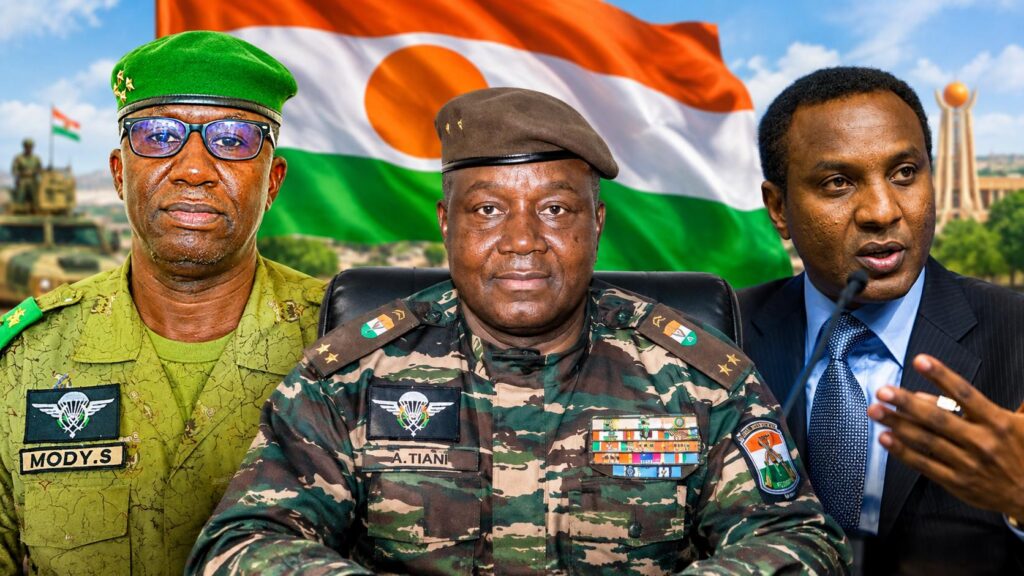
At the highest levels of Niger’s government, a fierce struggle is unfolding around a military program whose stakes go far beyond security. The core of the dispute involves the Commandement des Forces de Protection et de Développement (CFPD), General Salifou Mody, CNSP leader Abdourahamane Tiani, former Finance Minister and Prime Minister Lamine Zeine, and a monthly allocation of 1.8 billion FCFA. The key question: who will ultimately control this massive financial flow and the power it represents?
The CFPD: a force at the heart of strategic interests
On May 9, 2024, General Abdourahamane Tiani signed decree No. 2024-309/P/CNSP/MDN, establishing the Commandement des Forces de Protection et de Développement. This unit is tasked with safeguarding Niger’s strategic infrastructure: mining and oil installations, corridors, and pipelines. The Ministry of Defense confirmed the creation of this structure to secure key sites and routes. In parallel, the recruitment of 10,000 young people in 2024 boosts the ranks of the Nigerien armed forces. The project serves a security purpose and supports the expansion of the military apparatus.
Article 28 and the 1.8 billion figure
Article 28 of the decree sets a minimum daily allowance (Prime Unique d’Astreinte, PUA) of at least 12,000 FCFA per man per day, while imposing a financial contribution on companies benefiting from the security services. For a force of 5,000 men, the amounts are as follows:
- Per day: 5,000 men × 12,000 FCFA = 60 million FCFA.
- Per month (30 days): 1.8 billion FCFA.
- Per year: 21.9 billion FCFA.
These figures represent the financial reality of the program, backed by contracts with companies, payments made, and deployed personnel. This is the very heart of the power struggle within the regime.
Defense versus Finance
General Salifou Mody pushed for the implementation of the CFPD. General Tiani signed the decree under direct pressure from his Minister of Defense. After the signing, the CNSP leader ordered Finance Minister Lamine Zeine to block the financial provisions of the CFPD. As a result, the structure was created but deprived of the means to operate. General Mody thus faced a direct political blockage of his project.
The Mody-Zeine dispute
Lamine Zeine is the central point of friction. The Ministry of Finance deliberately blocked the budgetary translation of the military program. By January 2026, Lamine Zeine held both the positions of Prime Minister and Minister of Economy and Finance, while Salifou Mody served as Minister of State for Defense. Mody secured the removal of the Finance portfolio from Zeine, then forced his departure from the Prime Ministership. The conflict over the CFPD shattered trust among the pillars of power.
Mody at the Prime Ministership
The reshuffling of power required Zeine’s exit. General Mody took the helm of the government and imposed his condition: combining the roles of Prime Minister and Minister of Defense. He thus concentrated political, military, and administrative levers in his own hands.
Damolleydi: the second battle
Faced with the CFPD blockage, the regime launched the general mobilization “Damolleydi” to rally volunteers and existing structures. General Mody was appointed to lead the committee for this mobilization, sidelining General Mohamed Toumba, Minister of the Interior. Mody found himself at the head of this strategic initiative but deliberately slowed its implementation. The program lost visibility, supplanted by autonomous local structures.
Control over resources
This affair locks the state apparatus around three axes:
- Command: control over personnel assigned to strategic sites.
- Missions: designation of infrastructure to secure and setting of priorities.
- Money: control over contributing companies and management of financial flows.
Article 28 of the decree governs this financial mechanism of 1.8 billion FCFA per month.
Systemic control
This 1.8 billion amount is the direct financial stake of the program. It confirms the political dimension of the CFPD, at the crossroads of strategic resources, contributing companies, and the chain of command. Beyond the rivalry between Tiani, Mody, and Zeine, the winner of this confrontation holds exclusive control over Niger’s men, missions, and resources. Behind these personal quarrels lies the total mastery of the state apparatus.

More Stories
Can Benin and Spain turn cultural diplomacy into a lasting strategic advantage?
Can a leader who seized power by force ever feel secure in Niger?
Can Mali’s press reform survive its own internal divisions?