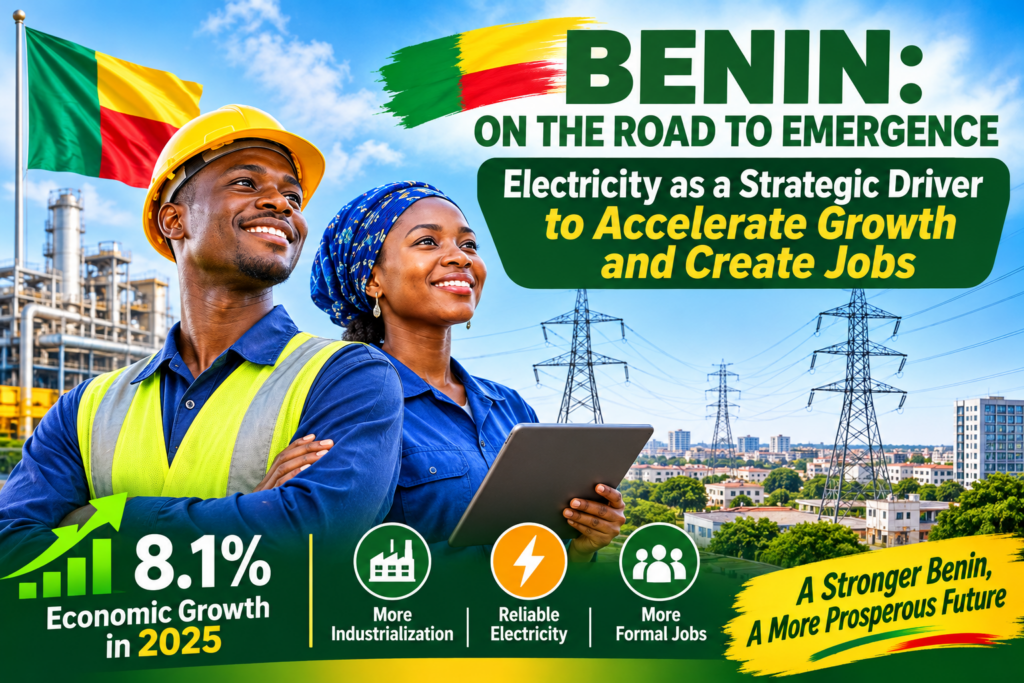
The West African nation of Benin boasts one of the region’s fastest-growing economies, with 8.1 % GDP growth recorded in 2025. Between 2021 and 2025 the country averaged 7.1 % annual growth, fuelled by heavy investment in infrastructure, industrial parks and economic modernisation programmes. Yet beneath these impressive headline figures lies a persistent challenge: the expansion of Benin’s economy still fails to translate into enough formal, stable and adequately paid employment for its citizens.
From growth figures to real payrolls: the economy’s missing link
World Bank analysis released in late 2026 reveals that 96.3 % of Benin’s workforce remained employed in the informal sector as recently as 2022. Fully 80 % of newly created jobs are classified as self-employment rather than salaried positions. By 2024 only 19.8 % of workers held formal employment contracts, a figure that falls to 9 % among young people aged 15-24.
These statistics underline a critical gap: economic growth on its own does not automatically generate productive jobs. A street vendor, a seamstress or a small-scale manufacturer may earn a living, but without the security of a formal contract, steady income or social protections, their ability to expand operations and hire others remains severely limited. The World Bank warns that unless the economy can convert growth into formal employment, the risk of persistent underemployment and poverty persists despite robust GDP gains.
Electricity outages and unreliable grids: the hidden cost to business
Nearly half of Beninese enterprises now identify electricity access as a major obstacle to their operations. Surveys indicate that 86.1 % of firms experience routine power cuts, forcing costly stoppages and reduced output. Agro-processing plants lose raw materials and export orders when the lights go out, while textile workshops and small manufacturers must run diesel generators to keep machinery running, pushing overheads higher and chipping away at competitiveness.
The situation is compounded by structural weaknesses in the national grid. Transmission losses reached 24.7 % in 2024, half of all high-voltage lines and substations are more than 25 years old, and chronic gas supply shortfalls have forced utilities to rely increasingly on expensive heavy fuel oil to keep turbines spinning. The result is an energy network that is both ageing and inefficient, undermining the very industries Benin hopes to scale up.
Mission 300 and Benin’s push for energy-driven transformation
Against this backdrop the government has partnered with the World Bank and the African Development Bank on Mission 300, a pan-African initiative aiming to connect an additional 300 million Africans to reliable electricity by 2030. Benin’s corresponding National Energy Compact outlines a three-pronged strategy: expand generation, modernise transmission and distribution, and attract private capital to accelerate roll-out.
Already four new solar plants at Natitingou, Djougou, Bohicon and Parakou are slated to add 50 MW of clean power, while the planned 128 MW Onigbolo thermal plant will bolster baseload supply. If fully implemented, these projects could unlock not only greater energy security but also significant employment gains. Modelling by the World Bank suggests that meeting the compact’s targets could create or improve nearly 159,000 jobs nationwide by 2030, provided the government simultaneously reins in technical and commercial losses, secures competitive fuel sources and speeds up new grid connections.
From megawatts to manpower: unlocking productivity beyond industrial parks
The 28.8 % year-on-year rise in employment at the Glo-Djigbé Industrial Zone (22,798 jobs in 2025) demonstrates that large-scale industrial parks can serve as engines of formal job creation. Yet the majority of Beninese businesses especially small and medium enterprises, agricultural cooperatives and young entrepreneurs operate outside such enclaves. For these actors, reliable power is the difference between stagnation and expansion. Factories can introduce new shifts, cold-storage units can preserve perishable goods, and digital start-ups can scale up without fearing daily blackouts.
Achieving this broader impact will require more than new power stations. It demands systematic grid refurbishment, transparent tendering for private generation projects, stronger metering to curb energy theft, and targeted subsidies or guarantees to encourage the connection of rural and peri-urban enterprises. Only then can Benin transform its energy investments into a catalyst for widespread, inclusive growth.
Measuring success beyond the GDP growth rate
Benin’s current 8.1 % expansion is undeniably positive, yet the true benchmark of development will be the number of salaried jobs created, the productivity gains recorded by SMEs, and the reliability of electricity supply. If industrialisation and energy reform proceed in tandem, the country could finally convert headline growth into tangible improvements in livelihoods. For Benin’s seven million-strong workforce, that shift cannot come soon enough.
By Emmanuel Mbarga — Journalist