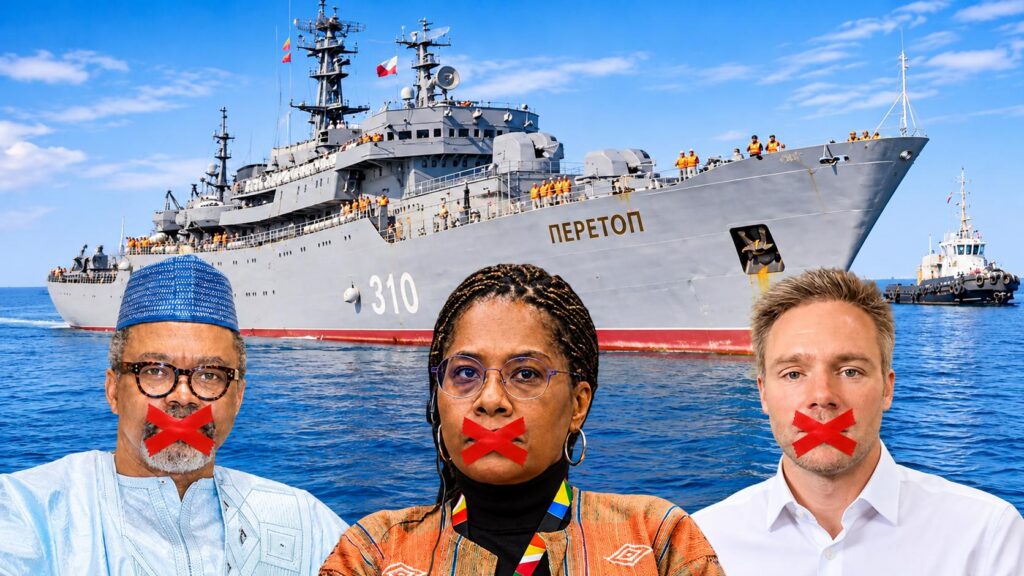
Earlier this month, the docking of a French warship in Cotonou triggered a wave of skepticism and criticism across certain media outlets aligned with the Alliance of Sahel States. Reports amplified concerns over France’s intentions, questioned Benin’s sovereignty, and fueled narratives that painted the visit as a potential threat without fully clarifying its purpose or context.
Last week, however, another vessel arrived in Benin’s waters. This time, the ship flew a Russian flag. The stark contrast in public and media reactions demands scrutiny.
Where were the outraged headlines? Where were the insistent demands for transparency? The silence surrounding the Russian vessel’s presence stands in sharp contrast to the scrutiny faced by the French ship. This disparity raises critical questions about whether Benin’s sovereignty is treated as an absolute principle or merely a selective concern.
The media’s shifting scrutiny: one standard for western ships, another for Russian ones
During the controversy over the French vessel, prominent voices including commentators advocating for closer ties with Russia were vocal in demanding answers about France’s role in Benin. Critics accused the French ship of undermining the country’s autonomy, portraying the visit as an act of neocolonial influence. But with the arrival of a Russian ship in the same port, the same voices have fallen conspicuously silent.
Among the most prominent figures who led the charge against the French naval presence was Nathalie Yamb, Antoine 2Moscou, and Franklin Nyamsi. Their commentary, amplified by regional media sympathetic to the Alliance of Sahel States, framed the French ship as a symbol of external interference. Yet, when a Russian vessel docked weeks later, little of that energy was directed at questioning the implications of that arrival.
This inconsistency suggests that criticism of foreign naval visits is not rooted solely in principles of national sovereignty but in the perceived geopolitical alignment of the visiting nation. When the ship is French, sovereignty becomes a rallying cry; when it is Russian, the same principle appears far less urgent.
Does sovereignty depend on the ship’s flag?
Benin, as an independent nation, has the right to determine its diplomatic partnerships and maritime engagements. Yet, the uneven response to foreign vessels reflects a troubling double standard. A sovereign state should not face accusations of surrendering its autonomy based on the nationality of a visiting ship. By the same token, the presence of any foreign vessel regardless of its origin should be subject to the same standards of transparency and public scrutiny.
The current disparity reveals a deeper issue: the selective application of national sovereignty as a principle. It implies that foreign influence is only problematic when it emanates from Western powers. This selective concern undermines the credibility of arguments about protecting Benin’s interests and independence.
What the Beninese public deserves: consistent standards, not politically motivated silence
The people of Benin deserve clear, factual reporting about maritime engagements. They should not be subjected to media narratives that fluctuate based on the geopolitical inclinations of commentators. Whether a ship is from France, Russia, or any other nation, the standards of transparency and accountability must remain constant.
Benin’s government is responsible for assessing the appropriateness of foreign naval visits based on national interest not on the preferences of regional commentators. Likewise, the media’s role is to inform the public objectively, avoiding selective outrage that serves geopolitical agendas rather than the pursuit of truth.
The arrival of the Russian ship should not be met with silence simply because it aligns with certain political narratives. Similarly, the French vessel’s visit should have been evaluated on its actual merits, not condemned solely due to historical associations with former colonial powers.
Conclusion: sovereignty must be a consistent principle, not a negotiated one
Sovereignty is not conditional on the flag a ship carries. It is not stronger when facing Western vessels and weaker when confronted by Russian ones. The principle of national independence must remain steadfast, regardless of shifting geopolitical winds or media narratives.
If Benin wishes to uphold its sovereignty in practice not just in rhetoric it must demand the same rigor from its partners, its commentators, and its own institutions. The country cannot afford a system where national dignity depends on which foreign power happens to be visiting its shores.
By Marguerite Ndongo — Journalist