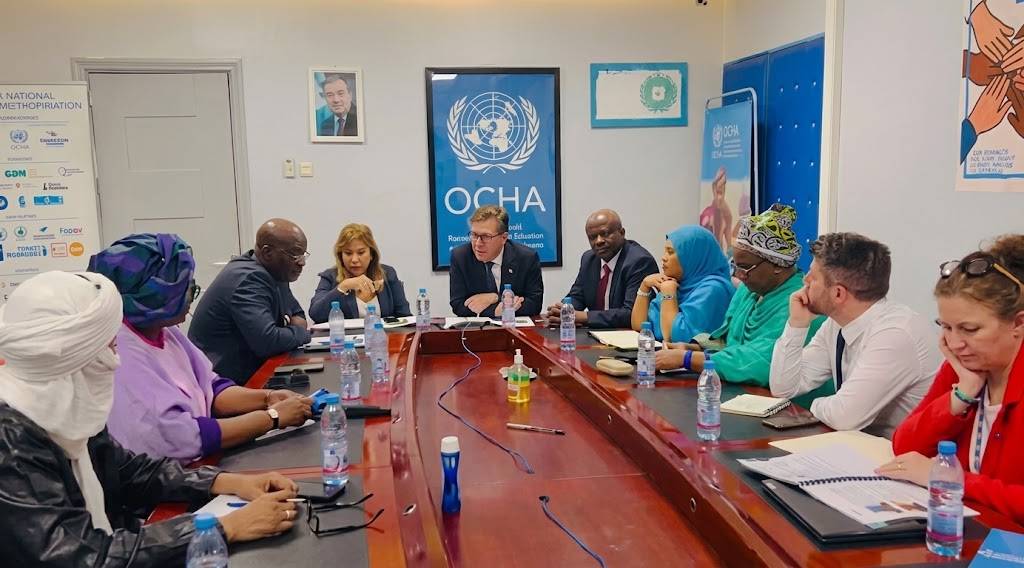
As Mali’s transitional authorities implement policies that have forced multiple international aid groups to withdraw, Bamako welcomed a high-level United Nations delegation led by Tom Fletcher this week. The visit comes at a critical moment, with projections from the UN’s 2026 Humanitarian Response Plan estimating that 5.1 million Malian citizens will require urgent assistance by next year.
The scale of need has reached unprecedented levels, with an estimated 3.8 million people already identified as priority beneficiaries for life-saving interventions. Vulnerable families, internally displaced communities, and rural populations are bearing the brunt of compounded crises—escalating insecurity, disrupted supply chains, and collapsing access to healthcare, clean water, and sanitation services.
Across the Sahel region, basic survival infrastructure is under severe strain. Food insecurity has surged, with nearly half the country’s population facing moderate or acute hunger. The healthcare system is buckling under the weight of preventable diseases and insufficient medical personnel. Meanwhile, safe water sources have dwindled, forcing communities to rely on unsafe alternatives that heighten the risk of waterborne illnesses.
The diplomatic tightrope: sovereignty vs humanitarian access
The arrival of Tom Fletcher, UN Assistant Secretary-General for Humanitarian Affairs and Emergency Relief Coordinator, takes place against a backdrop of shifting bilateral relations. The Malian government’s recent policy shifts—including restrictions on foreign organizations and programs—have led to the suspension of critical aid operations, disrupting food distribution, maternal health services, and child protection initiatives.
While Bamako’s reception of the UN delegation signals a willingness to re-engage on crisis response, officials emphasize that the visit does not imply endorsement of broader international partnerships. The Malian authorities have framed recent decisions as part of a broader sovereign agenda aimed at redefining the terms of foreign involvement in domestic affairs.
For humanitarian workers and affected communities, the timing raises a pressing question: Can a path forward be found that balances national sovereignty with the urgent needs of millions of civilians at risk?
Operational gaps and the widening help deficit
The gap between those in need (5.1 million) and those targeted for aid (3.8 million) underscores a widening operational shortfall. Current funding levels cover only a fraction of projected requirements, with appeals underfunded by nearly 40%. Logistical constraints—compounded by regional instability and restrictions on movement—further hinder the delivery of critical supplies to remote and conflict-affected areas.
Humanitarian partners warn that delayed or interrupted interventions will result in catastrophic outcomes: spikes in malnutrition, preventable deaths, and irreversible setbacks in community resilience. The window to prevent large-scale losses is shrinking, and the risk of a systemic humanitarian collapse looms larger with each passing month.
Consequences beyond statistics
- Economic strain: Local markets are collapsing as purchasing power erodes. Smallholder farmers, already vulnerable, face ruin as supply chains fracture and inputs become unaffordable.
- Social fabric endangered: Displacement has fractured communities, with children out of school and women and girls facing increased protection risks, including gender-based violence.
- Regional spillover: As Mali’s crisis deepens, neighboring countries confront a surge in cross-border migration, placing additional pressure on already strained resources and triggering tensions over resource allocation.
Can sustainability emerge from crisis?
The UN mission’s visit carries deeper implications than protocol or diplomacy. It represents a last-chance effort to realign priorities before irreversible damage is done. The outcome will reveal whether Mali’s leadership can reconcile national sovereignty with the moral imperative of protecting civilians—or whether the humanitarian landscape will continue its downward spiral.
For 5.1 million Malians—including over 2.5 million children—time is not a luxury. It is the difference between survival and catastrophe. As the world watches, the choices made in the coming weeks could shape the trajectory of an entire nation for years to come.