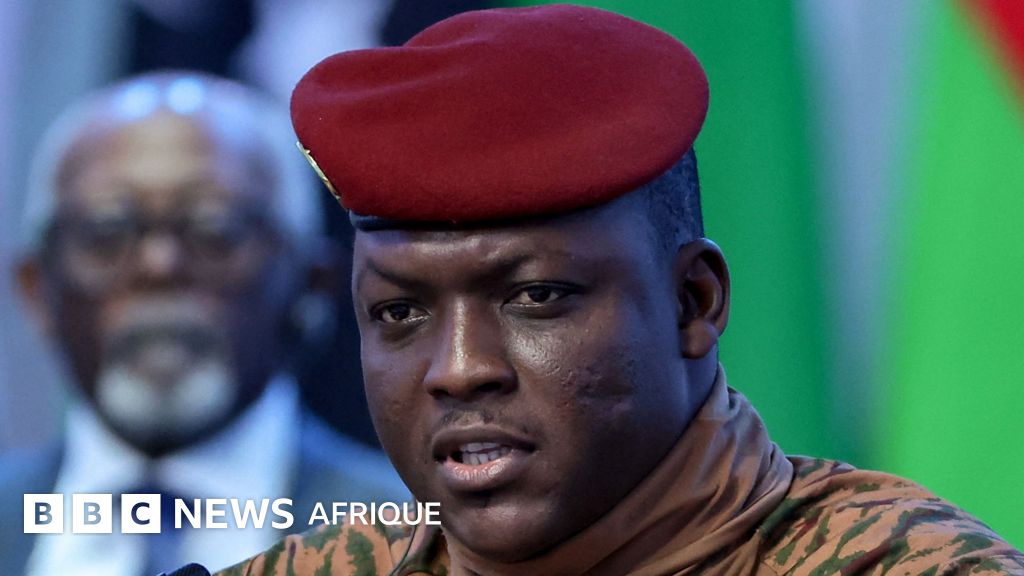
Captain Ibrahim Traoré declares democracy incompatible with Burkina Faso’s future

- Temps de lecture: 5 min
In a televised interview aired Thursday evening, Burkina Faso’s military leader Captain Ibrahim Traoré delivered a blunt message to the nation: democracy must be abandoned. « People should forget about democracy. It’s not for us, » he declared, positioning the country’s governance model outside Western political frameworks.
The 38-year-old junta chief, who seized power in a 2022 coup, argued that Africa’s political landscape requires a fundamental departure from traditional democratic systems. « Look at Libya – that’s what happens when foreign powers impose democracy, » he stated, referencing the country’s collapse following NATO intervention in 2011.
Traoré, who initially promised to restore constitutional rule by July 2024, extended his military mandate by five years in May, just two months before the previously announced transition. This decision came alongside a January decree dissolving all political parties, which the junta claims foster division and corruption.
« The truth is that in Africa – at least in Burkina Faso – real politicians embody all vices: liars, flatterers, and empty speakers, » he asserted. While not detailing his alternative model, Traoré emphasized Burkina Faso’s unique approach: « We don’t copy anyone. We’re here to completely change how things work. »
Building a revolutionary system
The military leader outlined a vision centered on sovereignty, patriotism, and revolutionary mobilization, with traditional leaders and grassroots structures playing pivotal roles. Economic and military self-reliance emerged as cornerstones, with Traoré insisting that Burkina Faso’s development requires working days exceeding eight hours – a sharp contrast to current standards.
His governance style has drawn both domestic criticism and continental praise. Supporters admire his anti-Western stance and pan-African rhetoric, while opponents accuse him of suppressing dissent. Reports indicate the junta has silenced critics by deploying them to frontline combat zones against Islamist militants, despite widespread accusations of human rights abuses.
International alliances shift
Like neighboring Mali and Niger, Burkina Faso has distanced itself from Western partners in its fight against Islamist insurgencies that have plagued the Sahel for over a decade. Instead, the country has turned to Russia for military support, though violence continues unabated.
Human rights monitors have documented devastating consequences. Since Traoré’s 2023 assumption of power, more than 1,800 civilians have been killed, with two-thirds of these deaths attributed to state forces and allied militias, according to monitoring organizations.
The junta’s actions reflect a broader regional trend of military leaders rejecting democratic norms in favor of centralized, nationalist governance models. As Burkina Faso charts this uncharted path, questions remain about its long-term stability and the human cost of this political transformation.