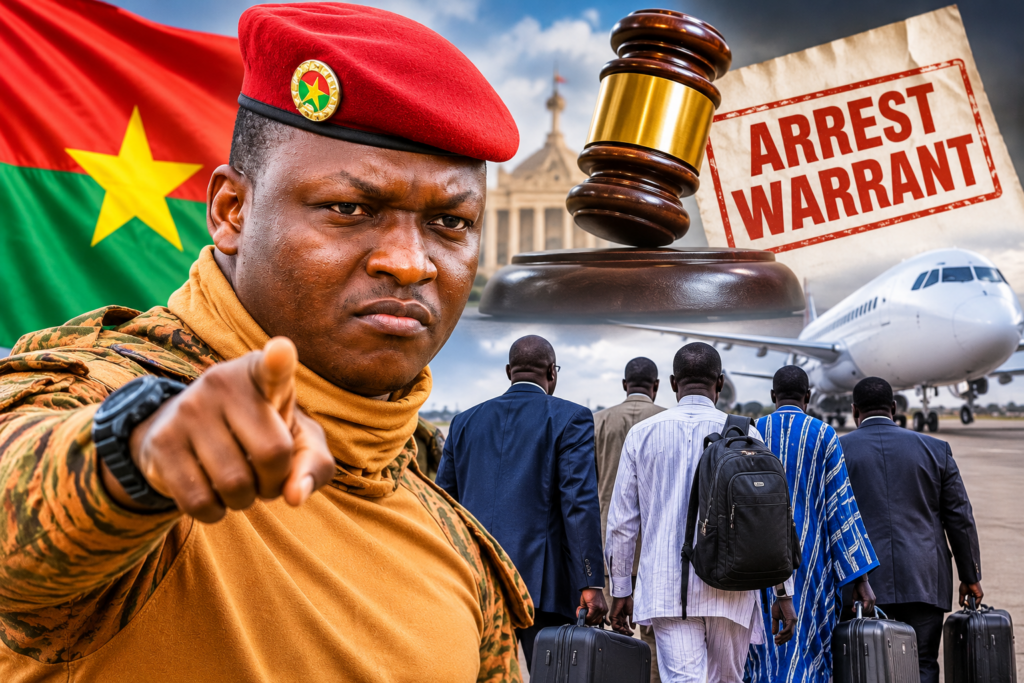
The government of Burkina Faso, led by interim leader Ibrahim Traoré, is escalating its legal campaign against political figures, military leaders, and journalists who have fled the country amid escalating instability. With international arrest warrants, extradition requests, and ongoing prosecutions, authorities are extending their reach beyond national borders, raising serious concerns about the motives and implications of these measures.
From exile to legal pursuit: the widening scope of accountability
For many former officials and critics who sought refuge overseas to escape political persecution, the issuance of international legal actions has come as a distressing surprise. These individuals, who once wielded influence in Burkina Faso’s corridors of power, now face charges in absentia, compelling authorities in neighboring and distant nations to consider extradition. This strategy, while framed as a quest for justice, appears increasingly to blur the line between legal accountability and political vendetta.
The rapid escalation of such cases suggests a systematic effort to confront former allies and adversaries long after their departure. Military officers, politicians, and media personalities once integral to the nation’s structure now find themselves enmeshed in legal proceedings initiated by the transitional authorities. The persistence of these actions raises a critical question: Is this a legitimate pursuit of justice, or is it becoming a means of silencing dissent beyond Burkina Faso’s borders?
Legal mechanisms under scrutiny: justice or political retaliation?
The use of national and international judicial tools to pursue exiled individuals is not inherently unlawful. However, when legal proceedings are launched without transparent evidence or appear motivated by retribution rather than constitutional principles, they risk undermining public trust in the justice system. A fair judicial process requires impartiality, verifiable evidence, and adherence to due process principles that are difficult to uphold when allegations seem politically driven.
Critics argue that this strategy extends the cycle of political confrontation rather than resolving it. By targeting former officials some of whom played key roles during past administrations authorities may be sending a signal that opposition, even from abroad, will not be tolerated. This approach contradicts the foundations of democratic pluralism and raises doubts about the transitional government’s commitment to reconciliation and inclusive governance.
International ripple effects: the erosion of trust in Burkina Faso
The extraterritorial application of Burkina Faso’s legal measures has not gone unnoticed by the international community. Countries hosting exiled individuals including neighboring states and European nations are now faced with complex diplomatic and legal dilemmas. While extradition requests must be evaluated on their merits, the perception of Burkina Faso’s judicial system as an instrument of political control could strain diplomatic relations and deter foreign investment.
Moreover, the families of those pursued, as well as sympathetic local and international observers, may increasingly view these actions as an abuse of power rather than a pursuit of justice. Such perceptions are particularly damaging in a region already grappling with deep political instability and a legacy of fragile institutions.
Beyond legal pursuit: what does Burkina Faso stand to lose?
While the transitional authorities argue that holding former leaders accountable is essential for national healing, the focus on pursuing exiles comes at a cost. Burkina Faso is confronting urgent challenges: a worsening security crisis, economic stagnation, and widespread humanitarian suffering. By diverting attention and resources toward extraterritorial legal battles, the government risks neglecting the immediate needs of its citizens.
More fundamentally, when justice becomes a political tool rather than an independent arbiter, the nation’s democratic fabric weakens. Citizens deserve a system that upholds the rule of law not one that serves as an extension of executive power. The true test of leadership lies not in the number of former officials prosecuted, but in the ability to foster institutions that deliver justice equitably and transparently, for all.
Ibrahim Traoré’s dilemma: accountability or authoritarianism?
At the heart of this debate is a basic question: Is Ibrahim Traoré leveraging the justice system to consolidate power, or is he genuinely committed to addressing corruption and abuse of office? The answer may lie in the transparency of the proceedings, the independence of the judiciary, and the willingness to pursue justice against all individuals regardless of their political alignment.
Without these safeguards, the pursuit of exiled critics risks being seen as an authoritarian tactic rather than a democratic imperative. For Burkina Faso to move forward, its leaders must demonstrate that justice is not a weapon, but a foundation upon which the nation can rebuild trust, stability, and hope for the future.
By Emmanuel Mbarga — Journalist