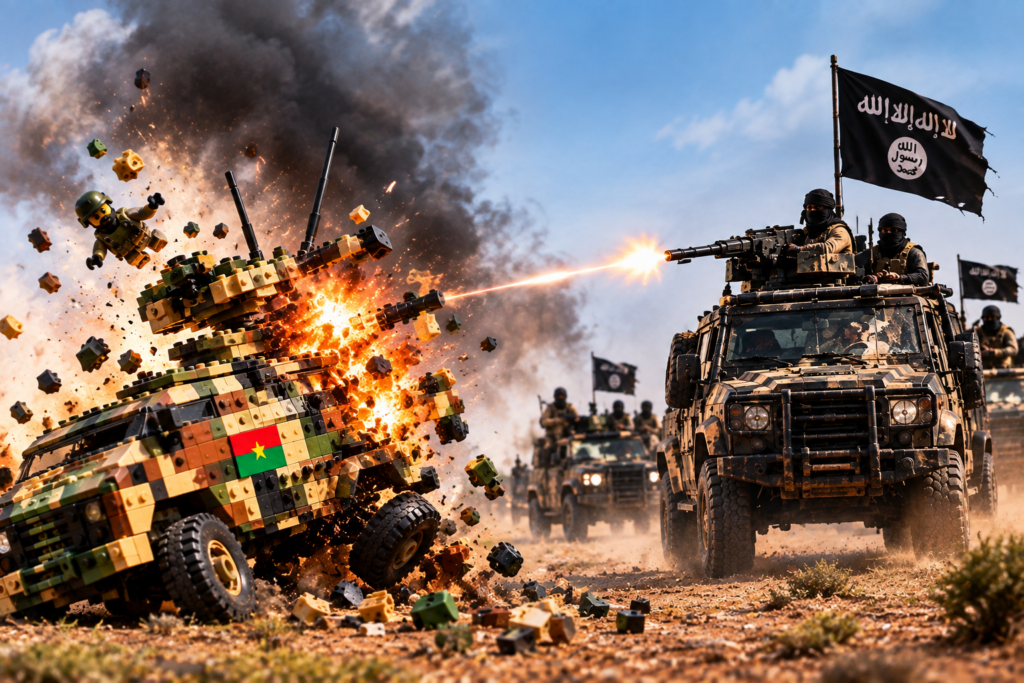
The battlefields of the Sahel are no proving grounds for political speeches they are real-world testing grounds where theory meets ruthless practice.
The cost of unproven military promises in Burkina Faso
On the morning of September 16, 2026, the Group for the Support of Islam and Muslims (JNIM) claimed to have captured two positions held by the Volunteers for the Defense of the Homeland (VDP) near Mahlou and Winten in Bam Province. The announcement, though unconfirmed by independent sources, has thrust a manufactured controversy into the spotlight: can locally produced armored vehicles live up to their billing in the heat of combat?
The incident comes amid a broader narrative pushed by Burkina Faso’s transitional government under Ibrahim Traoré, which has touted the expansion of a domestic defense industry as a cornerstone of national sovereignty. Government officials frequently highlight the country’s growing capacity to manufacture and assemble military hardware, framing it as a breakthrough in reducing reliance on foreign partners.
But sovereignty is not declared it is earned on the ground. And in the vast, contested spaces of northern Burkina Faso, where armed groups like JNIM continue to challenge state authority, the true test of military equipment lies not in production halls or promotional videos, but in fire and movement.
From propaganda to practicality: equipment under scrutiny
The so-called “Lego-style” armored vehicles assembled domestically and hailed as an engineering feat now face their first sustained real-world evaluation. Their performance could determine whether Burkina Faso’s industrial ambitions translate into tangible battlefield advantages or remain little more than staged photo opportunities.
Critics argue that while the vehicles may look impressive behind closed doors, their actual combat effectiveness remains unproven. Questions persist about their ballistic protection, mechanical reliability under harsh field conditions, and logistical support factors that are as critical as armor thickness in a sustained conflict.
This is not the first time local production has been scrutinized. Earlier in August 2026, JNIM also claimed multiple VDP position losses in Séguénéga and Bourzanga. Analysts have since pointed out that even after retaking certain areas, maintaining control has proven difficult a gap that hardware alone may struggle to bridge.
What’s at stake beyond the armor
The stakes extend far beyond the fate of a few vehicles. For the people of Bam Province, the security of Mahlou and Winten is not a technical debate it is a lifeline. The loss of these positions, if confirmed, could signal deeper vulnerabilities in Burkina Faso’s defense strategy, particularly in rural and under-resourced zones where state presence is already fragile.
Civilian populations, already displaced by years of conflict, face compounded risks when military equipment fails under pressure. Delayed reinforcements, equipment breakdowns, or even the loss of armored units can force communities to flee, further destabilizing regions struggling to recover.
Beyond the workshop: the real test of national defense
Burkina Faso’s push for self-sufficiency in military hardware is laudable in principle. But the events unfolding at Mahlou and Winten suggest that true defense sovereignty is not achieved by merely assembling vehicles it is proven when those vehicles stand firm under fire, protect lives, and allow the state to hold territory.
The coming days will reveal whether the armored vehicles are more than symbolic achievements. If they fail to perform, the consequences will not be measured in column inches or social media likes but in kilometers of abandoned soil, in lives lost, and in the erosion of public trust in the government’s ability to protect its citizens.
In warfare, no amount of industrial innovation can replace the harsh verdict of the battlefield. And for the people of Burkina Faso, that verdict is now being written in real time.
More Stories
Mali’s prison crisis at a tipping point: how mass arrests are reshaping justice and security
Burkina Faso’s agricultural turning point: when production fails the farmers who feed the nation
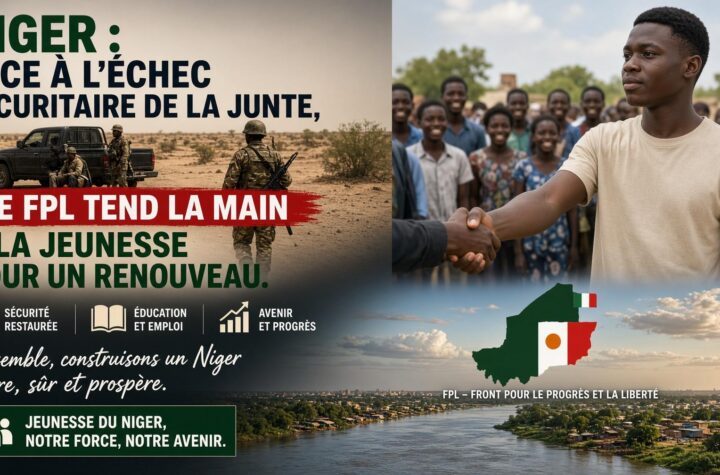
Niger’s youth at the forefront: how the FPL’s bold move could reshape the security deadlock