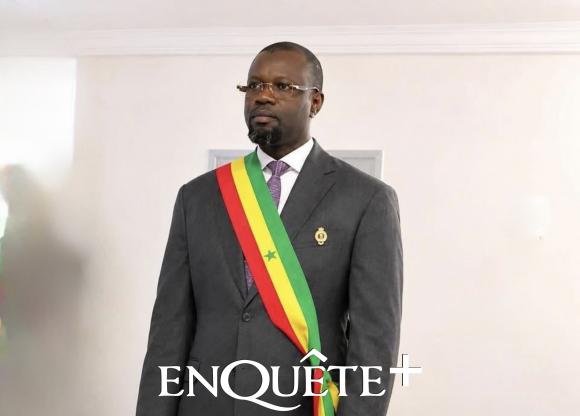
Opposition challenges Sonko’s parliamentary reinstatement before the judges
A group of opposition lawmakers has taken legal action against Ousmane Sonko’s reinstatement as a deputy and subsequent election as President of the National Assembly. In a statement released today, about twenty lawmakers from various opposition parties announced they had filed a petition with the Constitutional Council to have the decision declared unconstitutional.
Constitutional arguments at the heart of the dispute
The petition centers on Article 54 of the Constitution, which the opposition claims was violated when Sonko was reinstated as a deputy. They argue that his previous role as Prime Minister, combined with his 2024 election as a deputy, created an incompatibility under the Constitution and parliamentary rules. By retaining his government position, they contend, Sonko effectively forfeited his parliamentary mandate—meaning his reinstatement and election as Assembly President were illegal.
The opposition emphasizes that the Constitutional Council is the only body with the authority to review such a decision, acting as the guardian of parliamentary mandates and institutional balance. Their legal challenge underscores concerns about the separation of powers and the integrity of democratic institutions.
Procedural hurdles and transparency concerns
Beyond the constitutional debate, the opposition has raised procedural objections. Lawmakers claim they were forced to issue formal summons to obtain critical documents—including Sonko’s reinstatement decree and the May 26 plenary session minutes—required for their legal challenge. Both the Secretary-General and First Vice-President of the National Assembly allegedly refused to provide these publicly accessible records, a move the opposition describes as a grave obstruction to democratic transparency.
Their statement condemns the refusal as a deliberate attempt to undermine parliamentary oversight and calls on the Constitutional Council to intervene, arguing that such actions erode public trust in institutions. The opposition reaffirms its commitment to resolving the dispute through legal, nonviolent means.
A high-stakes political showdown
The legal battle unfolds against a backdrop of intense political maneuvering. Ousmane Sonko, dismissed as Prime Minister on May 22, staged a dramatic political comeback by securing 132 out of 133 votes to become Assembly President on May 26. His election followed the resignation of his predecessor, El Malick Ndiaye, and makes him the second-highest-ranking official in the country.
The opposition had already boycotted the vote, labeling it a constitutional coup. Jurists remain divided on the merits of the case, with some arguing that Article 54 does not explicitly address automatic reinstatement or suspension of mandates, while others cite internal parliamentary rules (Article 123) that allow for replacements when deputies join the government.
Legal uncertainty looms over the petition
A critical question now hangs over the opposition’s challenge: whether their petition meets admissibility requirements. Legal experts note that parliamentarians may lack the direct authority to file such a petition; that power is traditionally reserved for the President of the Republic. The presidency has denied any involvement in the matter, leaving the Constitutional Council to determine whether the opposition’s case can proceed.
The Council’s decision on admissibility will set the stage for a high-stakes ruling with far-reaching implications for Senegal’s political and institutional landscape.