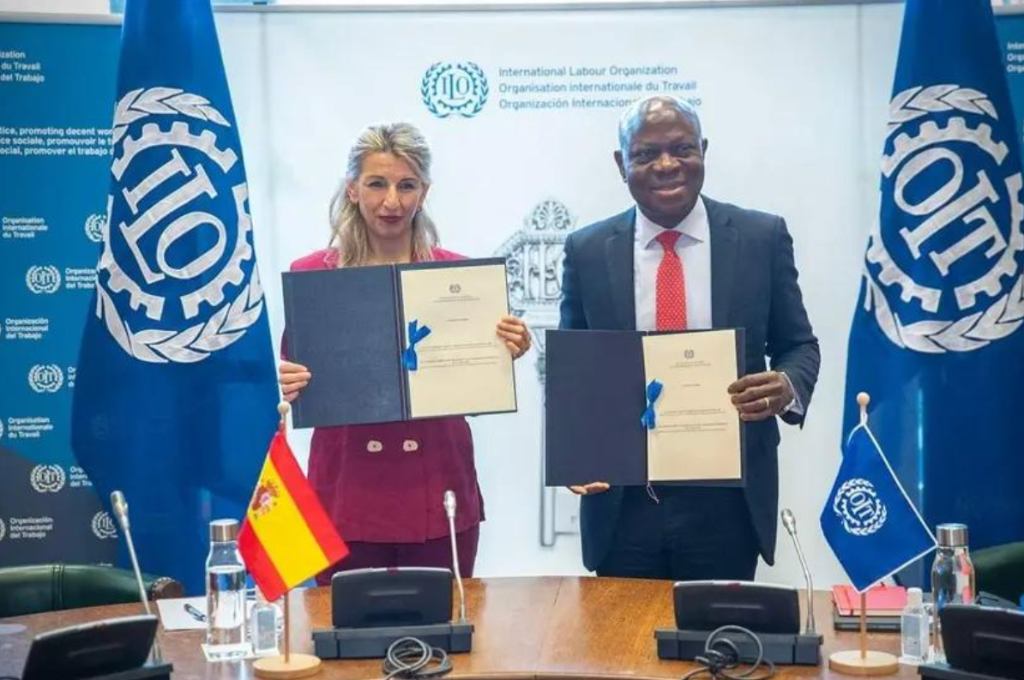
Another five-year term for Houngbo amid deepening instability
In a dramatic last-minute shift, the International Labour Organization (ILO) on Monday, 16 November 2026, handed Togo’s Gilbert Houngbo an uncontested second five-year mandate to lead the UN agency charged with protecting global labour rights. The surprise withdrawal of Spanish labour minister Yolanda Díaz—his only remaining rival—left Houngbo with an empty ballot box and the weight of a growing financial and legitimacy crisis squarely on his shoulders.
Díaz’s abrupt exit, framed as a bid to preserve unity inside the international trade-union movement, came with pointed accusations that the outgoing administration had mismanaged the ILO into one of its worst fiscal crises, pushed social dialogue to the brink, and shifted the heaviest cost burdens onto the institution’s own employees.
Financial haemorrhage risks eroding workers’ safety net
At the heart of Díaz’s public reckoning is the ILO’s deteriorating financial health. Arrears from major member states—particularly the United States—have swollen to historic levels, draining the agency’s operating reserves and forcing belt-tightening measures that critics warn will hollow out frontline worker protections.
The resulting cuts have already triggered internal restructuring programmes, including targeted layoffs and programme cancellations. Employees and their representatives argue these austerity steps disproportionately target the workforce rather than the structural inefficiencies cited by management. The fear is that further reductions will weaken the very teams that monitor global compliance with core labour standards, leaving vulnerable workers without advocates and watchdogs.
Unpaid dues compound global inequality
- Delayed contributions from the world’s largest economies are forcing the ILO to defer critical technical-assistance missions to low-income countries that rely on the agency’s expertise for fair-wage legislation, occupational-safety frameworks and social-protection systems.
- Workers’ rights in the balance: when the ILO cannot fund its field operations, labour inspections stall, collective-bargaining support evaporates and child-labour eradication programmes falter—directly undermining the rights Houngbo is pledged to uphold.
- Downward spiral: a shrinking budget also reduces the leverage the ILO can exert in policy forums, making it harder to push for binding conventions that raise minimum wages or criminalise forced labour.
Social dialogue on life-support inside the ILO
Criticism is not limited to balance sheets. Díaz’s campaign highlighted a paradox: an agency tasked with championing dialogue between governments, employers and unions is itself struggling to maintain a functioning social dialogue with its own staff.
Internal staff unions have publicly contested sweeping restructuring proposals, alleging that consultations amounted to perfunctory information sessions rather than genuine negotiation. Employees report feeling sidelined as decisions on job cuts and programme terminations are finalised at headquarters. The erosion of trust inside the organisation threatens to spill outward, damaging the ILO’s reputation as the gold standard for tripartite consensus-building.
Power plays behind the scenes
Díaz’s withdrawal also revealed fractures in the labour-movement coalition that once backed Houngbo. The International Trade Union Confederation (ITUC) and the International Organisation of Employers (IOE) had both publicly endorsed his candidacy, tipping the scales in a contest that had initially promised fierce competition.
Yet Díaz argued that the unions’ pro-Houngbo stance masked deep internal dissent. She claimed that rank-and-file affiliates, particularly in the Global South, felt their priorities—fair migration rules, universal social protection—were being sidelined in favour of cost-cutting reforms that erode worker protections. For Díaz, stepping aside was a last-ditch effort to prevent a lasting schism that could paralyse global labour advocacy.
The simultaneous exit of Peru’s Javier González-Olaechea left Houngbo facing no ballot opposition, turning what could have been a referendum on policy into a coronation marred by lingering doubts.
What’s next for the ILO’s reform agenda?
With the votes counted and the critics still vocal, Houngbo’s second term now hinges on whether he can turn rhetoric into results. Restoring financial stability without shredding the social contract with employees will be his first order of business.
The coming months will test his pledge to “align belt-tightening with the boundless mission of protecting every worker on earth.” Success hinges on three fronts:
- Fiscal turnaround: negotiating repayment schedules with delinquent member states and unlocking contingency financing from surplus-rich economies.
- Staff rapprochement: reopening genuine consultations with internal unions, guaranteeing transparency in restructuring decisions and safeguarding jobs that underpin the agency’s credibility.
- Global credibility rebound: relaunching field missions that support living-wage laws, safety regulations and gender-equality initiatives—especially in regions hit hardest by supply-chain disruptions and climate migration.
Absent credible reform, the alternate scenario is unmistakable: a hollowed-out ILO whose weakened presence leaves workers—from textile factories in Dhaka to cocoa farms in Côte d’Ivoire—more exposed than ever to exploitation, poverty wages and unsafe conditions. For millions who depend on the ILO’s watchdog role, the cost of failure will be measured in pay cheques denied, accidents unchecked and rights denied.