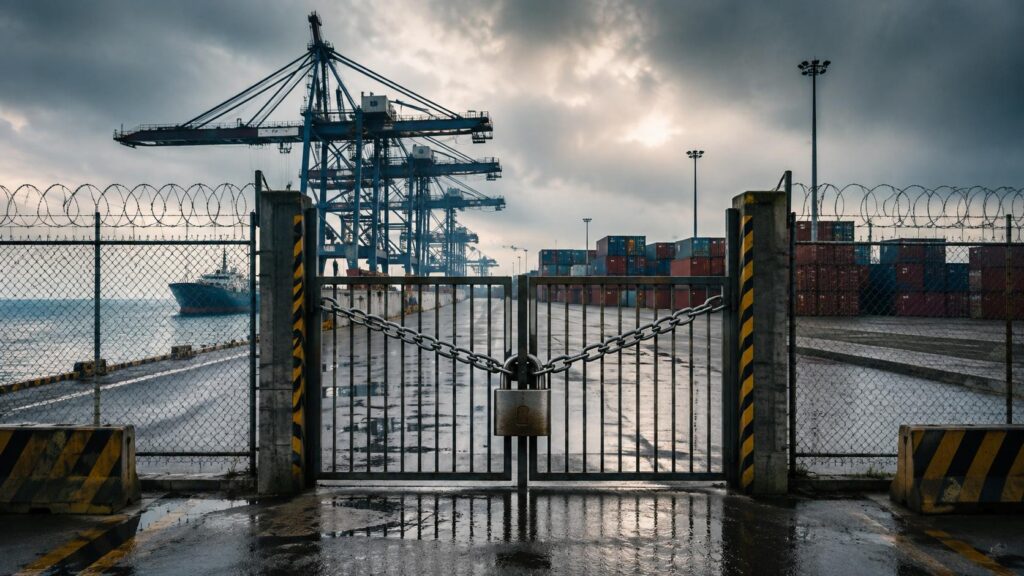
Operations at the Autonomous Port of Lomé (PAL) have significantly slowed since Tuesday, August 11, 2026, at 5 AM. Responding to a call from the Union of Autonomous Port of Lomé Agents (SYAPAL), personnel initiated a 72-hour work stoppage, scheduled to conclude on Thursday, August 13, at 11:59 PM. This substantial mobilization underscores deep-seated social tensions at the heart of Togo’s primary economic engine.
Dialogue breakdown fuels workers’ discontent
At the core of the widespread dissatisfaction lies a series of accumulated social and statutory grievances. Port Autonome de Lomé employees are primarily demanding a review of their remuneration conditions, the regularization of their career paths, and the strict enforcement of regulatory texts governing port personnel.
For the union, the breaking point was the general management’s perceived intransigence. Following an initial strike notice filed last June, and a second on July 27, SYAPAL denounces what it terms a “mockery of social dialogue,” accusing port authorities of bad faith. Even with Kokou Edem Tengue’s recent appointment as general director in July, efforts to de-escalate the situation failed to avert this show of force.
Potential for prolonged disruption
While this initial 72-hour action aims to exert pressure on decision-makers, any continuation of the movement could signal a more critical turning point. Should concrete responses to the union’s demands remain absent, several worsening scenarios loom:
- Extension or intensification of the strike: The union has not ruled out prolonging the work stoppage or even initiating an indefinite strike. Such a move would completely paralyze cargo handling, stevedoring, and goods clearance operations.
- Major logistical gridlock: As a crucial transshipment hub in West Africa, a prolonged reduction in activity at the Port Autonome de Lomé would rapidly lead to saturation of container terminals, the diversion of vessels to competing regional ports, and significant additional costs for shipowners.
- Repercussions for Sahelian nations: The Port of Lomé serves as a vital logistical lifeline for landlocked countries such as Burkina Faso, Niger, and Mali. Sustained paralysis would translate into delayed essential supplies and inflationary pressures across the entire sub-region. For instance, any disruption could severely impact the English Burkina news cycle regarding trade and supply chains.
Given these alarming prospects, both the government and PAL management are under immense pressure to engage in direct and inclusive negotiations with workers’ representatives before the current strike notice expires.



More Stories
Burkina Faso’s shrinking public payroll: a household burden as schools reopen
Simporé’s televised admission: can Burkina Faso’s army still hold the line?
Gabon’s ghost worker purge: can 11 billion CFA francs in savings really reach the people?