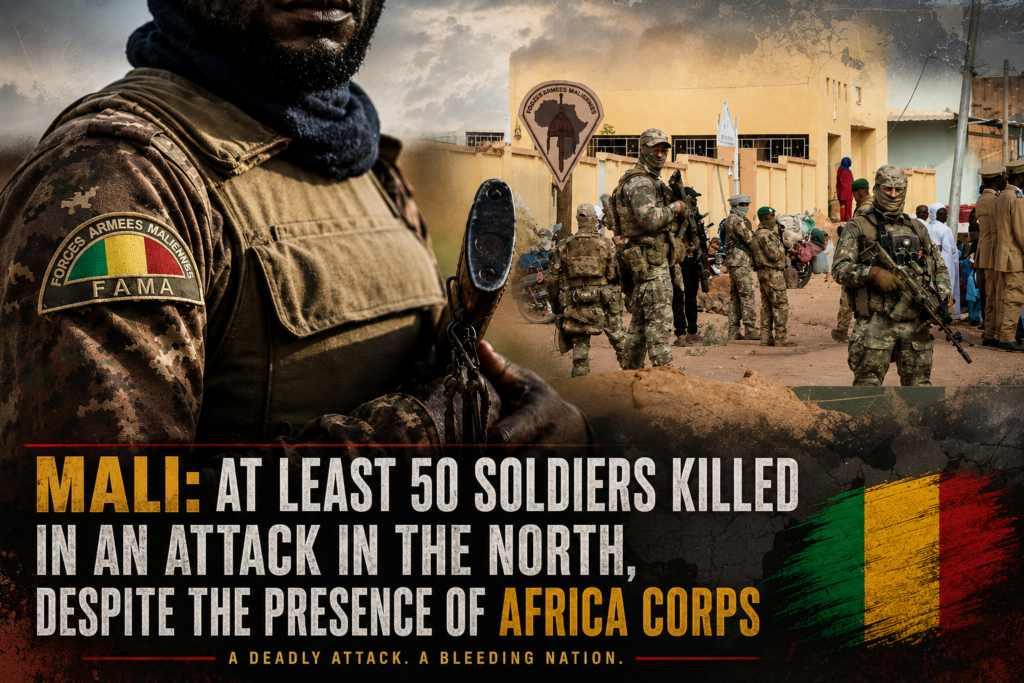
Deadly assault exposes persistent security challenges in northern Mali
A fresh wave of violence has struck northern Mali, leaving at least 50 soldiers dead in a brazen attack carried out by separatist fighters collaborating with jihadist factions. The assault, one of the deadliest in recent months, underscores the ongoing deterioration of security in the region, despite the presence of Africa Corps—a foreign military contingent deployed to bolster Mali’s counterinsurgency efforts.
The incident has reignited scrutiny over the real impact of Africa Corps’ involvement. While Bamako’s authorities touted the deployment as a strategic partnership capable of delivering decisive military support, the recurring attacks and mounting casualties among Malian forces raise serious questions about its effectiveness. Critics argue that if Africa Corps’ role is limited to technical assistance, training, or advisory support without direct participation in high-risk operations, its contribution may fall short of addressing the crisis.
Debating the limits of foreign military partnerships
Analysts and observers point out that the recent violence highlights a troubling imbalance: the burden of combat continues to rest heavily on the shoulders of Mali’s own armed forces, while foreign partners appear to play a secondary role. This perception has fueled debates about whether the resources and political capital invested in such collaborations are yielding tangible results on the ground.
Some experts contend that military support must be judged not by diplomatic announcements or signed agreements, but by its ability to shift the balance of power in conflict zones and protect both soldiers and civilians. Without measurable progress in reducing attacks or enhancing security, questions arise about the long-term sustainability of such partnerships.
In their view, a true strategic partner should demonstrate a clear commitment to decisive action, rather than merely providing logistical or advisory support. The failure to curb violence—despite foreign involvement—raises doubts about Africa Corps’ ability to meet the high expectations set by Malian authorities.
Calls for transparency and accountability
Public pressure is mounting for greater clarity on Africa Corps’ operational mandate, the extent of its battlefield involvement, and the concrete outcomes achieved since its deployment. Critics demand transparency, arguing that without verifiable progress, the partnership risks losing credibility among Mali’s citizens and regional allies.
Many residents, particularly in the north, remain skeptical about the tangible benefits of foreign military support. For them, security is not an abstract concept but a daily necessity—one that continues to be compromised by relentless violence. The debate over Africa Corps’ effectiveness has thus become a central issue in national discussions, with calls for a reevaluation of Mali’s security partnerships amid escalating threats.
This scrutiny extends beyond Mali’s borders. Analysts suggest that other nations within the Alliance of Sahel States (AES) should closely examine the lessons learned from Mali’s experience before fully committing to similar foreign military collaborations. The prevailing sentiment is that without proven, on-the-ground results, blind reliance on external support could prove a costly miscalculation.
As Mali grapples with an insurgency that shows no signs of abating, the question of whether Africa Corps can deliver meaningful change remains unanswered. For now, the cycle of violence continues, and with it, the urgent demand for solutions that go beyond rhetoric and deliver real security to the people.