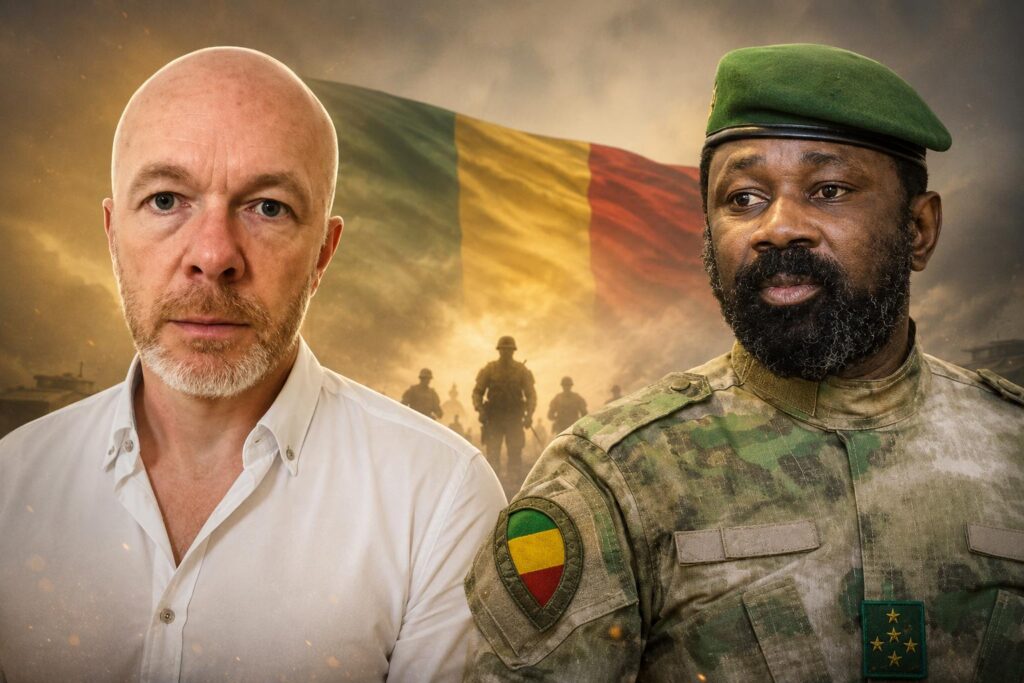
The announcement came draped in the customary trappings of sovereign authority: President Assimi Goïta granted a « presidential pardon » to Yann Vézilier, the French intelligence officer detained in Bamako a year prior. Last June, he was sentenced to two decades in prison for alleged « attempts to destabilize » the country. Now, the shadowy diplomat is set to return to France. Yet while Malian officials cloak this outcome in magnanimity and state forgiveness, the underlying facts tell a far different story.
Behind the diplomatic spectacle: negotiations and financial deals
What appears on the surface as a magnanimous gesture is, in reality, the final act of a carefully staged performance. Far from a spontaneous act of clemency or routine judicial procedure, this pardon was the planned conclusion of a propaganda trial designed from the outset to serve a political agenda.
While official rhetoric highlights the regime’s moral grandeur, behind-the-scenes security operations reveal a far more pragmatic—and embarrassing—reality for Mali’s transitional authorities.
Despite claims of full control over the territory and security situation, Malian forces have not engaged in direct combat with armed groups such as the Cadre Stratégique Permanent (CSP-DPA / FLA) and the Group for the Support of Islam and Muslims (JNIM). Contrary to public statements, Russian military instructors and mercenaries from Africa Corps played no operational role in recent confrontations and remained on the sidelines.
To secure the release of Malian soldiers captured in previous clashes, President Assimi Goïta and his envoys entered into discreet, direct negotiations with the leaders of the FLA and JNIM. Far from the image of unyielding military resolve, these exchanges involved substantial financial payments to the armed groups. Thus, beneath the veneer of unyielding justice and the orchestrated « presidential grace », Bamako’s leadership prioritizes covert financial transactions and direct security compromises to address its vulnerabilities on the ground.
How a trial became a political tool
From the moment Yann Vézilier was arrested in August 2025, his case was never about ordinary justice. Officially accredited with local authorities, his presence was widely known within Mali’s security apparatus. The abrupt decision to strip his status and portray him as a « conspirator » served a clear strategic purpose: to identify an external enemy and unite the nation behind the military regime.
The severity of the June sentence—20 years in prison—served a dual purpose. It projected an image of uncompromising justice capable of defying France, the former colonial power, while simultaneously establishing an extremely valuable diplomatic bargaining chip.
A trial designed for public consumption
Legal and diplomatic observers agree: the speed and conduct of the trial left no doubt about its political nature. The absence of publicly disclosed material evidence and the hasty classification of the case as a threat to state security followed a familiar pattern:
« Heavy judicial sentences serve to craft a narrative of aggression. The subsequent pardon then allows the regime to parade as the magnanimous victor. This is the essence of hostage diplomacy in action. »
The illusion of presidential clemency
Presenting the release as an act of presidential clemency is nothing more than semantic window dressing. Releases of intelligence officers are never acts of constitutional benevolence; they result from discreet bargaining, indirect concessions, and covert security arrangements conducted outside the judicial sphere.
By invoking the pardon, Bamako secures a complete symbolic victory: the regime retains the final word, reaffirms the supreme authority of its leader, and preserves the political capital gained from the initial trial. The Yann Vézilier affair will not be remembered as an example of judicial clemency, but as a stark demonstration of how justice can be molded—from sentencing to pardon—as a tool of strategic communication.
More Stories
Niger’s junta turns on its own: how general Barmou’s fall exposes systemic instability
Mutiny in Niamey exposes fractures in Niger’s military leadership
What Niamey’s aid dependency means for its sovereignty claims