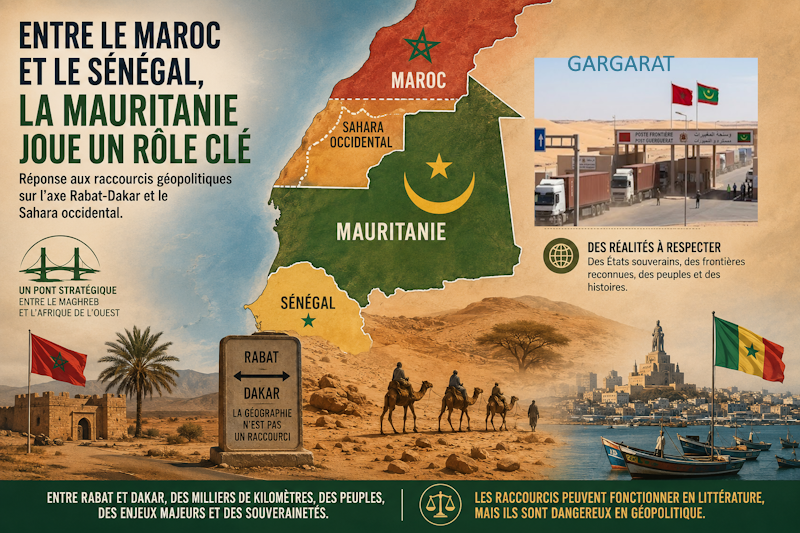

An unexpected diplomatic flare-up in Dakar this past July underscored Mauritania’s carefully crafted stance on the Western Sahara dispute. Between cautious neutrality, economic imperatives, and the preservation of national sovereignty, Nouakchott’s strategic ambiguity has become its defining diplomatic approach.
What began as a routine book launch at the Moroccan embassy in Dakar quickly escalated into a diplomatic confrontation. Former Senegalese foreign minister Cheikh Tidiane Gadio ignited controversy by claiming in his address that, in Senegalese collective memory, Morocco lay “just a few kilometers away”—a veiled reference to pre-colonial territorial claims that many saw as erasing Mauritania’s existence. His remarks triggered an immediate rebuke from Mauritanian ambassador Mohamed Ould Abdellahi Ould Ethmane, who walked out in protest, denouncing what he called a deliberate attempt to rewrite history.
While Morocco’s envoy, Hassan Naciri, swiftly stepped in to calm tensions, the incident laid bare the tightrope Mauritania walks. The country finds itself caught between attending events that celebrate Morocco’s claim to Western Sahara and maintaining its official neutrality in a decades-old conflict.
The fallout from Gadio’s comments continues to reverberate across Mauritania. Former Mauritanian foreign minister Isselmou Ahmed Izidbih took to social media to demand that Gadio be declared persona non grata in Mauritanian waters, airspace, and territory.
Nouakchott’s diplomatic tightrope
This clash in Dakar encapsulates Mauritania’s carefully balanced diplomatic posture. On one hand, the country has recognized the Sahrawi Arab Democratic Republic since 1984, maintains regular dialogue with the Polisario Front, and nurtures ties with Algeria—its key security partner in the north.
Yet on the other, Mauritania stops short of granting the Sahrawi representation full embassy status—a concession to Rabat, which views any formal recognition of the SADR as an act of war. By participating in official Moroccan commemorations, Mauritanian diplomacy signals respect to its northern neighbor, even as it avoids reviving the historical specter of the “Greater Morocco” concept, which once included Mauritanian lands.
Guerguerat: the economic lifeline
Beyond symbolism, Mauritania’s actions are guided by hard economic realities. The Guerguerat border crossing, where Moroccan-controlled territory meets Mauritania, has become the critical artery linking Morocco to West Africa. Daily convoys of Moroccan trucks pass through, supplying food and manufactured goods to Mauritania, Senegal, and Mali.
Nouakchott has no interest in disrupting this flow, which fuels its economy and secures vital supplies. By keeping its borders open to this trade, Mauritania tacitly acknowledges—without formally endorsing—Morocco’s operational control over Western Sahara.
A necessary ambiguity for survival
To regional observers, this “both-and” strategy is not indecision but survival. Trapped between an economically assertive Morocco and an Algeria sensitive to geopolitical shifts, Mauritania cannot afford to take sides without risking economic retaliation or border instability.
The incident sparked by Cheikh Tidiane Gadio serves as a reminder: Mauritania’s neutrality, however delicate, remains highly sensitive. Whenever its national sovereignty or territorial integrity appears threatened by neighboring ambitions, Nouakchott swiftly abandons its reserve to assert itself as the indispensable—and sovereign—pillar of Maghreb stability.

More Stories
Togo: how a journalist’s sanction resonates far beyond newsrooms
Niger: reshuffle fallout hits households, traders and an economy running on fumes
Niger’s military regime cuts off information flow—citizens and economy reel from media blackout