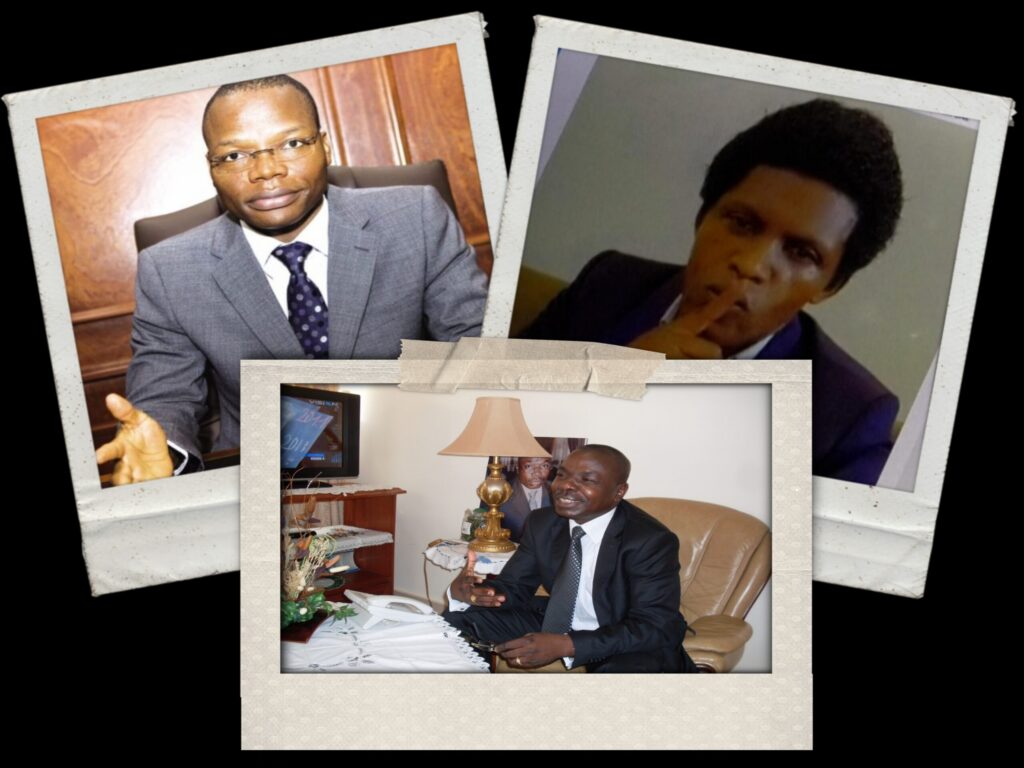
Did Modeste Mopa flee to the IMF to escape the truth?
An in-depth analysis of the latest developments in the Martinez Zogo trial and the controversial transfer of a key figure to the International Monetary Fund.
Cameroon’s political chessboard: when power speaks in whispers
In the aftermath of the Martinez Zogo trial, one name keeps resurfacing: Modeste Mopa. His sudden transfer to the International Monetary Fund (IMF) on January 27, 2023—just five days after Zogo’s body was discovered—has raised more questions than answers. Was this a routine administrative move, or a calculated maneuver to silence a key witness?
The phrase uttered by Lieutenant-Colonel Justin Danwé to Mopa—”We will resume psychological pressure on him”—wasn’t just a casual remark. It was a damning admission, a glimpse into the machinery of control that operates behind Cameroon’s political curtain. In a system where words are weapons and silence is compliance, every statement carries weight.
The anatomy of a political storm
To understand Mopa’s sudden departure, we must first dissect the tensions that preceded it. The conflict between the Ministry of Finance and the General Secretariat of the Presidency (SGPR), the battle over budgetary lines 94 and 65, and the weaponization of tax audits paint a picture of a state where institutions are pitted against each other. Journalists, once watchdogs of democracy, have become pawns in this high-stakes game.
Martinez Zogo’s death was not merely a tragedy—it was a message. The mutilated body found on January 22, 2023, was a stark reminder that in Cameroon, speaking truth to power comes at a cost. Zogo’s investigations into fictitious contracts and tax evasion implicated figures within the inner circle, including Mopa, who allegedly provided the documents Zogo used in his broadcasts.
The IMF transfer: coincidence or cover-up?
The timing of Mopa’s appointment to the IMF raises eyebrows. Standard recruitment procedures at the IMF involve rigorous vetting, yet no details have been disclosed about the selection process or the role he plays in the institution. Why was he chosen at this precise moment? Who advocated for his nomination, and what diplomatic levers were pulled to secure his position?
The lack of transparency is glaring. If Mopa was indeed involved in the events leading to Zogo’s death, his transfer to an international body like the IMF could be seen as an attempt to shield him from scrutiny. The IMF, bound by its own protocols, may now be unwittingly complicit in obstructing justice.
The digital footprint of power
Phone records, internet blackouts, and encrypted messages have emerged as critical pieces of this puzzle. The communications between key figures reveal a network of influence where loyalty is tested and betrayal is punished. The question lingers: who is watching whom, and for whose benefit?
Lieutenant-Colonel Danwé’s claim that he was monitoring the Ministry of Finance takes on a sinister tone when viewed through this lens. Was he acting on behalf of the state, or for a faction within it? The name Ferdinand Ngoh Ngoh, often whispered in political circles as a presidential hopeful, adds another layer of intrigue to this unfolding drama.
A philosophical inquiry into power and truth
This case transcends politics—it is a philosophical inquiry into the nature of power itself. In a system where truth is a liability and justice is negotiable, where does the line between policy and coercion blur? The Latin adage “Fiat justitia, ruat caelum”—”Let justice be done, though the heavens fall”—seems like a distant ideal in Cameroon’s current climate.
The death of Martinez Zogo was not just a crime; it was a statement. A statement that in Cameroon, fear remains the most effective language of control. The question now is whether his death will be in vain, or if it will force a reckoning with the shadows that govern this nation.
Final thoughts: the cost of silence
If Modeste Mopa was indeed exfiltrated to escape accountability, his transfer to the IMF does little to absolve Cameroon’s institutions of their complicity. The international community, too, must ask itself hard questions. When a state official accused in a criminal case is granted refuge in a global institution, what does that say about the integrity of that institution? And more importantly, what does it say about the state that allowed such a transfer to happen?
The dead do not rest easy. Their whispers haunt the corridors of power, demanding answers that may never come. Until then, Cameroon’s political theater remains a stage for shadows, where the truth is the first casualty.