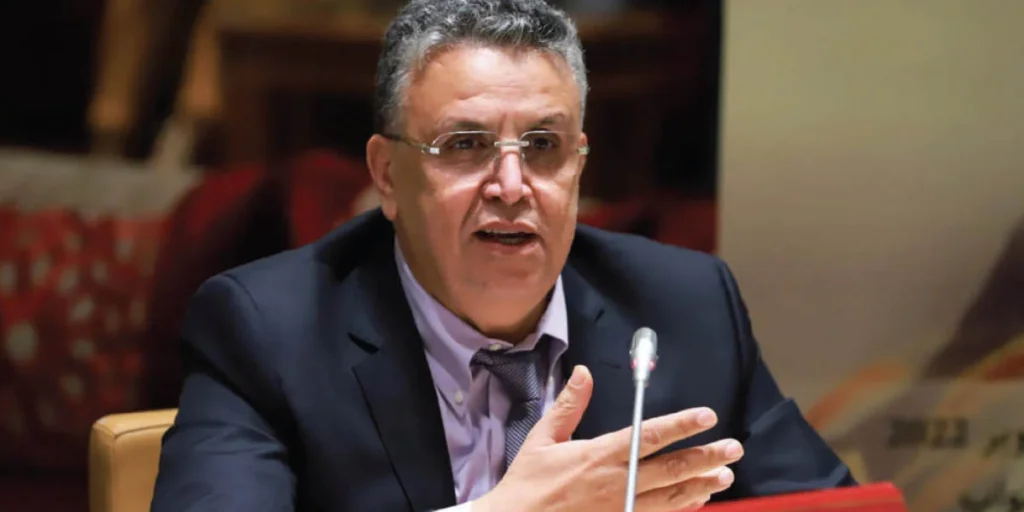
The Moroccan Minister of Justice, Abdellatif Ouahbi, has once again brought attention to the long-standing territorial dispute over Ceuta and Melilla, asserting that Morocco seeks formal negotiations with Spain regarding these cities, which Rabat considers integral parts of its national territory. Speaking in a recent interview, he emphasized that the issue remains an active topic in bilateral discussions, framed within a broader strategy of dialogue and patience.
In the same vein, Ouahbi addressed the recent surge in irregular migration toward Ceuta on July 30 and 31, urging Madrid to fulfill its obligations by ensuring the repatriation of unaccompanied Moroccan minors who crossed into Spanish territory. He also highlighted the inconsistency in Spain’s demands, noting that while requesting Morocco to curb irregular departures, it simultaneously allows those who reach its shores to access legal procedures.
The minister further underscored the need for both nations to align their legal frameworks and operational strategies to combat illegal migration, stressing that Morocco cannot shoulder the role of Europe’s sole enforcement authority.
In response, Spain’s Ministry of Foreign Affairs swiftly dismissed Morocco’s territorial claims, reaffirming that Ceuta and Melilla are «indisputably part of Spain’s internationally recognized sovereign territory.» The statement categorically ruled out any future discussions on the matter.
Madrid’s cautious stance vs. local outrage in Melilla
During a visit to Ceuta, Spanish Foreign Minister José Manuel Albares deliberately avoided addressing the sovereignty issue, focusing instead on the immediate migrant crisis. He acknowledged Morocco’s willingness to facilitate the return of unaccompanied minors involved in the recent mass crossings.
Meanwhile, Juan José Imbroda, President of Melilla and a prominent figure from the People’s Party (PP), took a more confrontational approach. In a public statement, he questioned the practical value of holding onto Ceuta and Melilla if Spain cannot manage its own challenges, particularly the exodus of its youth. Imbroda went further, framing the situation as an «international embarrassment» for Morocco and urging it to handle the crisis with greater responsibility.
The Moroccan Ministry of the Interior, in a separate statement, stressed the shared responsibility between both countries in managing irregular migration flows. It also raised concerns over online calls encouraging further crossings on August 15, warning that combating illegal migration and human trafficking cannot rest solely on one nation’s efforts.

More Stories
Burkina Faso’s shrinking public payroll: a household burden as schools reopen
Simporé’s televised admission: can Burkina Faso’s army still hold the line?
Gabon’s ghost worker purge: can 11 billion CFA francs in savings really reach the people?