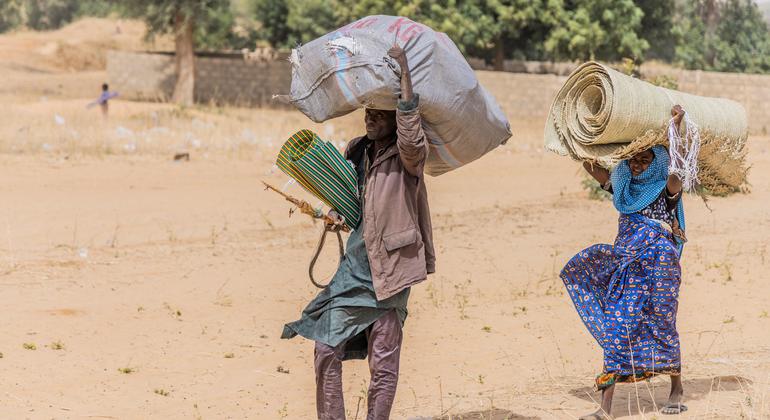
Nigeria’s deepening humanitarian crisis driven by widespread insecurity
The recent surge in kidnappings of schoolchildren, violent attacks on entire villages, and abductions of worshippers from churches and mosques has thrust Nigeria back into the global spotlight. This escalation of violence took on new geopolitical dimensions when the United States conducted Christmas Day airstrikes against jihadist positions in northern Nigeria, framed by Washington as a protective measure for Christian communities under threat.
Beyond religious targeting: a nation gripped by diverse security threats
While international attention has focused on attacks against Christian places of worship, the United Nations emphasizes that Nigeria’s security challenges extend far beyond religious divides. Mohamed Malik Fall, UN Coordinator of Humanitarian Affairs in Nigeria, states: « Security remains one of the country’s most pressing challenges. What’s particularly alarming is that this threat isn’t confined to a single region—it permeates nearly every part of the nation. »
A decades-long insurgency with devastating consequences
The crisis originated in Nigeria’s northeast, where Boko Haram’s armed uprising began in 2009. Two decades of conflict have left deep scars across the country. Fall highlights the staggering human cost: « Over two million people remain displaced—not temporarily, but as a permanent reality. An entire generation has grown up in displacement camps, knowing nothing else. »
The conflict has claimed more than 40,000 lives, destroyed thousands of schools and healthcare facilities, and rendered vast agricultural lands inaccessible. Fall underscores the broader impact: « Communities have been cut off from economic opportunities, stripped of their livelihoods, and robbed of their dignity. »
Rising banditry and local conflicts compound the crisis
The northeast insurgency has been compounded by spreading violence in other regions. In the northwest states of Zamfara, Katsina, and Sokoto, armed criminal gangs—dubbed « bandits » by authorities—engage in looting, kidnappings, and extortion. Fall reports: « Entire villages have been abandoned. We estimate nearly one million people have been displaced in the northwest alone. »
In central Nigeria, clashes between farmers and herders over land, intensified by population pressure and climate shocks, have triggered additional displacement waves. Further south, separatist movements and oil-related sabotage add to the instability. The result? With approximately 3.5 million internally displaced people, Nigeria accounts for nearly 10% of Africa’s total displaced population.
Humanitarian emergency: severe, underfunded, and worsening
Behind the security turmoil lies a massive humanitarian emergency. In the northeast alone, 7.2 million people require assistance, with nearly 6 million in severe or critical conditions, according to the UN. Food insecurity is a growing threat, with projections suggesting up to 36 million Nigerians could face food insecurity in the coming months. Among children under five, over 3.5 million risk acute malnutrition.
Fall warns of long-term consequences: « Malnutrition doesn’t just affect immediate health—it impairs cognitive development, disrupts education, and casts long shadows over future prospects. » The crisis is compounded by recurring climate disasters like droughts and floods, epidemics such as cholera and meningitis, and a fragile healthcare system.
Yet funding has plummeted. Fall recalls: « A few years ago, the humanitarian response plan exceeded $1 billion annually. In 2024, it dropped to $585 million. Last year, it fell to $262 million. This year, we may struggle to reach even $200 million. »
Nigeria’s economic paradox: a giant struggling to protect its people
Despite being one of Africa’s largest economies, Nigeria faces a paradox: a massive humanitarian crisis unfolding within its borders. Fall stresses: « Nigeria is not Sudan, Somalia, or South Sudan. It has resources. The primary responsibility for humanitarian response lies with the government. »
The UN is now urging a gradual transfer of leadership in aid delivery to federal and state authorities, while calling on international donors not to turn away. Fall concludes: « No community wants to live on aid indefinitely. People need opportunities—not handouts. Teaching them to fish sustains them far beyond emergency relief. »