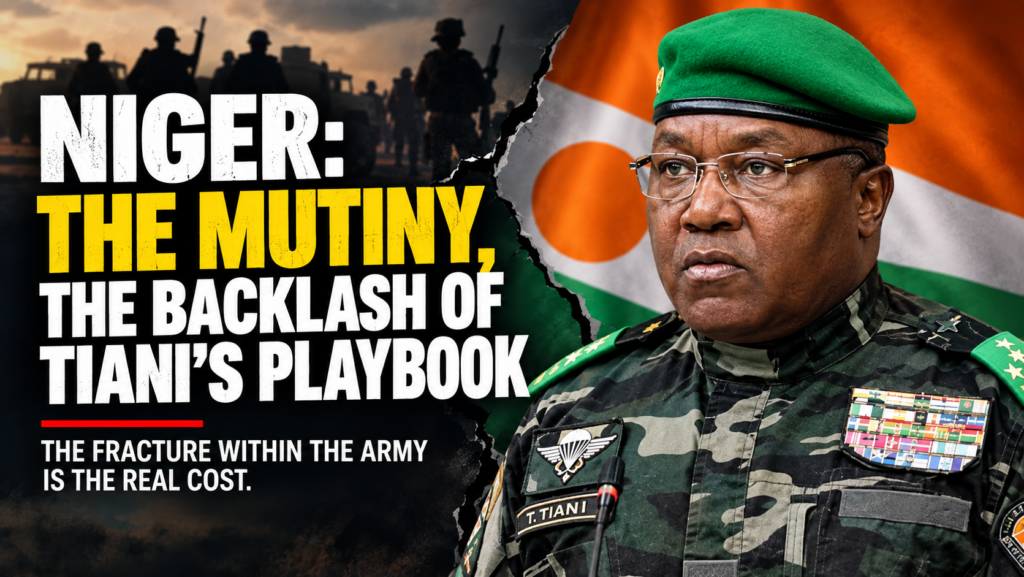
The events of August 28 and 29 in Niger were not an isolated disciplinary breach. They were the direct consequence of a gradual transformation of the army into a political tool, a process that began with General Tiani’s rise to power. Since then, promotions have favored loyalists, independent-minded officers have been sidelined, and a culture of personal loyalty has replaced merit and institutional neutrality. This has broken the internal balance that once held the armed forces together.
A divided army cannot defend the nation
When soldiers believe that career advancement depends more on proximity to power than on service records, a sense of injustice takes root. Frustrations grow, rivalries intensify, and trust between command levels erodes. The mutiny should therefore be seen as a symptom of deep-seated malaise, fed by years of tension and defiance within the military.
The stakes are high. An army that is divided and suspicious of its own leadership cannot operate with the same efficiency as one united behind a credible chain of command. In a country facing active armed groups on multiple fronts, every internal fracture weakens the defense of the territory.
Opaque handling fuels fear and distrust
The official silence about the fate of arrested soldiers is telling. No one knows who was detained, where they are held, or what charges they face. This uncertainty is a deliberate control tactic—it makes every soldier fear being next. But it also blocks any path to de-escalation. Rumors and suspicion fill the void, families wait in anguish, and the hierarchy loses more credibility.
By parading military equipment on television as “evidence” of a plot, the regime is not just communicating—it is constructing a narrative to justify arrests. But showing weapons does not answer the real questions: What were the mutineers’ demands? What individual responsibilities can be established? What procedures are being followed? And why did such a crisis erupt within the very forces meant to be the regime’s shield?
Prioritizing regime security over national security
This approach reveals a fundamental contradiction. The regime claims to strengthen the state and restore authority, yet it governs by distrust within the military itself. Real military discipline rests not only on obedience but also on trust in leadership, fairness of procedures, and a sense of shared purpose. Purges and sidelining of experienced officers carry an operational cost—each one is a loss of skill, experience, and cohesion that Niger cannot afford in its fight against insurgent groups.
While the regime’s rhetoric emphasizes sovereignty and territorial defense, much of its energy is spent monitoring and neutralizing dissent within the security apparatus. This priority on political security risks undermining national security itself.
An army that fears internal purges more than external threats will eventually lose its fighting spirit. Soldiers must focus on their primary mission: protecting civilians and defending the country. If their attention shifts to internal power struggles, the institution becomes less effective even as it is brought under tighter political control.
The deeper crisis of leadership
The mutiny of August 28–29 thus transcends the fate of the detained soldiers. It challenges Tiani’s whole conception of power, the army, and loyalty. No national army can be permanently turned into a tool for protecting a regime without generating internal tensions. By concentrating on hunting internal opponents rather than restoring genuine cohesion, Tiani risks weakening the very institution on which national security depends. Dividing the armed forces may offer short-term political advantages, but it is a strategic threat in the long run.
His fundamental political failure is conflating regime security with state security. In seeking to ensure his own survival, he undermines military cohesion, erodes trust, and leaves Niger more vulnerable to the dangers it faces. The current crisis, far from being an isolated event, is the outcome of governance based on suspicion, concentrated power, and the politicization of the security apparatus.