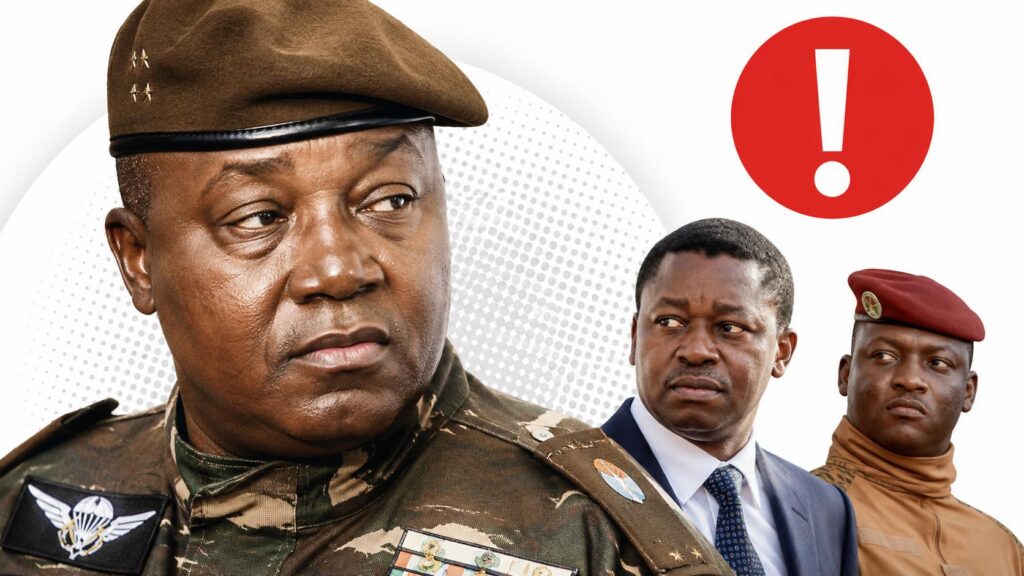
The turbulent landscape of West African politics has once again proven that those who play with fire often get burned. While international observers were dissecting the financial and logistical threads of a thwarted coup plot in Cotonou—where clear links to Niamey’s regime and its steadfast allies were exposed—the repercussions struck closer to home with brutal swiftness. In the early hours of August 28-29, the very foundations of General Abdourahamane Tiani’s authority in Niamey trembled under the relentless staccato of gunfire and artillery blasts. A bitter irony, yes, but one rooted in the unyielding logic of political consequence.
From architects of instability to victims of their own strategy
The Niamey-Lomé-Ouagadougou axis had become a well-oiled machine for exporting chaos. For months, the National Council for the Safeguarding of the Homeland (CNSP) in Niger had sought to shore up its shaky legitimacy by forging a high-stakes alliance with Burkina Faso’s Captain Ibrahim Traoré and Togo’s Faure Gnassingbé. Together, they pooled resources to bankroll destabilization efforts in neighboring Benin, viewing Cotonou as both a nuisance and an obstacle to their regional ambitions.
This fragile coalition, born out of mutual desperation, aimed to cripple neighboring democracies to justify its own military authoritarianism. Yet in its haste to undermine others, the Tiani regime overlooked a critical flaw in its strategy: financing disorder abroad while its own house stood on shaky ground.
Military juntas and the cracks in their foundations
The violent clashes near Niamey’s 101st Air Base and presidential palace lay bare a truth the Alliance of Sahel States can no longer obscure: rotten fruit falls from the tree. By seizing power through force in July 2023, General Tiani didn’t just overthrow an elected government—he rewrote the rules of political succession in Niger, reducing governance to the barrel of a gun.
As the junta funneled resources into regional destabilization plots alongside Ibrahim Traoré—with Faure Gnassingbé’s discreet backing—it neglected the escalating terrorism crisis and simmering discontent within its own ranks. The strategy backfired spectacularly:
- Resource drain: Funds and military assets meant to combat jihadist threats and unify the armed forces were diverted to clandestine operations aimed at toppling governments in neighboring capitals.
- Command fractures: The Nigerian military, increasingly factionalized and politicized, now operates more like a loose confederation of armed groups than a disciplined institution. When officers witness their leaders bankrolling coups abroad, the message is clear: power in Niamey is attainable for any bold armed faction.
- Erosion of trust: Three years into a transition with no clear electoral roadmap—and amid mounting security failures—the rank-and-file soldiers’ patience has worn thin, threatening to undermine the very command structures propping up the regime.
The inevitable reckoning
The Sahel’s political history is unforgiving to those who mistake strategy for recklessness. Stability cannot be built on the ruins of neighboring states. By co-financing chaos in Benin to distract from its own vulnerabilities, the Tiani regime only hastened its collapse from within.
The gunfire that echoed through Niamey on August 29 wasn’t an isolated incident—it was the sound of a system collapsing under its own weight. General Tiani is now confronting a harsh reality: the same weapons and financial networks used to destabilize others are the ones turning against him.
As the dust settles on Niger’s latest crisis, one question looms over the region: will Ibrahim Traoré and Faure Gnassingbé be next to face the consequences of their own meddling?