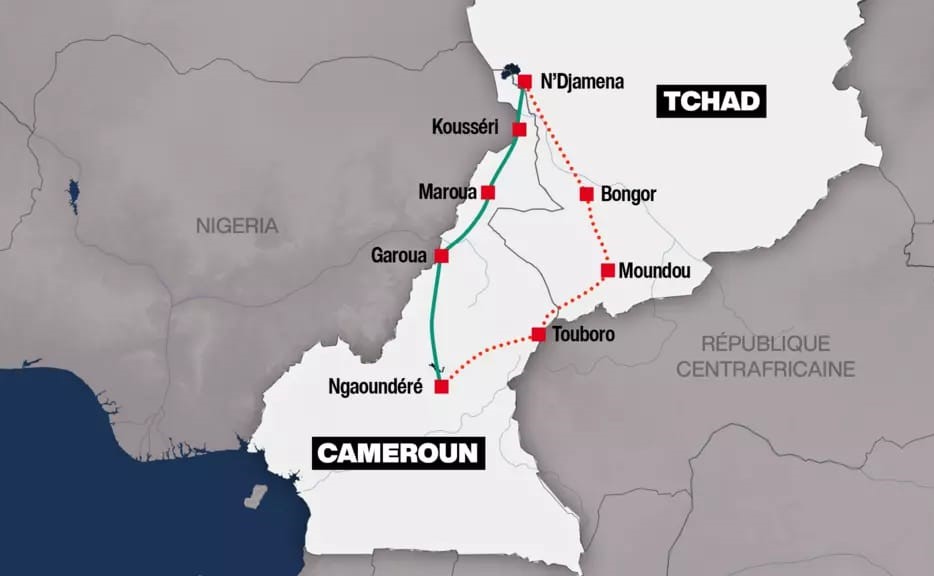
The ambitious railway project linking Cameroon and Chad has hit its first major hurdle, as N’Djamena formally rejected the route proposed by Yaoundé. This dispute highlights deeper tensions over how shared infrastructure projects should be designed and governed in Central Africa.
why the railway corridor matters for central africa
Envisioned as a game-changer for regional connectivity, the planned 900-kilometer railway would connect Cameroon‘s port cities of Douala and Kribi to Chad‘s capital, N’Djamena. The project aims to slash transport costs, boost trade flows, and reduce the landlocked country’s heavy reliance on Cameroonian logistics networks. Over 80% of Chad‘s external trade currently passes through the Douala-N’Djamena corridor, making this rail link a strategic priority for both nations.
The proposed route would run from Ngaoundéré through key northern cities like Garoua, Figuil, Maroua, and Kousséri before crossing into Chad. Cameroonian officials tout this as the most economically viable option, positioning the country as Central Africa’s maritime gateway to the Sahel. But the plan has triggered immediate pushback from N’Djamena, which argues that no final route has been mutually agreed upon.
economic and geopolitical implications of the dispute
The disagreement extends beyond technical details. Each country has distinct priorities:
- For Cameroon: The railway represents an opportunity to develop its northern regions, which lag in infrastructure, while strengthening its role as a regional logistics hub.
- For Chad: The current route is seen as favoring Cameroonian economic zones, with limited benefits for Chad’s agricultural and production areas. N’Djamena is pushing for a variant that better serves its own territory.
At stake are decades of economic opportunities, including:
- Lower logistics costs for agricultural exports like cotton and cereals
- Faster movement of hydrocarbons and construction materials
- New industrial and commercial hubs along the route
- Enhanced competitiveness for businesses in both countries
lessons in regional integration challenges
This stalemate underscores a persistent challenge in Central African infrastructure projects: the dominance of national interests over shared regional goals. The Economic Community of Central African States (ECCAS) has championed multimodal corridor development, yet many initiatives stall when individual countries prioritize domestic gains over collective benefits.
Successful transnational projects typically require:
- Joint governance mechanisms from the outset
- Equitable distribution of infrastructure benefits
- Concerted financing and technical standards
Without these safeguards, even high-potential projects risk becoming stalled or delivering uneven advantages. The Cameroon-Chad railway saga serves as a cautionary tale for future regional infrastructure endeavors in the subregion.
what happens next
The two governments have indicated they will resume bilateral consultations to find a mutually acceptable solution. The outcome will determine whether this project becomes a model of regional cooperation or another example of how competing national ambitions can undermine shared development goals.