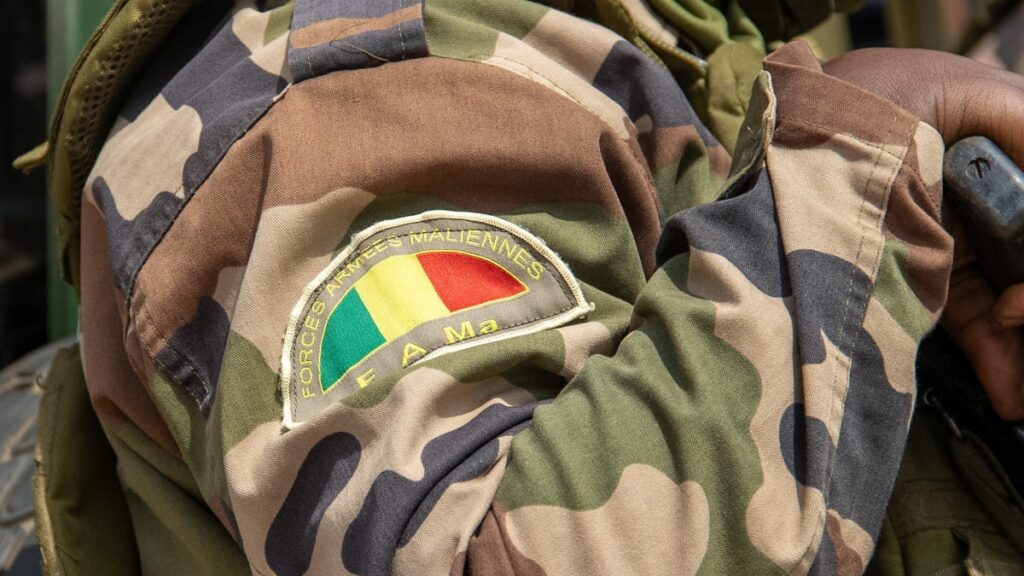
At least 31 civilians were killed and dozens of homes set ablaze in two separate villages in Mali’s central region during coordinated operations involving the national army and allied militias, according to local testimonies and field investigations.
On October 2, soldiers accompanied by Dozos—traditional hunters turned counterinsurgency fighters—stormed the village of Kamona, executing at least 21 men and torching over 10 homes. Witnesses reported that troops, dressed in camouflage and riding in seven pickup trucks and three armored vehicles, along with Dozo fighters on motorcycles, systematically hunted down male residents. Many villagers had already fled after receiving warnings from Islamist insurgents active in the area.
« Those who couldn’t escape were rounded up and shot on the spot, » recounted a survivor who watched from hiding. The attackers spared no age group, targeting men between 20 and 65 years old. Among the victims, 17 bodies were later found beneath a large tree, while four more were discovered north of the village. Survivors described the scene as horrific: « The bodies were riddled with bullets, » one witness said. « One man’s head had been completely crushed. »
Residents provided a list of 21 names of the dead, though locals believe the actual toll may be higher. « We heard at least 15 other men were killed in the bush that day, » said a villager. « But we didn’t dare go look—we were too afraid the army would return. »
Thirteen days later, on October 13, a similar operation unfolded in Balle, a village 55 kilometers from Kamona. Soldiers in five pickup trucks and Dozo fighters on at least 30 motorcycles descended on the settlement, prompting a chaotic exodus. « I didn’t run at first, but when I saw soldiers going door-to-door and beating men, I fled, » said a 24-year-old resident. From his hiding place, he heard gunfire ring out across the village.
By the time the attackers withdrew around 4 p.m., 10 civilians lay dead—nine men and one 55-year-old woman. The assailants also looted over 100 cattle. A 33-year-old herder recounted the grim discovery: « The bodies were lined up in the middle of the village, riddled with bullets. Some had broken limbs. » The woman’s daughter, aged 21, described her mother’s final moments: « She confronted the soldiers, shouting at them for their brutality. They dragged her to where the men were being held and executed her. »
Local leaders revealed that Balle has been under the control of the Group for the Support of Islam and Muslims (JNIM) for years. « We pay zakat to them every year, » said one elder. « If there’s a dispute, the jihadists settle it. There are no soldiers, gendarmes, or police here. The army doesn’t distinguish between us and them. »
Military officials claimed the October 13 operation was a « successful offensive reconnaissance » that « neutralized about twenty terrorists » and seized military equipment. However, witnesses and residents strongly dispute this narrative, insisting no armed confrontation took place.
This wave of violence follows a surge in Islamist attacks in the Ségou region, including a brazen assault on a sugar factory in Siribala on August 8. The escalating conflict has forced over 400,000 Malians from their homes since 2012, with civilians bearing the brunt of the brutality from both state forces and insurgent groups.
International humanitarian law prohibits deliberate attacks on civilians, extrajudicial killings, and the use of excessive force. Yet, Mali’s military junta has faced repeated allegations of grave abuses in its counterterrorism campaigns. Despite withdrawing from the International Criminal Court (ICC) in September, Mali remains bound by the Rome Statute until September 2026, with the Court investigating alleged war crimes dating back to 2012.
The African Union’s Peace and Security Council has been notably silent in the face of the deteriorating crisis, issuing only routine statements of concern. Human rights advocates urge the council to prioritize Mali, demanding urgent diplomatic action and coordinated regional efforts to hold all perpetrators accountable.
« The Council must move beyond statements and take concrete steps to address the atrocities unfolding in Mali, » said a senior researcher monitoring the conflict. « Without accountability, the cycle of violence will only deepen. »