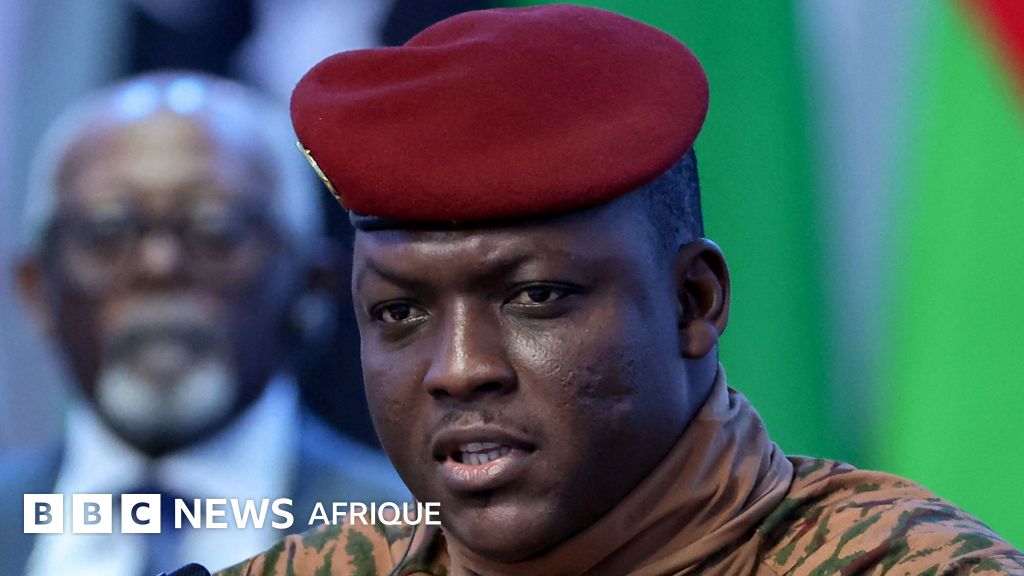
Burkina Faso’s military leader declares democracy incompatible with national progress
Captain Ibrahim Traoré, Burkina Faso’s military leader, has declared that the nation must “forget democracy” in a televised address, asserting that the system is fundamentally unsuited for the country’s development. His remarks, made during a state television interview, mark a stark departure from previous commitments to restore civilian rule by July 2024.
Traoré, who seized power in a 2022 coup, argued that democracy has brought instability across the continent, citing the Libyan example as evidence of its failures. “Democracy is not for us,” he stated emphatically, adding that Burkina Faso would forge its own path without Western influence or imitation of foreign systems.
Vision for a new Burkina Faso
The 38-year-old leader outlined a governance model centered on revolutionary patriotism, economic self-reliance, and military sovereignty. He criticized traditional politicians as corrupt and divisive, claiming they embody “all vices” including deceit and empty rhetoric.
Traoré condemned the dissolution of political parties in January, describing them as destabilizing forces incompatible with his revolutionary project. Instead, he emphasized the role of traditional leaders and grassroots structures in building a new national framework.
Addressing economic priorities, he stressed the need for long working hours and collective effort, rejecting the standard eight-hour workday as insufficient for a nation facing severe development challenges.
Human rights concerns amid revolutionary rhetoric
Since assuming leadership, Traoré has faced criticism for suppressing dissent, targeting opposition figures, independent media, and civil society organizations. Reports indicate that critics have been sent to frontline positions in the ongoing fight against Islamist militants, raising questions about the regime’s commitment to human rights.
A recent Human Rights Watch report documented over 1,800 civilian deaths in Burkina Faso since Traoré’s 2023 takeover, attributing two-thirds of these casualties to state security forces and allied militias. The violence persists despite Burkina Faso’s pivot from Western partnerships to military cooperation with Russia.
Traoré’s anti-Western rhetoric has resonated across West Africa, where military juntas in Mali and Niger have adopted similar stances. However, the shift in alliances has not translated into improved security, with Islamist insurgencies continuing unabated in all three nations.
Controversial comparisons and regional implications
During the interview, Traoré invoked the Libyan example to justify his rejection of democracy, highlighting how Western interventions in Libya led to prolonged instability after the fall of Muammar Gaddafi’s regime. “Wherever Western powers impose democracy, bloodshed follows,” he asserted, framing Burkina Faso’s turn away from democratic norms as a protective measure against foreign domination.
His comments come amid growing skepticism about military-led transitions in the Sahel region. While elections continue in most African countries, recent polls in Gabon and Guinea—won by military leaders—have been widely criticized as neither free nor fair.
Traoré’s vision for Burkina Faso remains undefined beyond its rejection of existing systems, with his government focusing on anti-imperialist rhetoric and military consolidation. The international community continues to monitor the situation as the nation grapples with existential security threats and governance crises.