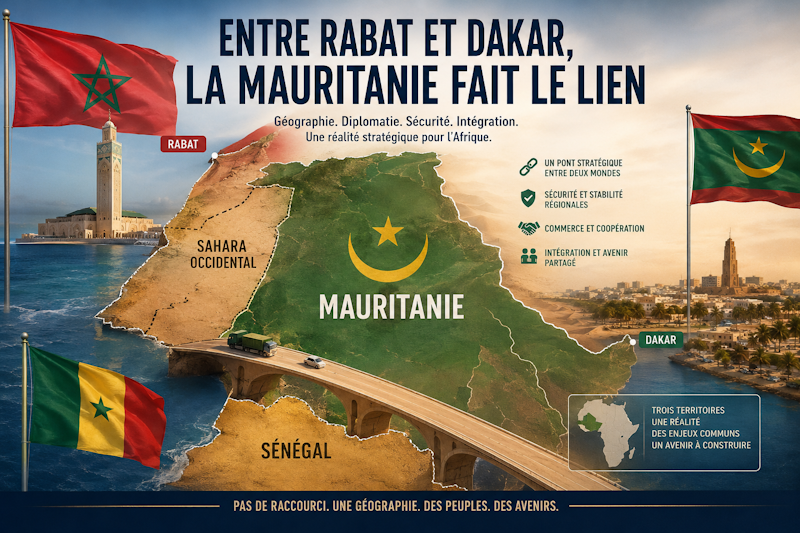

The Sahara stretches between Morocco and Senegal, but it’s the vast expanse of Mauritania that truly shapes the geopolitical landscape of the region, as noted by journalist Ahmed Ould Bettar.
When examining relations between Rabat and Dakar, one must first acknowledge a fundamental geographical truth: there are no shortcuts. The Western Sahara lies between them—but so does Mauritania.
This may seem obvious, yet the oversight persists, especially when influential voices overlook the critical role of Nouakchott in African geopolitics. Neglecting Mauritania in this context is like removing a cornerstone from the arch connecting North Africa and West Africa.
Mauritania is far more than a stretch of desert or a mere transit zone. It is a sovereign nation, a key diplomatic player, and a vital bridge between two distinct regions. Beyond its borders, it plays a pivotal role in regional security, trade flows, and economic integration—functions that no analysis of Maghreb-West Africa relations can afford to ignore.
The geography of this space is not just a matter of cartography; it reflects tangible realities and demands respect. Borders matter, as do the states they define. Dismissing them—even unintentionally—leads to a dangerously oversimplified view of a complex geopolitical puzzle.
From the disputed territories of Western Sahara to the shores of the Atlantic, thousands of kilometers separate Morocco and Senegal. In between lie the people, histories, and strategic interests of Mauritania—a nation whose central position in this regional dynamic is impossible to overlook.
In geopolitics, as in diplomacy, shortcuts rarely lead to sound conclusions. Precision, context, and respect for regional complexities are essential.
Ahmed Ould Bettar
More Stories
In Niger, a transition that speaks of security from Niamey while the villages await the state
Niger: the disappearance of Moussa Kaka and the silence around Tiani
Niger : ce que les remaniements militaires disent des tensions au sommet du pouvoir