Moroccan authorities had forewarned Spanish counterparts about the potential migration crisis triggered by a recent Spanish court decision, a senior Moroccan official stated, firmly dismissing any lapse in the country’s security protocols.
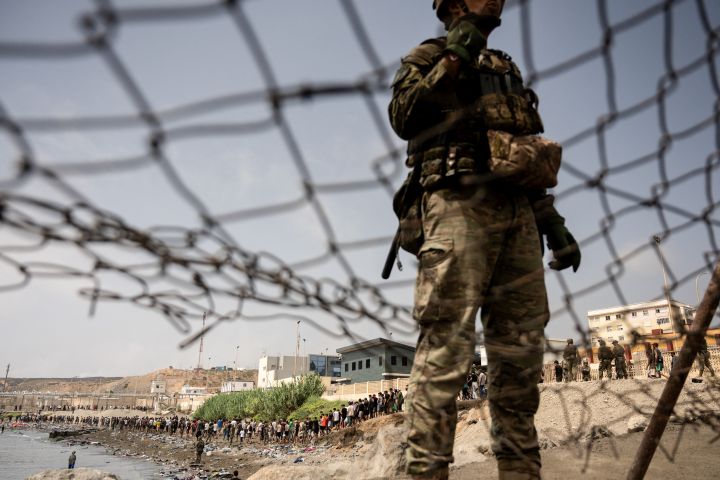
In the past few days, nearly 60,000 individuals, predominantly Moroccan nationals, crossed or attempted to cross into the Spanish enclave of Ceuta on foot or by swimming from the nearby town of Fnideq. This unprecedented influx overwhelmed Ceuta’s infrastructure before prompting thousands of returns to Morocco.
The high-ranking official, speaking off the record, revealed that Moroccan authorities had alerted Madrid about the risks posed by a Spanish Supreme Court ruling stating that immediate deportation would not apply to migrants arriving by sea. «We explained that this ruling would create a problem. And it did,» the official remarked.
Spanish Prime Minister Pedro Sánchez attributed the ongoing crisis in Ceuta to rumors spread by «human trafficking mafias,» alleging a deliberate misinterpretation of the court’s decision.
According to the Moroccan official, diplomatic exchanges with Spain began around July 22-23, when smuggling networks started circulating information about the ruling. He emphasized that Morocco’s security measures had functioned as intended, with no operational failures.
«It’s simplistic to suggest Morocco should have stopped them by force alone. That ignores the scale of this phenomenon,» he argued, noting that law enforcement could not feasibly confront such a large crowd. He also stressed that migration management «is not Morocco’s responsibility alone,» highlighting an annual cost of approximately €500 million for the kingdom.
Despite the tensions, the official confirmed that Rabat and Madrid had maintained «reliable partnership» and «flawless coordination» on migration-related matters. «Now, it’s Spain’s turn to address the challenges posed by this ruling,» he concluded.
Migrants return to Morocco after crossing into Ceuta, a Spanish enclave in North Africa, on July 31, 2026. ©Jorge Guerrero / AFP




More Stories
Senegal’s palm oil gambit: can 60,000 hectares and Indonesian expertise finally end import reliance?
Can Burkina Faso’s military buildup succeed while its people keep fleeing?
Senegal’s 2026 revised finance bill: will the three-day delay derail the budget timetable?