
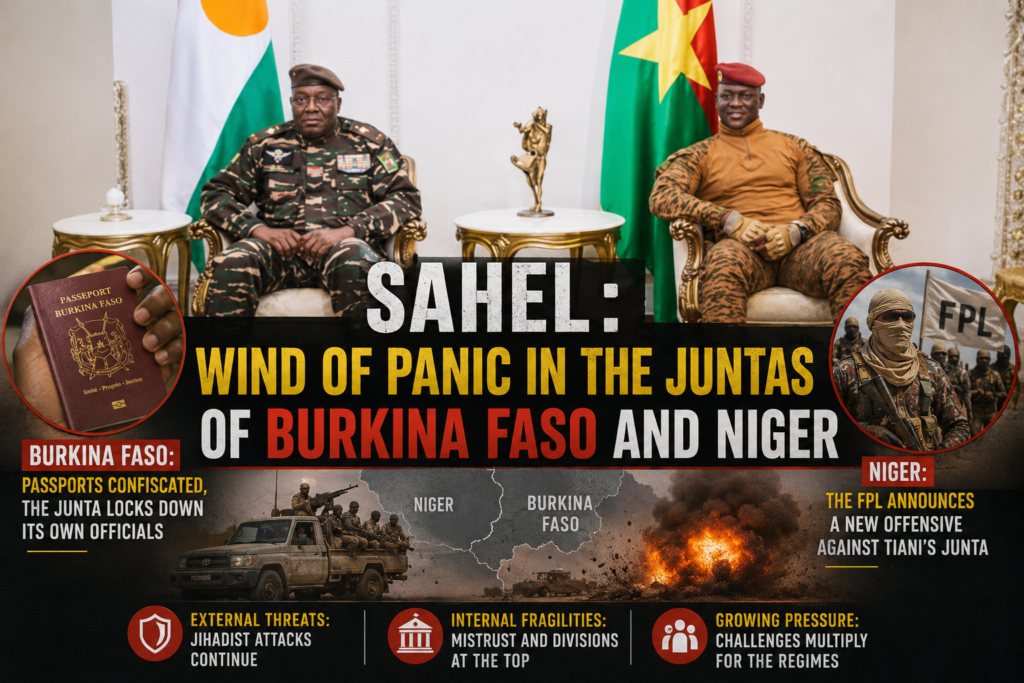
The geopolitical and security landscape across the Sahel-Saharan strip is experiencing heightened volatility. Military administrations within the Alliance des États du Sahel (AES), notably in Burkina Faso and Niger, appear to be under increasing duress. This pressure stems from two distinct yet interconnected developments: the Burkinabè authorities are tightening their grip on their own senior officials, while a resurgent Nigerien opposition movement has vowed a new offensive against Niamey. Collectively, these occurrences underscore a fundamental truth: military governments are compelled to contend with both external menaces and inherent internal vulnerabilities.
Burkina Faso: consolidating state control
In Ouagadougou, an atmosphere of pervasive distrust prevails. The military government has reportedly implemented a drastic measure: the seizure of passports belonging to cabinet members.
This unprecedented restriction extends beyond just ministerial positions, encompassing numerous high-ranking military officers. Such an expansion signals that oversight is now being rigorously applied even within the uppermost echelons of power.
By precluding certain officials from departing the national territory at will, the regime ostensibly aims to mitigate any potential for abrupt exits, the leakage of sensitive intelligence, or unauthorized engagements with foreign entities. In any political climate, such a stringent measure is rarely insignificant; it typically signifies an imperative to assert heightened control over the governing elite, particularly when mutual confidence wanes.
This directive emerges as Burkina Faso grapples with unremitting insecurity across extensive portions of its landmass. Despite intensified military operations and the substantial deployment of Volontaires pour la Défense de la Patrie (VDP), jihadist assaults continue to afflict both security forces and civilian populations. This perpetual security strain exacerbates internal tensions at the apex of the state, reinforcing the authorities’ resolve to secure all decision-making centers.
For numerous analysts, these imposed restrictions also underscore the inherent challenge for military administrations in fostering enduring cohesion within their own frameworks. The more authority becomes centralized in the hands of a select few, the more the apprehension of internal schisms, rivalries, or defections transforms into a critical strategic concern.
Niger: FPL announces new offensive against Tiani’s junta
In Niger, dissent is escalating into an overtly military confrontation.
Barely a month following his release on June 22, 2026, Mohamed Salah, Secretary-General of the Front Patriotique pour la Libération (FPL), has re-emerged, delivering a notably aggressive statement.
The rebel leader’s freedom was secured through a highly sensitive hostage exchange orchestrated by Marshal Khalifa Haftar’s forces in Libya. In return, Nigerien authorities released Barkadine Mahamat Rifi, a commander of the Libyan « Ahrar Fazzan » katiba, who had been sought by Haftar’s forces.
Empowered by his newfound liberty, Mohamed Salah now asserts that he is orchestrating a « great operation » with the explicit aim of toppling the junta led by General Abdourahamane Tiani.
Since the coup d’état that deposed President Mohamed Bazoum, the FPL has positioned itself as a resistance movement dedicated to restoring constitutional governance. The organization persistently calls for the release of Mohamed Bazoum, whom it recognizes as the sole legitimate President of Niger, duly elected by universal suffrage.
The FPL’s pronouncements signify a critical shift in the Nigerien crisis. While the authorities primarily focus their resources on combating jihadist factions, they must now also contend with the imminent prospect of an armed opposition openly advocating for regime change. This proliferation of flashpoints threatens to further strain and fragment the nation’s security capabilities.
Military regimes face multifaceted challenges
These recent occurrences reveal that the hurdles confronting the military administrations in Burkina Faso and Niger now extend far beyond merely counter-terrorism efforts.
In Burkina Faso, the authorities appear deeply concerned with the internal stability of their state apparatus, leading to the imposition of unparalleled restrictions on their political and military leadership. Conversely, in Niger, the primary threat emanates from an organized opposition that has unequivocally declared its intent to overthrow the ruling junta.
This confluence of internal pressures, pervasive security challenges, and both political and armed opposition movements starkly highlights the inherent fragility of governance structures established through coups d’état. Despite articulating a narrative focused on restoring sovereignty and security, both regimes continue to grapple with formidable obstacles that call into question their long-term capacity to stabilize their respective nations.
As these tensions continue to mount, the overall situation in the Sahel region grows increasingly intricate. Military authorities are now tasked with simultaneously managing armed group attacks, political critiques, economic hardships, public expectations, and the potential for dissent within their own power structures. This convergence of crises could significantly undermine regional stability in the foreseeable future.
More Stories
Niger-ECOWAS: navigating the diplomatic thaw after the coup
Nigeria backs polisario front in western Sahara dispute
Cameroon’s economic prospects face headwinds as Hilli Episeyo departs