Coordinated assaults in Mopti underscore Mali’s escalating security collapse
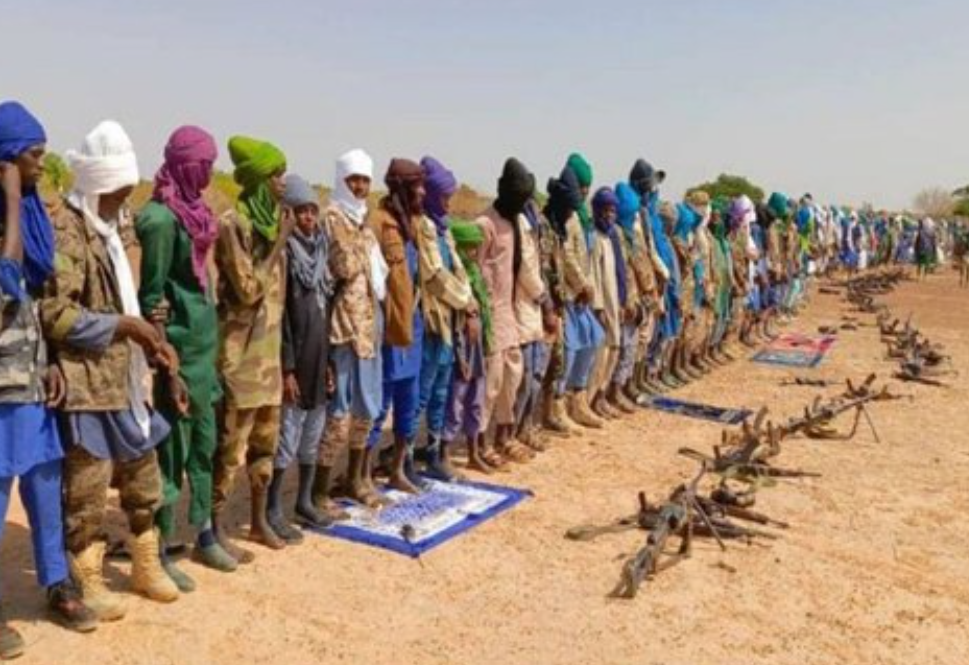
On Sunday, July 19, the volatile region of Mopti became the latest flashpoint in a relentless wave of violence gripping central Mali. The Group for the Support of Islam and Muslims (JNIM), an Al-Qaïda affiliate, claimed responsibility for four synchronized attacks targeting Malian armed forces, their Russian allies in Africa Corps, and local militia groups. This bold display of operational capacity underscores the group’s unchecked freedom of movement across the Sahel.
Five years after Colonel Assimi Goïta’s seizure of power, the junta’s vows to restore territorial sovereignty ring hollow against a backdrop of soaring violence, failed military partnerships, and the erosion of state control. The July 19 offensive is a stark reminder that despite heavy investment in security, Mali remains trapped in a spiral of insecurity and humanitarian despair.
A pattern of coordinated violence in Mopti
The attacks unfolded in two distinct locations, revealing both tactical precision and indiscriminate brutality. In the Douentza district, the JNIM deployed three improvised explosive devices (IEDs) targeting a military convoy, a truck carrying logistics, and a motorcycle detachment of soldiers. These strikes were deliberately aimed at both Malian troops and Russian mercenaries from Africa Corps—formerly Wagner Group—highlighting the group’s intent to cripple joint operations. Further west, near Kansila, the insurgents launched a direct assault on a traditional Dozo hunter militia, a local defense force often aligned with government efforts. According to the group’s claim, three Dozo fighters were killed in the ambush.
Goïta’s regime: statistics that tell a grim story
When Goïta assumed leadership in 2019, his junta pledged to reclaim all national territory and restore peace where international partners—particularly the former Barkhane mission—had allegedly fallen short. Yet independent conflict data reveals a stark reversal. Research from conflict monitoring organizations shows a dramatic surge in fatalities, with deaths from political violence and terrorist attacks doubling or even tripling in several provinces compared to pre-coup levels. The conflict landscape has also grown more complex, with the rise of Africa Corps and targeted violence against certain communities fueling interethnic tensions and accelerating recruitment into jihadist ranks. Perhaps most alarming is the normalization of ambushes and IED strikes, which now occur daily, paralyzing key transport routes and strangling local economies.
State collapse and an invisible humanitarian disaster
While Bamako celebrates symbolic military gains—such as the retaking of Kidal in late 2023—the reality on the ground is one of shrinking government influence. Large swaths of the country, particularly in the center and north, have slipped into lawlessness, where public services are absent and civilian life is governed by fear.
According to United Nations agencies, over 400,000 people have been internally displaced across Mali. Families flee not only the direct brutality of armed groups but also the collateral damage wrought by military operations. The blockade of entire towns by jihadist factions—including the JNIM and the Islamic State in the Greater Sahara (ISGS)—has plunged regions into acute food insecurity. Without secure roads, humanitarian aid cannot reach those in need, turning a security crisis into a silent humanitarian catastrophe.
Africa Corps: a Russian partnership that delivers little
Seeking to replace the departing French forces and the UN mission MINUSMA, the Malian junta turned to Moscow. First under the Wagner Group banner, and later through Africa Corps—a unit directly tied to the Russian Ministry of Defense—hundreds of Russian paramilitaries were deployed. Yet this partnership has yielded minimal military gains and raised serious ethical concerns. Human rights monitors have documented repeated allegations of civilian abuses by Russian forces, including during the notorious Moura massacre. Such actions have only driven local populations toward insurgent groups, who present themselves as protectors. Militarily, Africa Corps has struggled to contain the threat, suffering consistent losses and lacking the manpower to conduct effective counterinsurgency across Mali’s vast terrain.
Air power: a flawed pillar of Bamako’s strategy
Facing chronic shortages of ground forces, the Goïta regime has heavily invested in aerial capabilities, purchasing attack helicopters and drones from Russia and Turkey, including Bayraktar TB2 models. While these assets initially enabled large-scale strikes, they now face critical limitations. Maintenance has become a major hurdle: several aircraft, including Albatros L-39 jets and Mi-24 helicopters, have been lost to mechanical failures or brought down by rebel fire. The logistical challenges of sourcing spare parts from Russia have slowed repairs to a crawl. Meanwhile, insurgents have adapted. Groups like the JNIM now operate in smaller, dispersed units, blending into civilian areas or exploiting dense vegetation to evade detection. As a result, airstrikes have become less effective and increasingly prone to civilian casualties.
Military-first approach reaches a dead end
The coordinated assaults on July 19 are not isolated incidents but symptoms of a systemic failure. Bamako’s reliance on a military-only strategy has reached an impasse. By severing dialogue channels, alienating regional and international partners, and tying the nation’s fate to Russian mercenaries more focused on resource extraction than stabilization, the junta has isolated itself. Without a comprehensive political solution—one that restores governance, re-establishes public services, and prioritizes civilian protection—Mali risks further territorial fragmentation. The jihadist threat, far from receding, continues to expand across the Sahel, fueled by unaddressed grievances and unchecked violence.